Preventive Maintenance Checklist: How to Build a PM Program That Actually Gets Done
Executive Summary
A preventive maintenance checklist is one of the most effective tools for reducing equipment failures, improving reliability, and controlling maintenance costs. However, many organizations discover that creating checklists is easy, while consistently completing preventive maintenance is much harder.
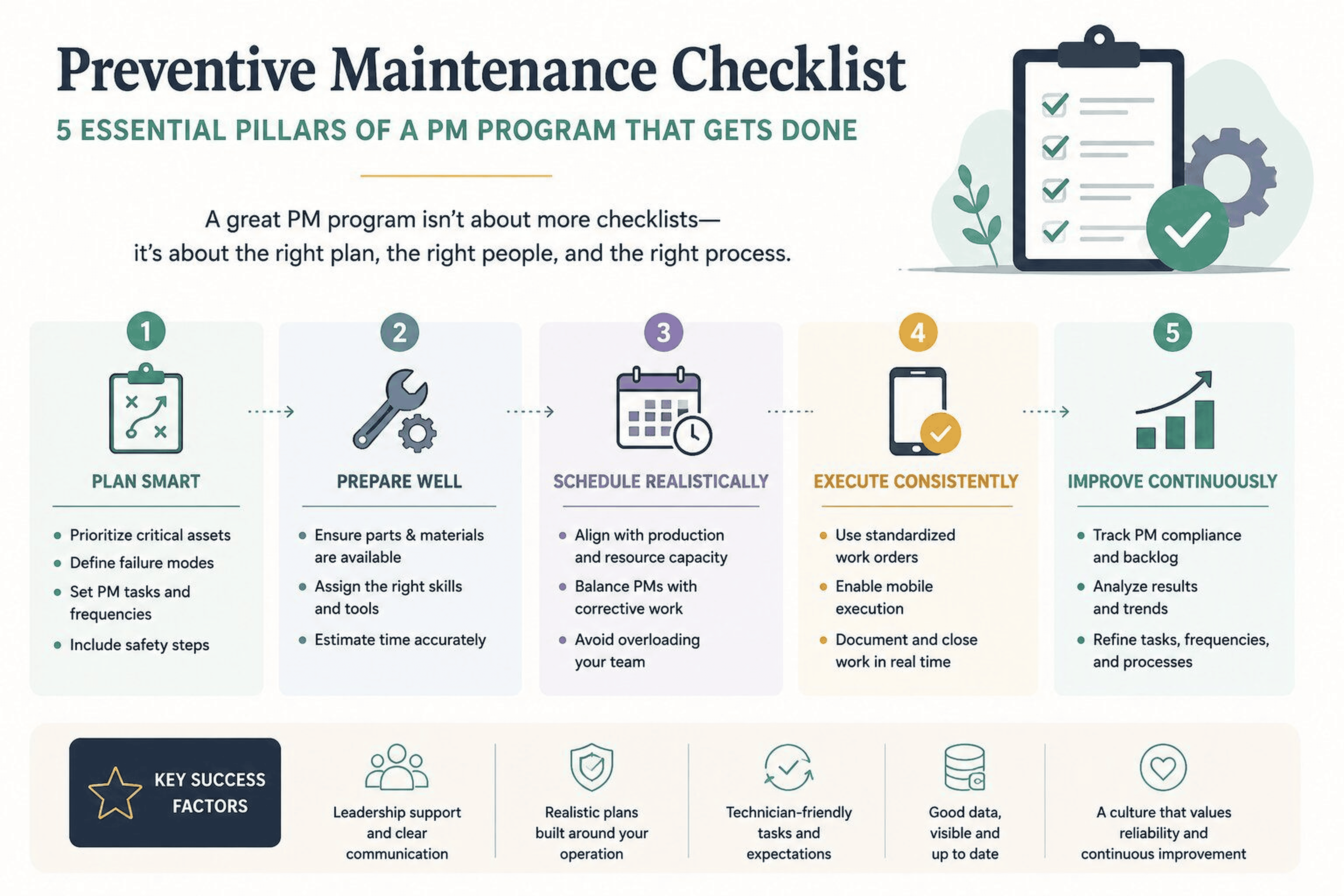
In many facilities, labor shortages, production demands, poor scheduling, missing parts, and unclear work instructions prevent PM programs from delivering their intended value. As a result, this guide provides a practical framework for building a preventive maintenance program that technicians can actually execute. It also covers asset prioritization, PM design, scheduling, work order management, inventory readiness, mobile execution, compliance tracking, and continuous improvement.
What Is a Preventive Maintenance Checklist?
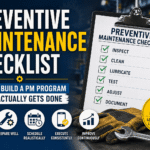
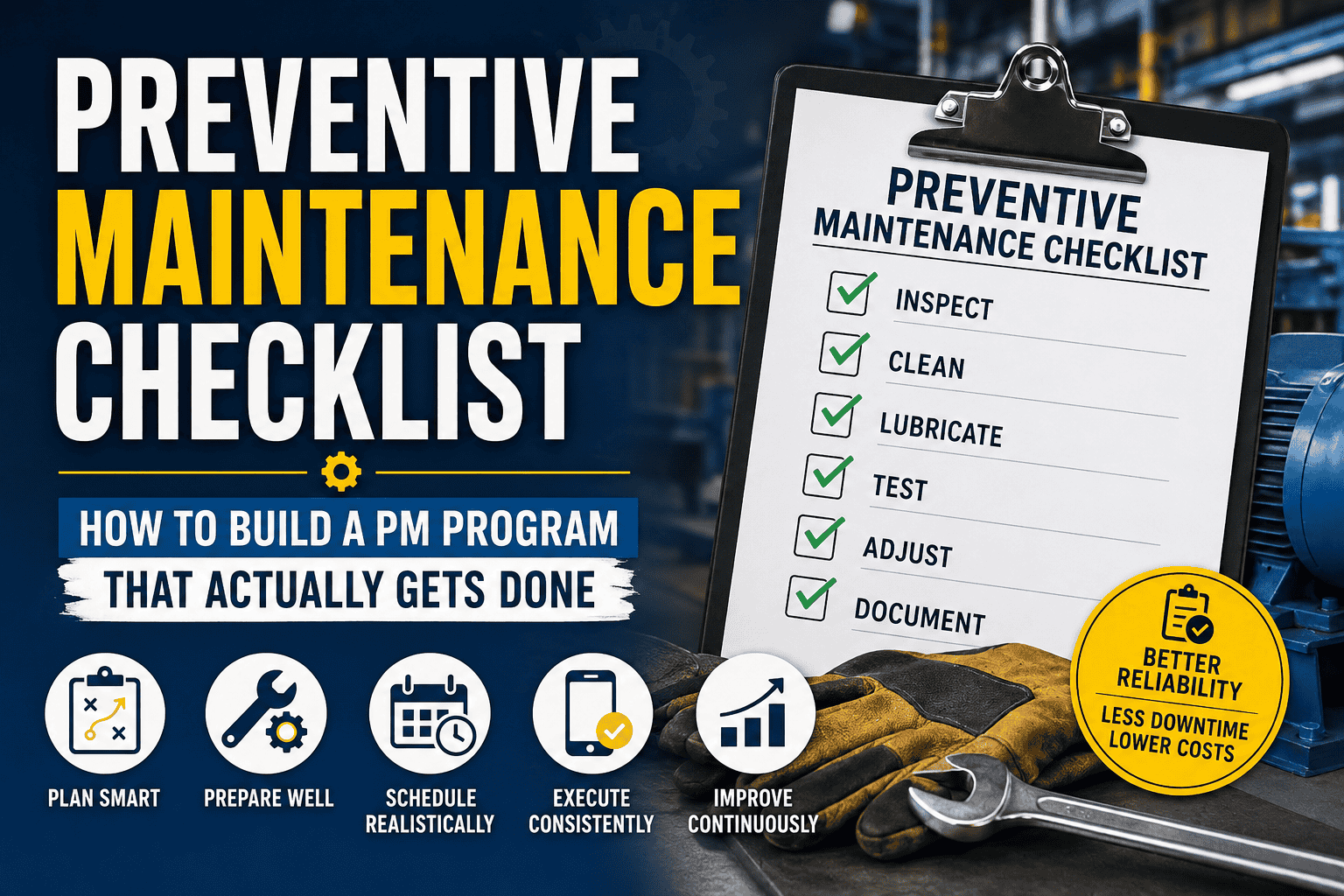
This checklist is a standardized set of inspections, measurements, cleaning tasks, lubrication activities, adjustments, tests, and documentation requirements used to maintain equipment before failures occur. In practice, it helps ensure maintenance work is performed consistently regardless of technician, shift, or location.
A strong PM checklist typically includes asset information, safety requirements, task instructions, measurements, required tools and parts, completion criteria, and follow-up actions. Instead of acting as a simple reminder, it becomes a repeatable maintenance process that supports reliability and accountability.
Why Preventive Maintenance Programs Fail
Unfortunately, many preventive maintenance programs fail not because the organization lacks commitment, but because the program was designed around documentation instead of execution. Teams often inherit manufacturer recommendations without considering labor availability, asset criticality, production schedules, or actual failure history.
Common causes of PM failure include vague instructions, unrealistic frequencies, excessive low-value inspections, missing parts, poor work order management, lack of technician involvement, and limited reporting visibility. Therefore, successful programs address these issues before work reaches the technician.
Preventive Maintenance Quick Assessment
Before making changes, use the questions below to evaluate whether your current PM program is built for execution. If several answers are no, there are clear opportunities to strengthen the program.
- Do you know which assets are most critical?
- Are PM tasks written clearly enough for any technician to perform?
- Is PM compliance consistently above target?
- Are parts available before PM work is scheduled?
- Can managers easily identify overdue PMs?
- Do failed inspections automatically create corrective work?
- Is PM performance reviewed regularly?
Preventive Maintenance Frequency Decision Matrix
Preventive maintenance frequency should reflect asset criticality, failure history, operating conditions, and compliance requirements. However, frequencies should also be realistic enough for the maintenance team to complete consistently.
| Asset Condition | Recommended PM Strategy | Example |
|---|---|---|
| High criticality, frequent failures | Monthly or condition-based | Production conveyor |
| High criticality, low failures | Quarterly | Emergency generator |
| Medium criticality | Quarterly or semiannual | HVAC unit |
| Low criticality | Annual inspection | Exhaust fan |
| Regulated asset | Compliance-driven | Fire suppression system |
How to Build a Preventive Maintenance Checklist
Step 1: Prioritize Critical Assets
Begin with assets that create the greatest safety, operational, compliance, environmental, or financial risk when they fail. Because resources are limited, criticality analysis helps maintenance teams focus effort where it produces the greatest return.
Step 2: Define Failure Modes
Every PM should target a known failure mode. To make each task useful, determine how the asset fails, what symptoms appear first, and what maintenance activity can prevent or detect the problem.
Step 3: Create Technician-Ready Instructions
Replace vague directions such as “inspect equipment” with measurable tasks. Define what to inspect, acceptable ranges, what to record, and when to escalate. As a result, technicians can complete the work consistently across shifts and locations.
Step 4: Establish Realistic Frequencies
Use manufacturer recommendations as a starting point, then adjust using operating conditions, asset history, technician experience, and reliability data. However, avoid frequencies that overwhelm the team without improving reliability.
Step 5: Build Safety into Every Checklist
Include lockout/tagout requirements, PPE, permits, access restrictions, startup procedures, and special hazards. Before the technician begins the task, safety instructions should be clear and easy to follow.
Step 6: Ensure Parts and Tool Readiness
Attach required parts, lubricants, meters, test equipment, and specialty tools to each PM. Since missing materials are a common cause of delayed work, inventory readiness should be built into PM planning.
Step 7: Execute Through Work Orders
Calendar reminders alone are not enough. Instead, work orders provide ownership, documentation, labor tracking, asset history, and accountability.
Step 8: Support Mobile Execution
Technicians should be able to access instructions, record readings, attach photos, and complete documentation directly at the asset. In addition, mobile execution helps reduce paperwork delays and improves reporting accuracy.
Step 9: Define Escalation Rules
Specify what happens when inspections fail. For better follow-through, identify when corrective work orders should be generated and how priorities should be assigned.
Step 10: Measure Performance
Track PM compliance, backlog, planned maintenance percentage, downtime trends, and corrective work generated from PM inspections. These maintenance KPIs help leaders understand whether the PM program is working.
Step 11: Continuously Improve
Review findings, failure trends, technician feedback, and asset performance regularly. Over time, preventive maintenance should evolve as conditions change.
Preventive Maintenance vs Predictive Maintenance
Scheduled maintenance follows defined intervals, while predictive maintenance relies on asset condition and monitoring data. In most cases, organizations benefit from using both approaches together.
For example, scheduled PM provides structure and consistency, while predictive maintenance helps teams focus attention on high-risk assets where failures would have significant consequences. Therefore, teams should use both strategies where they make sense operationally and financially.
When Preventive Maintenance Becomes Over-Maintenance
One overlooked maintenance challenge is performing maintenance too frequently. Excessive inspections, redundant tasks, and unnecessary service intervals can consume labor without improving reliability.
Warning signs include PMs repeatedly finding no issues, rising backlog, increasing labor costs, and minimal improvements in asset performance. As a result, maintenance leaders should periodically review frequencies and eliminate low-value tasks.
PM Compliance Scorecard
PM compliance helps maintenance leaders understand whether scheduled preventive maintenance work is being completed on time. However, the score should be interpreted alongside backlog, labor availability, asset criticality, and equipment performance.
| Compliance | Interpretation | Action |
|---|---|---|
| 95-100% | World Class | Maintain and optimize. |
| 85-94% | Strong | Refine scheduling. |
| 75-84% | Needs Improvement | Review labor and workload. |
| Below 75% | High Risk | Reassess PM strategy. |
Industry-Specific PM Priorities
Naturally, preventive maintenance priorities vary by industry. For example, manufacturing organizations often focus on production equipment, conveyors, pumps, compressed air systems, and utilities. Meanwhile, healthcare organizations prioritize generators, HVAC, refrigeration, and life-safety systems.
Educational institutions often focus on campus infrastructure and HVAC. Meanwhile, property management teams emphasize HVAC, elevators, and occupant-facing systems. Government facilities frequently prioritize compliance-driven assets and documentation.
Signs Your PM Program Needs a CMMS
If PM compliance is tracked in spreadsheets, work orders are difficult to manage, asset history is fragmented, inventory shortages delay work, or reporting is inconsistent, a CMMS can help centralize maintenance activities.
In addition, a CMMS improves scheduling, documentation, reporting, asset management, inventory visibility, and technician accountability. It also helps maintenance teams connect preventive maintenance work to asset history, downtime trends, and long-term reliability.
Example Preventive Maintenance Checklist Template
For example, use the following template as a starting point for building a practical preventive maintenance checklist.
| Checklist Section | What to Include |
|---|---|
| Asset Information | Asset ID, location, manufacturer, model, criticality, frequency, and assigned technician. |
| Safety Requirements | PPE, lockout/tagout, permits, shutdown requirements, access rules, and hazards. |
| Task List | Inspect, clean, lubricate, test, measure, document, and escalate issues. |
| Completion Requirements | Notes, readings, photos, labor hours, follow-up work orders, and supervisor review. |
What High-Performing Maintenance Teams Do Differently
Likewise, high-performing organizations prioritize critical assets, remove low-value PMs, involve technicians in checklist development, review compliance weekly, monitor backlog, and use maintenance data to improve decisions.
Most importantly, they treat preventive maintenance as a living program rather than a static document. Therefore, their PM programs evolve as asset conditions, staffing levels, production needs, and reliability data change.
Frequently Asked Questions
What should be included in a preventive maintenance checklist?
A preventive maintenance checklist should include asset details, safety requirements, task instructions, measurements, parts, tools, completion criteria, and follow-up actions.
How do you create a preventive maintenance program?
Start by prioritizing assets, identifying failure modes, building PM tasks, assigning realistic frequencies, preparing parts, scheduling work, and measuring results.
How often should preventive maintenance be performed?
Frequency depends on asset criticality, operating conditions, usage, compliance requirements, and manufacturer guidance. However, schedules should be reviewed over time based on performance data.
What is PM compliance?
Maintenance teams use PM compliance to compare completed preventive maintenance work against scheduled preventive maintenance work.
What is a good PM compliance rate?
Many organizations target 85% or higher, while highly mature maintenance programs often exceed 95%.
Why do PM programs fail?
PM programs often fail because of unclear instructions, unrealistic schedules, missing parts, weak reporting, poor adoption, and limited technician involvement.
Can preventive maintenance reduce maintenance costs?
Yes. Effective PM programs help reduce emergency repairs, extend asset life, improve labor efficiency, and reduce avoidable downtime.
What is the difference between a PM checklist and a work order?
A checklist defines the tasks. A work order manages assignment, execution, labor tracking, documentation, and completion.
Can a CMMS help with preventive maintenance?
Yes. A CMMS automates scheduling, work orders, reporting, asset history, inventory management, and compliance tracking.
Should PM schedules change over time?
Yes. Maintenance leaders should review and adjust frequencies and tasks based on performance data, failure history, technician feedback, and operating conditions.
About This Guide
Maintenance professionals developed this guide using preventive maintenance best practices from manufacturing, healthcare, education, government, facilities management, and property management environments. The objective is to help maintenance leaders build practical programs that improve reliability, reduce downtime, and support long-term asset performance.
Final Takeaway
The most effective preventive maintenance checklist is not the most detailed checklist. Rather, it is the one that gets completed consistently.
To build a stronger PM program, focus on critical assets, clear instructions, realistic schedules, strong work order management, parts readiness, and continuous improvement. When preventive maintenance is connected to execution, reporting, and accountability, it becomes a powerful tool for improving reliability and reducing avoidable failures.