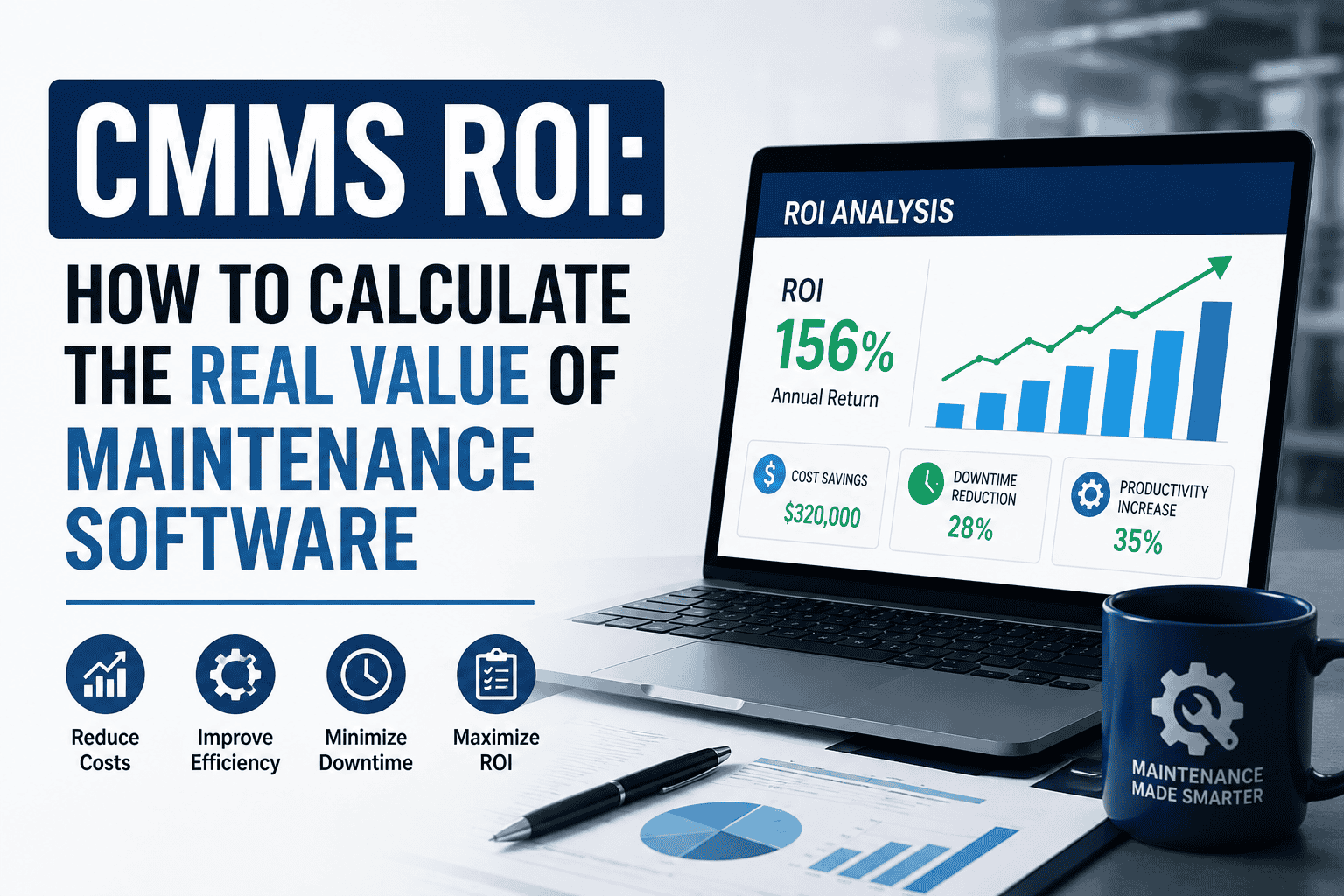
CMMS ROI: How to Calculate the Real Value of Maintenance Software
Executive Summary
CMMS ROI measures whether the financial and operational value of maintenance software is greater than the cost of buying, implementing, and using it.
Basic CMMS ROI Formula:
CMMS ROI = (Total Financial Benefit – Total CMMS Cost) / Total CMMS Cost x 100
However, the real value of a CMMS goes beyond software savings. Maintenance teams should also evaluate labor efficiency, downtime visibility, preventive maintenance execution, parts inventory control, reporting time, compliance documentation, and asset decision-making.
In addition, teams should treat some benefits as risk reduction or operational visibility instead of forcing every improvement into a questionable dollar amount. Therefore, a strong CMMS ROI analysis compares current maintenance performance against a realistic future state, separates hard-dollar savings from softer operational benefits, and validates assumptions with maintenance, operations, finance, and leadership teams.
What Is CMMS ROI?
CMMS ROI is the return an organization expects from computerized maintenance management system software compared with the total cost of ownership. It helps maintenance, facilities, operations, and finance leaders decide whether the investment makes sense.
A useful ROI calculation compares the current state of maintenance work with the expected future state after implementation. For example, the model should use baseline data from work orders, downtime records, labor hours, inventory activity, repair costs, and reporting processes.
If baseline data is incomplete, label the ROI estimate clearly as an estimate. As a result, the business case stays credible and leadership teams are less likely to treat rough assumptions as guaranteed savings.
Why Baseline Data Matters
Baseline data is the difference between a credible ROI model and a guess. Without current maintenance data, an organization may overestimate savings, understate implementation effort, or count operational improvements as guaranteed financial returns.
However, baseline data does not have to be perfect to be useful. Even imperfect data can support a practical ROI estimate when maintenance, operations, finance, and leadership teams review the assumptions together.
Review work volume, completion trends, overdue work, and administrative effort.
Use actual downtime data when estimating availability improvements.
Review emergency purchases, stockouts, excess parts, and parts usage.
Estimate how much time teams spend preparing reports and audit documentation.
The Basic CMMS ROI Formula
The basic CMMS ROI formula is:
CMMS ROI = (Total Financial Benefit – Total CMMS Cost) / Total CMMS Cost x 100
Example CMMS ROI Calculation
For example, if an organization estimates $80,000 in annual financial benefit and $50,000 in total first-year CMMS cost, the estimated first-year ROI would be 60 percent.
Example: ($80,000 – $50,000) / $50,000 x 100 = 60% ROI
Ultimately, this is only a model. The quality of the result depends on the quality of the assumptions.
Conservative vs. Expected vs. Optimistic ROI
For a stronger analysis, calculate ROI across multiple scenarios: conservative, expected, and optimistic. This gives leadership a range of possible outcomes instead of one overly confident estimate.
Include only savings supported by current data or strong financial evidence.
Include likely improvements supported by reasonable operational assumptions.
Show upside potential, but avoid using it as the only business case.
What Costs Should Be Included in a CMMS ROI Calculation?
A realistic ROI calculation should include more than the software subscription or license cost. Instead, the total cost of ownership should reflect the work required to implement, support, maintain, and administer the system.
| Cost Category | What to Include |
|---|---|
| Software cost | Subscription, license, modules, user access, or other approved software costs. |
| Implementation | Configuration, project management, workflow setup, permissions, testing, and launch support. |
| Data preparation | Asset lists, PM schedules, parts data, vendor data, location structure, and maintenance history cleanup. |
| Training | Administrator, planner, supervisor, technician, mobile user, and reporting-user training. |
| Internal labor | Employee time spent on setup, data review, testing, meetings, rollout, and adoption. |
| Ongoing administration | User management, data maintenance, report updates, process reviews, permissions, and system governance. |
Software Costs
Software costs may include subscription fees, license fees, modules, user access, mobile access, integrations, or other approved software costs. Although these costs are usually the most visible, they are not the only costs that matter.
Implementation Costs
Implementation costs may include configuration, workflow setup, project management, permissions, testing, and launch support. These costs matter because a CMMS only creates value when teams configure it around real maintenance workflows.
Data Preparation Costs
Data preparation often includes asset lists, preventive maintenance schedules, parts records, vendor data, location structure, and maintenance history cleanup. In many cases, underestimating data work makes the ROI model look stronger than it really is.
Training and Internal Labor Costs
Training should include technicians, supervisors, planners, administrators, and reporting users. In addition, include internal labor because employees usually spend time in setup meetings, testing, data review, and rollout activities.
What Benefits Should Be Included in CMMS ROI?
The strongest CMMS ROI calculations separate direct financial benefits from operational benefits. Direct benefits can often be estimated in dollars. Meanwhile, operational benefits may still matter, but teams should describe them honestly when they are difficult to quantify.
Estimate time saved searching for work orders, asset history, PM schedules, parts information, and status updates.
Use actual downtime records when available, and separate confirmed savings from estimated risk reduction.
Review PM compliance, overdue PMs, planned maintenance percentage, emergency work, and repeat failures.
Estimate value from better stock visibility, fewer emergency purchases, and reduced time spent looking for parts.
Review time spent preparing reports, audit documentation, work histories, and compliance records.
Separate Hard Savings From Soft Benefits
One of the biggest mistakes in CMMS ROI analysis is treating every improvement as direct financial savings. Therefore, a stronger ROI model separates benefits into hard savings and soft benefits.
| Hard Savings | Soft Benefits |
|---|---|
| Reduced overtime | Better maintenance visibility |
| Reduced contractor spending | Improved decision-making |
| Lower emergency purchasing costs | Better audit readiness |
| Reduced downtime costs | Improved documentation quality |
| Lower inventory carrying costs | Better communication between departments |
Why the Difference Matters
Teams can often verify hard savings through accounting records, maintenance budgets, labor reports, purchasing history, or downtime records. Soft benefits may still create significant operational value, but organizations should avoid converting them into dollar figures unless they have a documented calculation method.
As a result, this distinction makes the ROI model more credible to finance and leadership teams.
Why CMMS ROI Varies by Maintenance Maturity
Not every organization receives the same value from a CMMS. For example, organizations with mostly reactive maintenance often experience different benefits than organizations with mature preventive maintenance programs.
| Maintenance Maturity | Common ROI Drivers |
|---|---|
| Reactive maintenance | Improved work-order control, visibility into urgent work, better maintenance documentation, and reduced communication gaps. |
| Developing PM program | Better scheduling, PM compliance, labor planning, overdue PM visibility, and improved work prioritization. |
| Mature maintenance program | Asset analytics, reporting efficiency, inventory optimization, lifecycle decisions, and multi-metric performance tracking. |
| Multi-site operation | Standardized workflows, centralized reporting, consistent asset records, and enterprise-wide maintenance visibility. |
Therefore, organizations should evaluate a CMMS based on their current maintenance maturity rather than industry averages or generic software claims. The same software can create different value depending on data quality, process discipline, leadership support, and user adoption.
Step-by-Step: How to Calculate CMMS ROI
Use first-year ROI, three-year ROI, or payback period.
Include labor, downtime, parts, emergency work, reporting time, and administrative effort.
Include software, implementation, data preparation, training, internal labor, and administration.
Use current work order, downtime, inventory, and labor data where possible.
Keep hard-dollar savings separate from visibility, documentation, and planning confidence.
Use: (total financial benefit – total cost) / total cost x 100.
Use: total CMMS cost / monthly net financial benefit.
Validate assumptions with maintenance, operations, finance, and leadership.
Payback Period Formula
CMMS payback period estimates how long it takes for net financial benefits to equal the total CMMS cost. To calculate it, divide total CMMS cost by monthly net financial benefit.
Payback Period = Total CMMS Cost / Monthly Net Financial Benefit
In addition, use payback period alongside ROI, not instead of it, because it focuses on the time required to recover the investment rather than the full long-term value.
Score Your ROI Assumptions by Confidence Level
Not all ROI assumptions carry the same level of confidence. Before presenting a business case, classify each benefit estimate by confidence level.
| Confidence Level | How to Use It | Example |
|---|---|---|
| High | Include in conservative ROI when current data or strong financial evidence supports it. | Verified reduction in report preparation time or documented labor savings. |
| Medium | Include in expected ROI when operational evidence supports it but full verification is not available. | Estimated reduction in emergency purchases based on purchasing history and maintenance patterns. |
| Low | Keep separate from the main business case or include only in an optimistic scenario. | Predicted downtime reduction without reliable historical downtime data. |
As a result, organizations can calculate three versions of ROI: conservative ROI using high-confidence assumptions only, expected ROI using high and medium confidence assumptions, and optimistic ROI using all assumptions.
CMMS ROI Metrics to Track Before and After Implementation
With baseline data, ROI becomes easier to test after implementation. Start with a small set of metrics that your team can maintain consistently.
| Metric | Why It Matters |
|---|---|
| PM compliance | Shows whether teams complete scheduled preventive maintenance. |
| Planned maintenance percentage | Shows how much maintenance work is planned versus reactive. |
| MTTR | Shows average repair time and can indicate repair-process friction. |
| MTBF | Shows average operating time between failures for repairable assets. |
| Emergency work volume | Shows whether reactive work is consuming maintenance capacity. |
| Parts stockouts | Shows whether inventory issues are delaying maintenance work. |
| Reporting time | Shows administrative effort spent preparing maintenance visibility for leaders. |
| Backlog age | Shows whether open work is becoming stale or difficult to prioritize. |
CMMS ROI vs. Total Cost of Ownership
During software selection, evaluate CMMS ROI and total cost of ownership together. ROI measures the expected value generated by the software. Total cost of ownership measures the full cost required to purchase, implement, support, maintain, and administer the system throughout its lifecycle.
Organizations sometimes focus heavily on subscription or license costs while underestimating implementation effort, data preparation, training requirements, change management activities, and long-term administration. Therefore, a CMMS with a lower purchase price may not always deliver the lowest total ownership cost. Likewise, a higher-cost solution may provide greater long-term value if it supports maintenance workflows more effectively.
| ROI Focus | TCO Focus |
|---|---|
| Financial and operational return | Full lifecycle cost |
| Labor, downtime, inventory, reporting, and compliance benefits | Software, implementation, data, training, support, and administration costs |
| Helps justify the investment | Helps compare the true cost of options |
| Often used in the business case | Often used in procurement and budgeting |
Ultimately, evaluating ROI without considering TCO can create an incomplete picture of software value.
CMMS ROI Considerations by Industry
The factors that drive CMMS ROI often vary by industry. Asset complexity, compliance requirements, operational schedules, and labor constraints can change what counts as a meaningful return.
| Industry | Common CMMS ROI Drivers |
|---|---|
| Manufacturing | Downtime reduction, PM compliance, asset reliability, maintenance planning, and repair visibility. |
| Facilities management | Labor efficiency, work-order visibility, vendor coordination, occupant service response, and reporting. |
| Healthcare | Compliance documentation, equipment uptime, audit readiness, maintenance history, and asset accountability. |
| Education | Resource allocation, preventive maintenance planning, campus work-order visibility, and budget planning. |
| Government | Asset accountability, documentation management, reporting consistency, and maintenance transparency. |
For this reason, organizations should evaluate ROI using industry-specific operational challenges rather than relying solely on generalized maintenance software assumptions.
Maintenance Leadership Perspective on CMMS ROI
Maintenance leaders often evaluate software based on features, dashboards, reporting tools, and automation capabilities. Those factors matter, but implementation success also depends heavily on maintenance processes, user adoption, asset data quality, and organizational discipline.
In general, organizations that maintain accurate asset records, consistent work-order procedures, realistic preventive maintenance schedules, and reliable maintenance data are better positioned to achieve measurable ROI than organizations implementing software without established maintenance practices.
Therefore, CMMS ROI should be viewed as the result of technology, process improvement, and organizational adoption working together. Software can support better maintenance management, but the organization still needs clear workflows, accurate data, and consistent system use.
Questions to Ask Before Using a CMMS ROI Calculator
Before using any CMMS ROI calculator, verify that your organization can answer the following questions. The quality of an ROI calculation depends on the quality of the baseline information entered into the model.
| Question | Why It Matters |
|---|---|
| How many work orders are completed each month? | Helps estimate labor volume, administrative workload, and potential process improvement. |
| What percentage of maintenance work is planned versus reactive? | Shows whether ROI may come from planning improvements or reactive-work reduction. |
| How much downtime is currently tracked? | Determines whether downtime savings can be modeled with confidence. |
| How much technician time is spent on administrative work? | Helps estimate labor efficiency gains. |
| How often do inventory stockouts delay maintenance? | Supports inventory and purchasing ROI assumptions. |
| What maintenance reports are generated manually? | Helps estimate reporting time savings and documentation improvements. |
If these questions cannot be answered yet, the ROI calculator can still be useful. However, the output should be treated as an estimate rather than a firm projection.
Common CMMS ROI Mistakes
1: Counting every possible benefit as guaranteed savings.
2: Ignoring implementation, data cleanup, training, and internal labor costs.
3: Using downtime estimates without confirming how downtime is currently measured.
4: Treating soft benefits as hard-dollar savings without finance approval.
5: Assuming software will create value without workflow changes or adoption.
6: Calculating ROI once and never comparing the estimate against actual results after launch.
7: Using a generic ROI benchmark instead of organization-specific maintenance data.
8: Overlooking total cost of ownership when comparing software options.
How MicroMain Fits Into a CMMS ROI Evaluation
MicroMain provides CMMS software for maintenance teams and offers a CMMS ROI calculator page that can be used as a starting point for estimating potential value.
MicroMain’s CMMS software page lists capabilities related to work order management, preventive maintenance, asset management, parts and inventory management, workforce tracking, mobile maintenance, reporting, alerts, document storage, and API support.
Readers should compare those listed capabilities with their own baseline maintenance data and implementation requirements. Ultimately, the most useful ROI analysis will be specific to the organization, not a generic claim about what maintenance software always produces.
Next step: Explore MicroMain CMMS software or use MicroMain’s CMMS ROI calculator as an evaluation starting point, then validate the assumptions with your maintenance, operations, and finance teams.
Sources and Methodology
This article uses commonly accepted maintenance management practices, preventive maintenance planning principles, CMMS implementation workflows, asset management concepts, and maintenance performance metrics used by maintenance, facilities, and operations teams.
Organizations should validate ROI assumptions using their own work-order history, downtime records, labor costs, inventory activity, maintenance budgets, and financial reporting processes. Because maintenance environments vary significantly by industry, asset type, asset criticality, staffing model, and operational requirements, teams should treat ROI calculations as organization-specific evaluations rather than universal benchmarks.
Additional Maintenance and Asset Management Resources
Maintenance and reliability professional guidance.
Facility management resources and professional education.
Asset management standards and lifecycle guidance.
Reliability, maintenance, and asset performance insights.
Asset management education and industry resources.
FAQ: CMMS ROI
What is CMMS ROI?
CMMS ROI is the estimated return from maintenance software compared with the total cost of buying, implementing, and using it. It helps organizations evaluate whether the expected value from labor efficiency, downtime visibility, PM execution, inventory control, reporting, and documentation justifies the investment.
How do you calculate CMMS ROI?
Use the formula: CMMS ROI = (total financial benefit – total CMMS cost) / total CMMS cost x 100. For a stronger calculation, use baseline maintenance data and separate conservative, expected, and optimistic assumptions.
What should be included in CMMS cost?
CMMS cost should include software, implementation, configuration, data preparation, training, internal labor, integrations if applicable, and ongoing administration. In contrast, looking only at subscription or license cost can understate the true investment.
What benefits should be included in CMMS ROI?
Common benefit categories include labor efficiency, downtime visibility, preventive maintenance execution, parts inventory control, reporting time, and documentation quality. To keep the ROI model credible, separate hard savings from soft benefits.
Can CMMS software guarantee cost savings?
No. A CMMS can support better maintenance management, but financial results depend on workflow design, data quality, adoption, asset conditions, maintenance maturity, and operational discipline. Therefore, savings should be modeled as estimates unless the organization verifies them with its own data.
What is CMMS payback period?
CMMS payback period estimates how long it takes for net financial benefits to equal the total CMMS cost. The formula is total CMMS cost divided by monthly net financial benefit. However, payback period should be evaluated alongside ROI and total cost of ownership.
What is the difference between CMMS ROI and CMMS TCO?
CMMS ROI measures expected return, while CMMS total cost of ownership measures the full lifecycle cost of owning and operating the system. A complete evaluation should consider both because a low purchase price does not always mean low long-term cost or high value.
Should soft benefits be included in CMMS ROI?
Soft benefits can be included in the business case, but they should be labeled clearly. Benefits such as better visibility, audit readiness, and communication may be valuable. However, teams should not treat them as hard-dollar savings unless the organization has a documented method for calculating their financial impact.