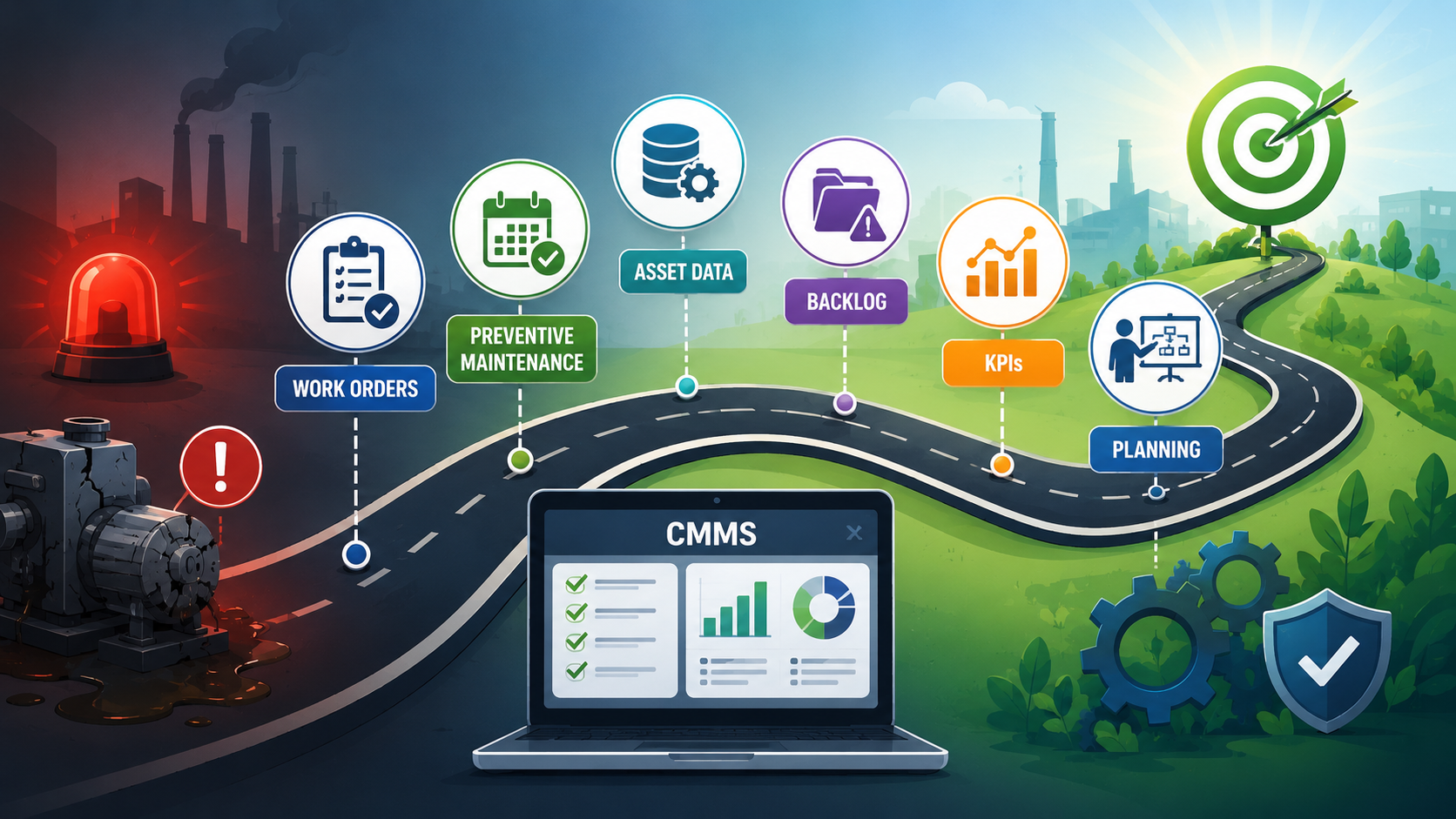
From Reactive to Proactive Maintenance: How to Build a Practical CMMS Roadmap
Proactive maintenance helps maintenance teams reduce firefighting, improve asset reliability, and gain better control over daily work. However, many teams know they need to become more proactive but still struggle to build a clear path forward.
Reactive maintenance is expensive, stressful, and difficult to control. Equipment failures can disrupt production, delay service, increase overtime, and create safety or compliance concerns. As a result, maintenance leaders often look for better planning, stronger asset visibility, and more consistent preventive maintenance.
Even so, moving from reactive to proactive maintenance does not happen by buying software alone. A CMMS can support the transition, but teams also need a practical roadmap. First, they need to know what to fix, what data to collect, which workflows to standardize, and when to expand into more advanced strategies such as predictive maintenance or AI-assisted planning.
This guide explains how maintenance teams can move from reactive maintenance to proactive maintenance using a practical CMMS roadmap built around work orders, preventive maintenance, asset data, backlog control, KPIs, planning, and continuous improvement.
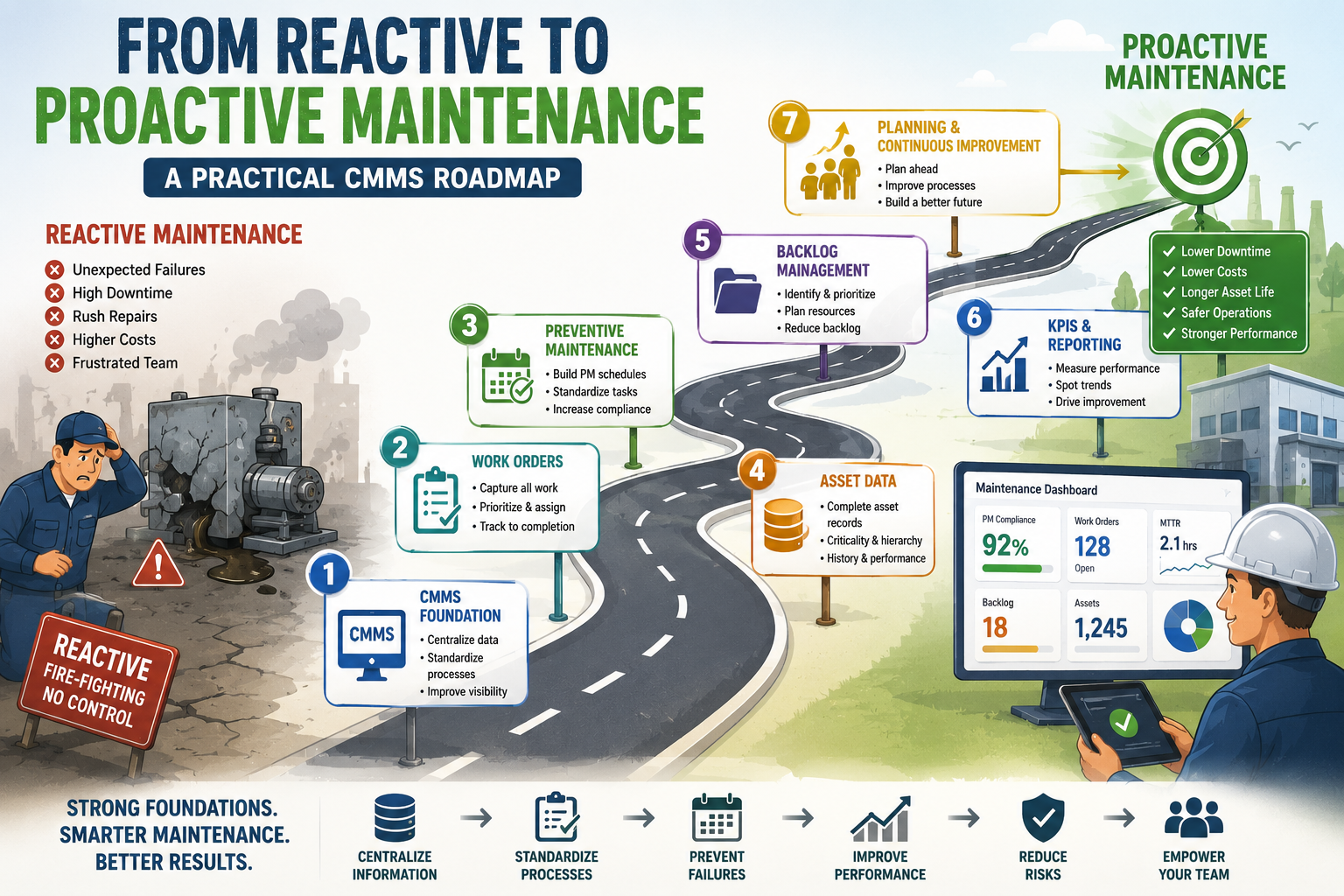
Example proactive maintenance roadmap for moving from reactive repairs to planned, data-driven maintenance.
Quick answer
A proactive maintenance roadmap helps teams move from emergency repairs to planned maintenance in stages. The roadmap usually starts with centralized work orders, accurate asset records, preventive maintenance, PM compliance tracking, backlog management, planning and scheduling, maintenance KPIs, root cause analysis, and continuous improvement. A CMMS supports this shift by giving teams one system for work, assets, history, parts, and reporting.
What Is Reactive Maintenance?
Reactive maintenance happens after equipment fails or after a problem becomes urgent. In other words, the team responds only when something breaks, stops working, causes complaints, or interrupts operations.
For example, reactive work may include repairing a motor after it stops running, replacing a belt after it breaks, fixing an HVAC unit after occupants complain, or responding to a pump failure after production stops.
Some reactive maintenance is unavoidable because no organization can prevent every failure. However, when most work is reactive, the team loses control of the schedule. Over time, technicians spend more time fighting emergencies than improving reliability.
| Reactive maintenance risk | How it affects the team |
|---|---|
| More emergency work | Technicians spend more time responding to urgent repairs instead of completing planned work. |
| Higher downtime risk | Failures interrupt production, service delivery, or facility operations. |
| Poor parts planning | The team may need rush orders or may delay repairs while waiting for parts. |
| Weak reporting | Leaders may struggle to explain workload, downtime, cost, and asset performance. |
Practical note: A reactive team may look busy every day, but being busy is not the same as being in control. Proactive maintenance gives teams a better way to control risk, workload, and asset performance.
What Is Proactive Maintenance?
Proactive maintenance focuses on preventing failures, reducing risk, and addressing problems before they become emergencies. Instead of waiting for breakdowns, maintenance teams use planned work, inspections, asset history, and performance data to stay ahead of issues.
Proactive maintenance may include preventive maintenance, planned corrective work, asset inspections, lubrication programs, condition monitoring, root cause analysis, KPI tracking, continuous improvement, and predictive maintenance where appropriate.
The main idea is simple: maintenance teams should spend more time preventing problems and less time reacting to breakdowns. However, proactive maintenance does not mean every task is planned perfectly. It means the team has better visibility, stronger processes, and more control over maintenance work.
Reactive vs. Proactive Maintenance
Reactive maintenance focuses on fixing problems after they occur. In contrast, proactive maintenance focuses on reducing the likelihood, frequency, and impact of those problems before they become urgent.
| Area | Reactive maintenance | Proactive maintenance |
|---|---|---|
| Timing | Work happens after failure or after a problem becomes urgent. | Work happens before failure or before risk becomes urgent. |
| Planning | Little time to plan labor, parts, tools, or downtime. | Teams plan work, schedule resources, and prepare parts earlier. |
| Workload | Emergency work often interrupts the day. | More work becomes planned, prioritized, and visible. |
| Data | Records may be incomplete or inconsistent. | Work history, PM records, and KPIs guide decisions. |
Why Maintenance Teams Struggle to Become Proactive
Many organizations want proactive maintenance, but several barriers get in the way. In most cases, the issue is not effort. Instead, the team lacks clear workflows, clean data, and enough visibility to plan ahead.
| Barrier | Why it blocks progress | What to improve first |
|---|---|---|
| Unstandardized work orders | Requests come from calls, texts, emails, paper forms, and hallway conversations. | Create one process for submitting, assigning, and closing work. |
| Incomplete asset data | Teams cannot plan well if they do not know what assets exist, where they are, or how they perform. | Start with critical assets and clean the highest-value records first. |
| Inconsistent preventive maintenance | Missed PMs keep teams stuck in reactive work. | Build realistic PM schedules and track completion. |
| Poor inventory visibility | Planned work can still stall when parts are missing. | Track parts usage, stock levels, and reorder points. |
| No KPI tracking | Leaders cannot prove whether performance is improving. | Track a small set of useful maintenance KPIs. |
The Practical CMMS Roadmap: From Reactive to Proactive Maintenance
A CMMS roadmap helps maintenance teams modernize in stages. Instead of trying to fix everything at once, the team focuses on the right priorities in the right order.
The goal is not to jump from paper work orders to fully predictive maintenance overnight. Instead, the goal is to build maintenance maturity step by step.
Roadmap tip: Start with the basics first. Then, once work orders, assets, PMs, and KPIs become reliable, more advanced strategies such as predictive maintenance become easier to evaluate and implement.
| Roadmap stage | Main goal | Key outcome |
|---|---|---|
| 1. Centralize work orders | Create visibility | Fewer lost requests |
| 2. Build asset records | Improve asset history | Better planning |
| 3. Establish PMs | Prevent failures | More planned work |
| 4. Track PM compliance | Confirm execution | Fewer missed PMs |
| 5. Manage backlog | Prioritize work | Better workload control |
| 6. Improve scheduling | Reduce delays | Higher schedule compliance |
| 7. Track KPIs | Measure progress | Better decisions |
| 8. Analyze repeat failures | Fix root causes | Improved reliability |
| 9. Prepare for predictive maintenance | Use advanced data wisely | Stronger readiness |
| 10. Continuously improve | Keep the program current | Long-term maturity |
Stage 1: Centralize Work Orders
First, create one reliable process for submitting, assigning, completing, and closing maintenance work. A CMMS helps centralize work orders so teams can see what work has been requested, who owns it, which assets are affected, what priority the task has, and whether the work is open, in progress, or complete.
Without centralized work orders, maintenance leaders cannot accurately manage workload, backlog, labor, or asset history. As a result, work slips through the cracks because the team has no single source of truth.
What to do first
- Standardize basic work order fields such as asset, location, priority, status, labor time, parts used, and completion notes.
- Create a simple request process so work does not arrive through scattered channels.
- Keep the process simple at first so technicians adopt the CMMS instead of avoiding it.
Stage 2: Build Accurate Asset Records
Once work orders are centralized, the next step is improving asset data. After all, proactive maintenance requires asset visibility. Maintenance teams need to know which assets are most important, how often they fail, what work technicians have performed, and what parts they need.
A useful asset record may include asset name, asset ID, location, manufacturer, model, serial number, asset type, priority level, maintenance history, related parts, and manuals or documents.
What to do first
Do not try to perfect every asset record at once. Instead, start with assets that affect safety, compliance, production, facility uptime, or essential operations.
- Production-critical equipment
- HVAC systems
- Pumps and motors
- Electrical systems
- Safety systems
- Generators and compressors
- High-cost or high-risk assets
Stage 3: Establish a Preventive Maintenance Program
Preventive maintenance is often the foundation of proactive maintenance. With a PM program, teams can schedule recurring tasks before assets fail. These tasks may include inspections, lubrication, cleaning, calibration, testing, adjustments, and planned replacement of wear components.
Preventive maintenance gives teams a structured way to reduce failure risk. Additionally, it helps shift labor from emergency repairs to planned work.
What to do first
Start by reviewing critical assets and creating PM tasks based on manufacturer guidance, asset priority, operating conditions, failure history, safety requirements, compliance needs, and technician input.
Additionally, every good PM work order should include clear task instructions, asset and location, safety notes, required tools or parts, estimated labor time, inspection criteria, and required closeout notes.
Avoid this mistake: Do not create too many low-value PMs. An overloaded PM schedule can reduce compliance, frustrate technicians, and push truly important work into the backlog.
Stage 4: Track PM Compliance and Overdue Work
After teams schedule PMs, they must track whether technicians complete them on time. Preventive maintenance compliance measures the percentage of scheduled PM tasks completed within the required time frame.
PM Compliance Formula
PM Compliance = Completed PM Work Orders ÷ Scheduled PM Work Orders × 100
For example, if 100 PMs are scheduled in a month and 85 are completed on time, PM compliance is 85%.
A PM program only works when the work gets done. Therefore, tracking compliance helps managers see whether preventive maintenance is realistic, properly staffed, and executed consistently.
What to do first
- Track PMs due this week.
- Review overdue PMs.
- Separate critical missed PMs from lower-risk missed tasks.
- Monitor PM completion by location, technician, crew, and asset type.
- Review corrective work created from PM findings.
If compliance is low, investigate the cause. For example, the issue may be too much reactive work, unrealistic schedules, missing parts, unclear instructions, or poor CMMS adoption.
Stage 5: Manage Maintenance Backlog
Maintenance backlog is approved work that has not yet been completed. However, a backlog is not automatically bad. In fact, a healthy backlog gives planners work to schedule. However, an unmanaged backlog can bury important work under lower-priority tasks.
Backlog visibility helps teams understand whether they have enough labor, whether critical work is delayed, and whether reactive work is crowding out planned maintenance.
Separate backlog by priority, asset priority, age, location, estimated labor hours, work type, and safety or compliance impact. As a result, maintenance leaders can decide what should be scheduled first.
Stage 6: Improve Planning and Scheduling
Once work orders, assets, PMs, and backlog are visible, maintenance teams can improve planning and scheduling. Planning focuses on preparing the work. Meanwhile, scheduling focuses on deciding when the work will happen.
Better planning reduces wasted time. As a result, technicians work more effectively when they have clear instructions, required parts, correct tools, and realistic schedules.
- Confirm the work scope is clear.
- Identify the asset and location.
- Check that required parts are available.
- Review the labor estimate and priority.
- Document safety requirements.
- Coordinate downtime with operations when needed.
Stage 7: Track Maintenance KPIs
Maintenance KPIs help teams measure whether the move toward proactive maintenance is working. Without KPIs, it is hard to prove improvement, justify budgets, or identify problems.
Start with a small KPI set. Too many metrics can create noise. Instead, use a practical starter set that connects each metric to a clear maintenance goal.
| Goal | Recommended KPI |
|---|---|
| Improve PM execution | PM compliance |
| Reduce firefighting | Reactive maintenance percentage |
| Improve planning | Schedule compliance |
| Manage workload | Backlog by labor hours |
| Improve reliability | MTBF and repeat failures |
| Reduce downtime | Downtime by critical asset |
Stage 8: Use Root Cause Analysis for Repeat Failures
A team becomes more proactive when it stops fixing the same problems over and over. In many cases, repeat failures show that the team has not addressed the true cause.
For example, a team may replace the same bearing repeatedly without correcting misalignment. Likewise, technicians may clean the same clogged filter without addressing contamination, or they may replace belts without checking tension and pulley alignment.
Reactive teams repair symptoms. Proactive teams investigate causes. Therefore, maintenance leaders should use CMMS work order history to identify assets with recurring problems and create corrective actions that address the cause, not just the immediate failure.
Stage 9: Prepare for Condition Monitoring or Predictive Maintenance
Predictive maintenance can be valuable for some organizations, but it should come after the basics are in place. For example, predictive maintenance may use vibration, temperature, oil analysis, pressure, or sensor readings to identify signs of potential failure.
Predictive maintenance depends on data, process discipline, and the ability to act on alerts. Therefore, if the team cannot consistently complete PMs or manage work orders, predictive alerts may create more noise than value.
Predictive Maintenance Readiness Checklist
- Do we have accurate asset data?
- Do we track work order history consistently?
- Do we know which assets are critical?
- Do we track downtime and failures?
- Can technicians respond to alerts?
- Do we have a process for creating follow-up work?
- Are PMs already under control?
If the answer is no, strengthen the CMMS foundation first.
Stage 10: Continuously Improve the Maintenance Program
Proactive maintenance is not a one-time project. Instead, it is an ongoing improvement process. Asset conditions change, production demands shift, staffing changes, and PM programs can become outdated when no one reviews them.
Set a regular review rhythm. For example, weekly reviews can focus on open work, overdue PMs, urgent issues, and backlog. Monthly reviews can focus on trends, KPIs, asset reliability, and PM effectiveness. Finally, quarterly reviews can focus on strategy, staffing, budget, and capital planning.
How CMMS Software Supports Proactive Maintenance
A CMMS helps maintenance teams move from reactive to proactive maintenance by centralizing the information and workflows needed to manage planned work.
In addition, a CMMS can support work order management, preventive maintenance scheduling, asset records, maintenance history, inventory tracking, backlog visibility, KPI reporting, technician records, corrective work planning, and audit support.
Software alone does not make a team proactive. However, when teams combine a CMMS with clear processes, clean data, technician adoption, and leadership support, they can gain better control over maintenance work.
For additional maintenance and reliability context, teams can review the U.S. Department of Energy’s Operations and Maintenance Best Practices Guide and NIST guidance on maintenance and reliability practices.
How MicroMain Fits Into a Proactive Maintenance Roadmap
MicroMain supports maintenance teams through core CMMS capabilities, including work order management, preventive maintenance scheduling, asset tracking, inventory management, reporting, and maintenance records.
For organizations moving from reactive to proactive maintenance, these capabilities can help lay the foundation for standardizing workflows, tracking PM completion, managing backlog, monitoring KPIs, and building a more reliable asset history.
The practical goal is not to chase every new maintenance trend at once. Instead, the goal is to build the right foundation so the team can make better maintenance decisions over time.
Ready to move from reactive to proactive maintenance?
Explore MicroMain CMMS software to centralize work orders, schedule preventive maintenance, manage assets, track inventory, monitor KPIs, and build a stronger maintenance roadmap.
Final Takeaway
Moving from reactive to proactive maintenance is not about flipping a switch. Instead, it is a roadmap. To make progress, maintenance teams need to centralize work orders, clean up asset data, build a realistic preventive maintenance program, track PM compliance, manage backlog, monitor KPIs, and continuously improve.
Advanced tools such as predictive maintenance or AI-assisted insights may become useful later. However, those tools work best when the maintenance foundation is strong enough to support them.
For most teams, the best place to start is simple: create one reliable system for maintenance work, complete the right PMs on time, and use data to make better decisions. Ultimately, that is how reactive maintenance starts becoming proactive maintenance.
Frequently Asked Questions
What is proactive maintenance?
Proactive maintenance is a strategy focused on preventing failures, reducing risk, and addressing issues before they become urgent problems.
What is the difference between reactive and proactive maintenance?
Reactive maintenance happens after equipment fails or a problem becomes urgent. In contrast, proactive maintenance focuses on planned work, inspections, preventive maintenance, and reliability improvement before failures occur.
How does a CMMS help with proactive maintenance?
A CMMS helps centralize work orders, schedule preventive maintenance, track asset history, manage backlog, record parts and labor, and report on maintenance KPIs.
What is the first step in moving from reactive to proactive maintenance?
The first step is usually centralizing work orders so the maintenance team can track, prioritize, assign, complete, and document work consistently.
Why do proactive maintenance programs fail?
Proactive maintenance programs can fail when teams have poor data, unrealistic PM schedules, weak CMMS adoption, unclear workflows, or too much reactive work interrupting planned maintenance.
Is preventive maintenance the same as proactive maintenance?
Preventive maintenance is one part of proactive maintenance. Additionally, proactive maintenance may include planning, inspections, condition monitoring, root cause analysis, reliability improvement, and KPI tracking.
When should a team consider predictive maintenance?
Predictive maintenance may make sense when a team has critical assets, reliable asset data, maintenance history, condition monitoring data, and the ability to respond to alerts.
What KPIs help measure proactive maintenance?
Useful KPIs include PM compliance, planned maintenance percentage, reactive maintenance percentage, backlog, downtime, MTBF, MTTR, and repeat failure rate.
How long does it take to become proactive?
The timeline varies by organization. Usually, it depends on data quality, CMMS adoption, staffing, asset complexity, and how consistently the team improves its maintenance processes.
How does MicroMain support proactive maintenance?
MicroMain supports proactive maintenance through CMMS features such as work order management, preventive maintenance scheduling, asset management, inventory tracking, reporting, and maintenance records.