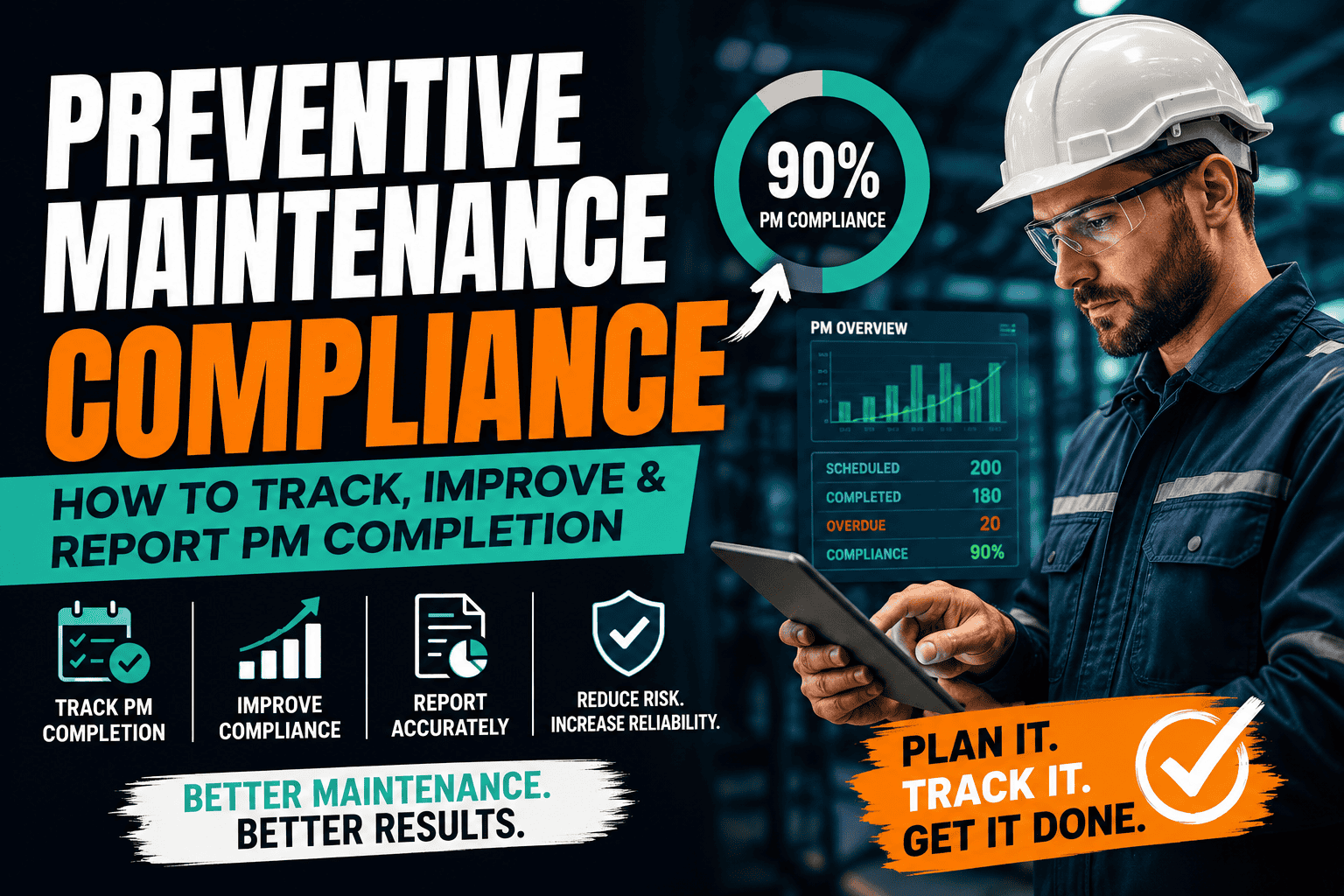
Preventive Maintenance Compliance: How to Track, Improve, and Report PM Completion
Preventive maintenance only works when it actually gets done. Many maintenance teams have PM schedules, recurring work orders, checklists, and asset inspection routines. However, having a PM program on paper does not always mean the work the team completes on time or that reliability is improving.
That is where preventive maintenance compliance becomes important. It measures whether scheduled preventive maintenance tasks teams complete within the required time frame. As a result, maintenance managers can see whether the team is staying ahead of equipment issues or slowly slipping into reactive maintenance.
This guide explains what preventive maintenance compliance means, how to calculate it, why it matters, what causes low compliance, how to improve it, and how CMMS software can help teams track PM completion more effectively.
Quick answer
Preventive maintenance compliance is the percentage of scheduled PM work orders completed on time. It helps maintenance teams understand whether planned maintenance is actually being executed. A strong PM compliance program tracks completed work, overdue PMs, critical missed tasks, schedule gaps, labor capacity, and corrective work created from PM findings.
What Is Preventive Maintenance Compliance?
Preventive maintenance compliance is a maintenance metric that measures how many scheduled preventive maintenance tasks teams completed within the required time frame. In simple terms, it answers one question: Did we complete the preventive maintenance work we planned?
PM compliance teams usually express as a percentage. For example, if a team schedules 200 PM work orders in a month and completes 180 on time, the PM compliance rate is 90%.
In addition, this metric matters because skipped, delayed, or undocumented PM work can increase equipment risk. In addition, it can make maintenance reports look better or worse than reality if teams do not define compliance clearly.
Preventive Maintenance Compliance Formula
PM Compliance = Completed PM Work Orders ÷ Scheduled PM Work Orders × 100
Example: 180 completed PM work orders ÷ 200 scheduled PM work orders × 100 = 90% PM compliance.
Why Preventive Maintenance Compliance Matters
Preventive maintenance helps reduce the risk of unexpected failures. However, if PM tasks are skipped, delayed, or closed without proper documentation, the program loses effectiveness.
Tracking PM compliance helps maintenance leaders determine whether the preventive maintenance plan is realistic, properly staffed, and aligned with asset needs. It also helps teams identify whether reactive work is pushing planned maintenance out of the schedule.
| Why it matters | What it helps reveal |
|---|---|
| Shows whether planned maintenance is happening | A full PM calendar does not mean the work is getting done. PM compliance shows whether scheduled tasks are completed on time. |
| Helps reduce reactive maintenance | Missed PMs can allow small issues to grow into urgent repairs. Tracking compliance helps teams catch execution gaps earlier. |
| Supports better scheduling | Low compliance may show that the schedule is overloaded, labor estimates are wrong, or technicians interruptions constantly pull technicians away. |
| Improves accountability | Supervisors can review overdue work, spot bottlenecks, and remove barriers before PM backlog grows. |
| Supports audits and documentation | In regulated environments, PM compliance reporting can help document inspections, safety checks, and recurring maintenance work. |
What Is a Good Preventive Maintenance Compliance Rate?
There is no universal PM compliance target that fits every organization. The right target depends on asset criticality, staffing, industry, operating environment, safety requirements, and maintenance maturity.
However, many maintenance teams use 90% or higher as a practical benchmark for strong preventive maintenance compliance. That does not mean every team below 90% is failing. Instead, it means the team should investigate why PM work is being missed and whether those missed tasks create risk.
It is also important to look beyond the overall percentage. For example, 95% compliance may look strong, but if the missed 5% includes critical safety inspections or high-value production assets, the risk may still be significant.
Practical note: A good PM compliance target should account for risk. Missing a low-priority inspection does not carry the same risk as missing a required safety check or a PM on a production-critical asset.
PM Compliance vs. Schedule Compliance
Preventive maintenance compliance and schedule compliance are related, but they do not mean the same thing. Because teams sometimes use these terms interchangeably, it is important to define them before reporting performance.
| Metric | What it measures | Example |
|---|---|---|
| PM compliance | Whether scheduled preventive maintenance tasks teams completed within the required period. | A monthly PM the team completed before the month ended. |
| Schedule compliance | Whether planned work the team completed during the exact scheduled time window. | A PM planned for Week 2 the team completed during Week 2. |
| PM completion rate | Whether PM tasks were eventually completed, even if they were late. | A PM due last month the team closed this month. |
Together, all three metrics can help. However, PM compliance usually works better for understanding whether preventive maintenance teams complete within the required period, while schedule compliance is better for measuring planning discipline.
Why PM Compliance Drops
Meanwhile, low preventive maintenance compliance is usually a symptom of a larger maintenance problem. It rarely comes from only a technician performance issue. Therefore, maintenance leaders should investigate the system behind the work, not only the people doing the work.
| Cause | How it affects PM compliance | What to review |
|---|---|---|
| Too much reactive maintenance | Breakdowns pull technicians away from scheduled PM work. | Reactive work volume, downtime, repeat failures, and emergency repairs. |
| Unrealistic PM schedules | The team may carry more scheduled work than available labor hours. | PM frequency, labor estimates, available capacity, and asset criticality. |
| Poor work order instructions | Vague tasks slow technicians down and reduce closeout quality. | Task steps, safety notes, inspection criteria, tools, parts, and escalation triggers. |
| Missing parts or tools | Technicians may struggle to finish scheduled PMs on time. | Parts availability, kitting, reorder points, and storeroom accuracy. |
| Poor asset data | Duplicate records or unclear locations make PM execution harder. | Asset hierarchy, naming conventions, location data, and equipment records. |
| Weak CMMS adoption | Completed work may not show up in reports if work orders technicians do not close work orders properly. | Technician training, mobile access, closeout fields, and supervisor follow-up. |
How to Improve Preventive Maintenance Compliance
Improving PM compliance requires more than telling technicians to complete more work. Instead, maintenance leaders need to look at planning, scheduling, workload, data quality, parts availability, and execution habits.
Step 1: Review the Current PM Schedule
Start by reviewing every recurring PM task. Some PMs may no longer fit current needs, duplicated, too frequent, or no longer tied to a meaningful failure mode. At the same time, critical assets may lack important PM work.
- Is this PM still necessary?
- Is the frequency realistic?
- Is the task tied to a critical asset?
- Is the work instruction clear?
- Is the estimated labor time accurate?
- Does the task help prevent a known failure mode?
Step 2: Prioritize PMs by Asset Criticality
Not every PM carries the same risk. For example, a missed inspection on a critical production asset, generator, safety system, or HVAC system may create more risk than a missed task on a low-priority asset.
| Priority | Asset type | PM response |
|---|---|---|
| High | Safety, compliance, production-critical, or high-value assets. | Complete on schedule and escalate quickly when missed. |
| Medium | Important operational assets that affect service, quality, or throughput. | Complete within a defined window and monitor overdue trends. |
| Low | Noncritical assets with low operational or safety risk. | Review frequency, defer if needed, and avoid crowding out critical PMs. |
Step 3: Improve PM Work Order Instructions
Clear instructions improve completion rates. In contrast, vague instructions such as “inspect equipment” or “perform maintenance” can slow technicians down and make closeout notes less useful.
- Asset name and location
- Task steps
- Safety notes
- Required tools
- Required parts or materials
- Estimated labor time
- Inspection criteria
- Completion notes or checklist fields
- Escalation trigger for corrective work
Step 4: Balance PM Workload With Available Labor
Low compliance may show the team has more scheduled work than available labor hours. Therefore, managers should compteams schedule PM labor hours against technician availability.
If the schedule exceeds actual capacity, the team may need to adjust frequencies, redistribute work, add resources, reduce low-value PM tasks, or move noncritical work to a more realistic window.
Step 5: Track Overdue PMs Separately
Although overall compliance is helpful, but overdue PMs deserve separate attention. This is especially true when overdue work affects critical assets, safety systems, or compliance requirements.
- Asset
- Location
- Priority
- Technician or crew
- Department
- Age of overdue work
- Reason for delay
Step 6: Use Failure History to Adjust PM Frequencies
Preventive maintenance should keep improving. If an asset continues to fail despite regular PMs, the task may be incomplete, the frequency may be wrong, or the root cause may not be addressed.
On the other hand, if an asset rarely has issues, it may be possible to reduce PM frequency depending on risk, manufacturer guidance, and operating conditions. Over time, failure history helps teams make PM schedules more realistic and more useful.
Step 7: Make PM Compliance Visible
PM compliance leaders should not hide in a report no one checks. Instead, maintenance leaders should review it regularly with supervisors, planners, and technicians.
A simple dashboard can show PM compliance rate, overdue PMs, PMs due this week, critical PMs missed, completion trends, PM labor hours, and PMs by asset or location. As a result, teams can spot problems before they become reliability issues.
Step 8: Improve CMMS Closeout Discipline
PM compliance reporting depends on accurate closeout. If work is completed but not documented, the CMMS cannot accurately reflect compliance.
- Work completed
- Labor time
- Parts used
- Condition found
- Follow-up work needed
- Notes or photos
- Failure concerns
Step 9: Create Corrective Work From PM Findings
Preventive maintenance does more than about checking boxes. It should help identify issues early. Therefore, technicians should create corrective work orders when they find defects during PM tasks.
For example, if a technician notices belt wear during a conveyor inspection, that finding should create corrective action before the belt fails. This keeps defects from being buried in notes and helps planners schedule follow-up work.
Step 10: Review PM Compliance Trends Monthly
For example, weekly reviews help manage execution. Meanwhile, monthly reviews help identify trends. For this reason, maintenance leaders should look beyond the current percentage and ask whether the PM program actually improves reliability.
- PM compliance by asset type
- PM compliance by location
- PM compliance by technician or crew
- Overdue PM trends
- Reactive work volume
- PM-generated corrective work
- Downtime trends
PM Compliance Dashboard Example
A good PM compliance dashboard should stay easy to understand at a glance. It should show whether PM work teams complete, where overdue work is building up, and which missed tasks carry the most risk.
| Dashboard item | What it tells you | Why it matters |
|---|---|---|
| Overall PM compliance rate | Percentage of scheduled PMs completed on time. | Shows general execution performance. |
| Overdue PM count | Number of PMs past the required completion window. | Helps managers focus on work that is slipping. |
| Critical PMs missed | Missed PMs tied to critical assets, safety systems, or compliance requirements. | Separates high-risk missed work from lower-risk tasks. |
| PM compliance by location | Completion performance by facility, area, department, or site. | Shows where planning or staffing problems may exist. |
| PM-generated corrective work | Corrective work orders created from PM findings. | Shows whether PMs are finding issues before failure. |
PM Compliance Reporting: What to Include
A strong PM compliance report should be simple enough to use but detailed enough to support decisions. In addition, it should separate normal overdue work from high-risk missed PMs.
- Overall PM compliance rate: Shows the percentage of scheduled PMs completed on time.
- Overdue PM count: Shows how many PMs teams did not complete within the required time frame.
- Critical PMs missed: Highlights missed PMs tied to critical assets, safety systems, or compliance requirements.
- PM completion by location: Helps identify facilities, departments, or areas falling behind.
- PM completion by asset type: Shows whether certain equipment groups are consistently missed.
- PM labor hours: Shows how much labor teams spend on preventive maintenance.
- Corrective work generated from PMs: Shows whether inspections identify problems before failure.
Preventive Maintenance Compliance Examples by Industry
However, PM compliance looks different across industries because assets, risk, and documentation needs vary. However, the basic goal stays the same: complete the right PM tasks on time and document the work clearly.
| Industry | Common PM compliance focus | Example |
|---|---|---|
| Manufacturing | Production equipment, conveyors, motors, pumps, compressed air, and safety devices. | Track missed PMs on production-critical assets separately from low-risk tasks. |
| Facilities | HVAC, plumbing, lighting, roof, doors, safety systems, and building inspections. | Monitor overdue PMs by building, floor, system, or service area. |
| Healthcare | Life-safety systems, facility equipment, inspections, and documentation-heavy maintenance. | Report missed PMs tied to safety, patient comfort, or inspection readiness. |
| Hospitality | Guest rooms, HVAC, kitchen equipment, laundry systems, elevators, and pools. | Use PM compliance to reduce guest-impacting failures and urgent repair requests. |
How CMMS Software Helps Track PM Compliance
As maintenance programs grow, manual PM tracking becomes difficult as maintenance programs grow. Spreadsheets and paper schedules can make it hard to see what is due, what is overdue, and what the team has completed.
CMMS software helps maintenance teams manage PM compliance by centralizing schedules, work orders, assets, documentation, and reporting. As a result, managers can track PM execution more consistently and make better planning decisions.
| CMMS capability | How it supports PM compliance |
|---|---|
| Recurring PM work orders | Automatically creates scheduled PM work based on time, meter, or usage triggers. |
| Overdue PM tracking | Shows PMs that teams did not complete within the required time frame. |
| Asset history | Connects completed PMs, corrective work, parts, notes, and inspections to each asset. |
| Standardized checklists | Helps technicians complete tasks consistently and document required details. |
| Mobile maintenance | Allows technicians to view PMs, update work orders, add photos, and close tasks in the field. |
| Reporting dashboards | Shows compliance trends, missed PMs, labor hours, corrective work, and workload visibility. |
Preventive Maintenance Compliance Checklist
Finally, use this checklist to improve PM compliance and make the metric more useful for maintenance planning.
- Review current PM schedules.
- Remove duplicate, outdated, or low-value PMs.
- Prioritize PMs by asset criticality.
- Improve PM work order instructions.
- Confirm labor estimates are realistic.
- Track overdue PMs separately.
- Review PM compliance weekly for execution.
- Create corrective work from PM findings.
- Train technicians on PM closeout requirements.
- Use CMMS dashboards to monitor trends.
- Adjust PM frequencies based on asset history.
- Report PM compliance to leadership monthly.
Common PM Compliance Mistakes
PM compliance should help teams improve execution, not create blame. Therefore, managers should use the metric to find root causes and remove barriers.
- Tracking completion without timeliness: A PM completed late may still expose the asset to risk.
- Treating all PMs equally: Critical asset PMs should receive more attention than low-risk tasks.
- Ignoring technician feedback: Technicians often know which PMs are unclear, outdated, or not useful.
- Overloading the schedule: Too many low-value PMs can reduce compliance and distract from critical work.
- Using PM compliance as a blame tool: Low compliance should trigger investigation, not finger-pointing.
How MicroMain Supports Preventive Maintenance Compliance
Additionally, MicroMain helps maintenance teams manage preventive maintenance through CMMS capabilities such as recurring work orders, PM scheduling, asset management, work order tracking, inventory visibility, mobile maintenance, and maintenance reporting.
With better visibility into scheduled and overdue PMs, maintenance teams can improve accountability, reduce manual tracking, and make more informed maintenance decisions. In addition, a CMMS can turn PM schedules into trackable work that is easier to assign, complete, document, and report.
Ready to improve PM compliance?
Explore MicroMain CMMS software to schedule preventive maintenance, track overdue PMs, assign work orders, document completion, manage inventory, and report PM compliance trends.
Final Takeaway
Preventive maintenance compliance is one of the clearest indicators of maintenance execution. A strong PM program is not measured only by how many tasks teams schedule. Instead, it teams measure by how consistently the right tasks are completed on time and how effectively those tasks reduce equipment risk.
To improve PM compliance, maintenance teams should clean up PM schedules, prioritize critical assets, improve work instructions, balance workload, track overdue work, and use CMMS reporting to monitor progress. When PM compliance improves, teams gain better control over planned work and build a stronger foundation for reliability.
Frequently Asked Questions
What is preventive maintenance compliance?
Preventive maintenance compliance measures the percentage of scheduled preventive maintenance tasks completed within the required time frame.
How do you calculate preventive maintenance compliance?
Use this formula: completed PM work orders divided by scheduled PM work orders, multiplied by 100. For example, 180 completed PMs divided by 200 scheduled PMs equals 90% PM compliance.
What is a good preventive maintenance compliance rate?
Many maintenance teams use 90% or higher as a practical benchmark. However, the right target depends on asset criticality, staffing, industry, operating environment, and risk.
Why is PM compliance important?
PM compliance helps maintenance teams understand whether preventive maintenance work teams complete as planned. It supports reliability, planning, accountability, and audit documentation.
What causes low PM compliance?
Common causes include too much reactive maintenance, unrealistic schedules, poor work instructions, missing parts, poor asset data, weak CMMS adoption, and lack of supervisor follow-up.
How can a CMMS improve PM compliance?
Specifically, a CMMS helps schedule recurring PM work, assign tasks, track completion, identify overdue PMs, document work, create corrective work orders, and report compliance trends.
What is the difference between PM compliance and schedule compliance?
PM compliance measures whether preventive maintenance was completed within the required period. Schedule compliance measures whether planned work the team completed during the exact scheduled time window.
How often should PM compliance be reviewed?
Maintenance teams often review PM compliance weekly for execution and monthly for trend analysis. Critical missed PMs leaders should review more quickly.
Should missed PMs always be rescheduled?
Not always. Missed PMs leaders should review based on asset criticality, risk, task importance, and whether the work still creates value. Critical PMs usually require prompt follow-up.
How does MicroMain help with preventive maintenance compliance?
MicroMain supports preventive maintenance compliance through recurring work orders, PM scheduling, asset tracking, work order management, inventory visibility, mobile maintenance, and maintenance reporting.