Contractor Maintenance Management: How to Track Vendor Work, Costs, SLAs, and Compliance in a CMMS
Outside maintenance work often becomes difficult to control because it lives in too many places. A supervisor requests work by phone, the contractor sends a quote by email, the completion note sits in a PDF, and the invoice arrives weeks later. That creates visibility gaps — the team may know work was requested, but not whether the vendor arrived on time, followed the scope, or met the service agreement.
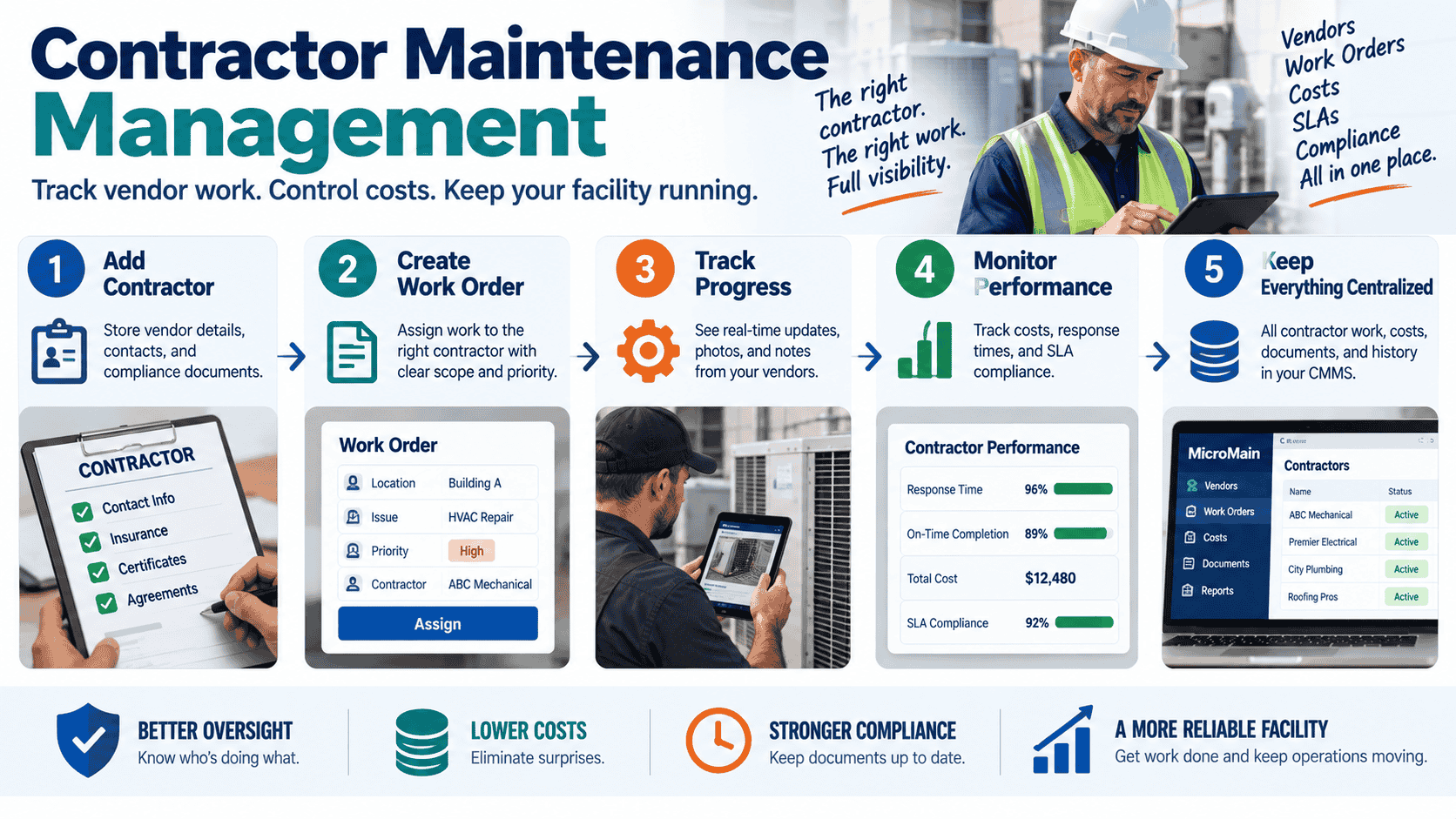
Contractor maintenance management closes that gap. It connects vendor records, work orders, service dates, labor, costs, photos, compliance documents, SLAs, and completion notes in one system, so outsourced work stays accountable instead of disappearing into separate vendor systems.
Contractor work should live in the same system as internal work, not scattered across emails and invoices.
Dispatch, arrival, and completion times turn a promised response time into an accountable one.
Internal teams should verify the work before closing it out.
Insurance, licenses, and certifications need review before work begins, not after an audit.
In This Guide
What Is Contractor Maintenance Management?
Contractor maintenance management is the structured process of managing maintenance work performed by outside providers. These providers may include HVAC contractors, electricians, plumbers, fire and life safety vendors, elevator service providers, controls technicians, calibration specialists, landscaping teams, janitorial providers, machine repair vendors, and emergency service contractors.
In simple terms, contractor maintenance management answers these questions:
- Which contractor is responsible, and what asset or location is affected?
- When was the vendor dispatched, and did they meet the expected response time?
- What work was completed, and what labor, parts, and costs were recorded?
- Did the internal team verify the work?
- Are compliance documents current, and how well does this vendor perform over time?
Why Contractor Maintenance Work Gets Hard to Control
Outside maintenance work often becomes difficult to control because it lives in too many places. A supervisor may request work by phone. The contractor may send a quote by email. The completion note may sit in a PDF. Photos may stay on someone’s phone. The invoice may arrive weeks later. Compliance documents may sit in a shared folder that no one checks until an audit or renewal.
Common problems include:
- Unclear contractor assignments
- No central record of vendor work
- Slow response to urgent calls
- Disputed labor hours or invoices
- Missing before-and-after photos
- Expired insurance or certifications
- Weak documentation for compliance work
- No vendor performance scorecard
- Poor visibility into outsourced maintenance cost
- Contractor work that never becomes part of asset history
In-House Maintenance vs. Contractor Maintenance
| Area | In-House Maintenance | Contractor Maintenance |
|---|---|---|
| Ownership | Internal maintenance team owns the work | Outside vendor completes the work |
| Visibility | Usually easier to track through internal CMMS workflows | Can become scattered across emails, calls, invoices, and vendor portals |
| Cost control | Labor cost may be tracked internally | Cost often depends on rates, quotes, materials, emergency fees, and invoices |
| Documentation | Technicians can close work orders directly | Vendor documentation must be collected, verified, and attached |
| Compliance | Internal procedures can be standardized | Certificates, licenses, safety requirements, and insurance may need tracking |
| Performance review | Manager reviews internal labor and backlog | Manager reviews SLA, quality, response time, cost, and repeat work |
Both types of work should stay visible in the maintenance system. If contractor work does not connect to work orders and asset history, the organization loses important maintenance data.
What Contractor Work Should Be Tracked in a CMMS?
Corrective Repairs
Teams should tie corrective repairs completed by outside vendors to the affected asset or location. This keeps repair history complete and helps managers understand whether a vendor is solving the problem or returning repeatedly for the same issue.
Preventive Maintenance
Some organizations outsource PM tasks such as HVAC service, generator inspections, fire system checks, elevator maintenance, or specialized equipment service. Teams should schedule, complete, and document these tasks like internal PMs.
Specialized Inspections
Contractors may perform inspections that require specific qualifications, tools, or certifications. A CMMS can store inspection results, reports, photos, findings, and follow-up work orders.
Safety or Compliance Work
Safety and compliance-related contractor work may require stronger documentation, including service reports, test results, certificates, inspection forms, permits, and proof that corrective actions were completed.
Emergency Service Calls
Teams should track emergency contractor work carefully because response time, downtime, cost, and documentation are often more important. A CMMS can help compare promised SLA response times with actual arrival and completion data.
Capital or Project Work
Contractors may also complete project work, upgrades, rebuilds, replacements, or asset improvements. Even when the work is not a normal repair, the maintenance record should retain key documents and asset updates.
How CMMS Helps Manage Contractor Maintenance
Contractor Work Orders
A contractor work order gives the outside vendor’s work a clear record. It should show the asset, location, scope, priority, vendor, service date, expected response time, completion status, cost, notes, and attachments.
Vendor Records
Vendor records help teams manage contact information, service categories, insurance documents, certifications, licenses, contract terms, preferred vendor status, and performance history.
SLA and Response Time Tracking
Service level agreements are only useful when teams can measure them. A CMMS can help track dispatch time, arrival time, completion time, priority level, and whether the contractor met response and resolution expectations.
Labor, Parts, and Cost Documentation
Contractor work should include labor hours, service fees, parts, materials, travel charges, emergency fees, and invoice references where practical. This helps maintenance and finance teams understand true outsourced maintenance cost.
Photos, Notes, and Attachments
Photos and attachments create evidence. A contractor work order may include quotes, purchase orders, service reports, inspection reports, before-and-after photos, test results, and invoices.
Compliance Certificates and Insurance Records
Contractors may need certificates of insurance, licenses, safety training documentation, background checks, or trade certifications. A CMMS or connected document process can help maintenance teams confirm required documents stay current before work begins.
Completion Verification
Completion should not depend only on an invoice. Internal teams should verify whether the work was completed, whether the asset returned to service, whether follow-up work is needed, and whether documentation was attached.
Contractor Maintenance Management Workflow
Create or Approve the Request
Confirm the maintenance need before deciding how to route the work.
Decide Internal or Contractor
Determine whether the internal team or an outside vendor should handle the work.
Select the Vendor
Choose based on asset, location, specialty, availability, compliance status, and contract terms.
Create the Work Order
Define clear scope, priority, SLA expectations, and required documentation.
Dispatch and Track
Send the vendor and track response time from dispatch to arrival.
Collect Details
Gather notes, photos, service reports, parts, labor, and cost details.
Verify Completion
Confirm the work internally before closing the work order.
Attach Documentation
Add invoices, reports, certificates, or inspection documents as needed.
Update Asset History
Record the work and create follow-up work orders if required.
Review Vendor Performance
Evaluate cost, quality, response time, and repeat work over time.
What Data Should Be Captured on Contractor Work Orders?
| Data Field | Why It Matters |
|---|---|
| Vendor name | Shows who performed the work |
| Asset or location | Connects contractor work to maintenance history |
| Work scope | Clarifies what the contractor was asked to do |
| Priority level | Supports SLA and response time tracking |
| Dispatch time | Starts response time measurement |
| Arrival time | Shows whether the vendor met response expectations |
| Completion time | Supports downtime and resolution tracking |
| Labor and materials | Supports cost verification |
| Photos and reports | Provides evidence of work performed |
| Internal verification | Confirms the work was accepted before closeout |
Contractor Performance KPIs to Track
| KPI | What It Shows | Why It Matters |
|---|---|---|
| SLA response compliance | Percent of vendor calls answered within expected response time | Shows whether vendors meet urgency expectations |
| First-time fix rate | Percent of contractor jobs completed without repeat visit | Shows work quality and repair effectiveness |
| Average resolution time | How long contractor work takes from dispatch to completion | Shows speed and operational impact |
| Cost variance | Difference between quote, expected cost, and final invoice | Supports budget control |
| Repeat work rate | How often the same vendor returns for the same asset or problem | Highlights quality or scope issues |
| Documentation completion | Percent of contractor work orders with required notes, photos, and reports | Supports audit readiness |
| Compliance document status | Whether vendor licenses, certificates, and insurance records are current | Reduces contractor risk |
Common Contractor Management Mistakes
- Letting contractor work live outside the CMMS: If outsourced maintenance runs through calls, emails, PDFs, and invoices only, the CMMS will not show the true maintenance workload or asset history.
- Not defining the scope clearly: A vague request can lead to scope disputes, repeat visits, or invoices that do not match expectations. Contractor work orders should define the problem, asset, location, expected outcome, and required documentation.
- Ignoring SLA tracking: If teams promise response times but never measure them, vendor accountability becomes difficult. SLA expectations should tie to priority levels and stay tracked in the work record.
- Closing work orders before verification: A contractor may mark work complete, but internal teams should confirm that the asset is operational, documentation is attached, and the team has identified any follow-up work.
- Not tracking vendor documents: Expired insurance, missing certifications, or outdated licenses can create risk. Teams should review vendor documentation before assigning work, especially for safety or compliance-related jobs.
- Reviewing vendors only at renewal time: Vendor performance should get reviewed throughout the year. If issues only come up during renewal, the team may miss months of cost, quality, or response problems.
Contractor Maintenance Checklist
- Create contractor work orders in the CMMS
- Link contractor work to the correct asset or location
- Define scope, priority, and expected outcome
- Track dispatch, arrival, and completion times
- Attach quotes, reports, photos, and invoices
- Record labor, parts, materials, and cost
- Verify completion before closing the work order
- Track insurance, licenses, certifications, and contract documents
- Review SLA performance by priority level
- Monitor repeat work and first-time fix rate
- Compare quoted costs with final invoices
- Review vendor performance regularly
Questions to Ask Vendors Before Assigning Maintenance Work
- Are you qualified and authorized to work on this asset or system?
- Are insurance, certifications, licenses, and safety documents current?
- What response time can you commit to for this priority level?
- What information do you need before dispatch?
- Will you provide photos, readings, reports, or test results?
- How will you bill parts, materials, labor hours, and travel charges?
- What conditions may create additional charges?
- How should the team approve follow-up work, and who verifies completion before approving the invoice?
How Contractor Management Supports Compliance and Audit Readiness
Contractor work can affect safety, quality, compliance, and asset history. If a third party completes an inspection, calibration, repair, or safety-related task, the organization may still need clear records showing what happened.
Audit-ready contractor records may include service reports, inspection results, dates, names, certificates, photos, parts, corrective actions, and work order closeout notes. The CMMS can help organize this information so teams do not have to search through emails and invoices during an audit or review.
How Contractor Management Supports Budget Planning
Outsourced maintenance can become expensive when emergency calls, repeat visits, premium labor, travel fees, and material markups go untracked. Contractor work orders help maintenance leaders see where vendor spend is going and whether costs tie to specific assets, locations, or recurring failures.
This data can support better budget discussions, contract negotiations, repair-versus-replace decisions, and vendor renewals.
How MicroMain Supports Contractor and Vendor Maintenance Workflows
MicroMain supports maintenance teams with CMMS capabilities such as work order management, preventive maintenance scheduling, asset management, inventory tracking, reporting, and maintenance documentation.
For contractor maintenance management, the practical goal is to keep outsourced work visible and connected to maintenance history. When contractor work runs through work orders, teams can document scope, assignment, response, completion, costs, attachments, and follow-up work in a more organized way.
A CMMS does not replace vendor oversight. Maintenance leaders still need clear contracts, qualified vendors, internal verification, and review processes. However, a CMMS can help create the recordkeeping and visibility needed to manage contractors more effectively.
Related Resources
Final Takeaway
Contractor maintenance management helps teams control outsourced work instead of letting it disappear into emails, phone calls, invoices, and separate vendor systems. A strong process tracks who performed the work, what asset was affected, what scope was assigned, when the contractor responded, what got completed, what it cost, and whether the work met expectations.
When contractor work runs through a CMMS, maintenance teams gain better visibility into vendor performance, compliance documentation, outsourced maintenance cost, asset history, and follow-up work. The goal is simple: outside vendors may perform the work, but the maintenance team should still own the visibility, records, and accountability.
Ready to Bring Contractor Work Into One System?
See how MicroMain can help track vendor work orders, SLA response times, costs, compliance documents, and performance from one system.
Frequently Asked Questions
Understanding Contractor Management
What is contractor maintenance management?
Contractor maintenance management is the process of assigning, tracking, verifying, and documenting maintenance work performed by outside vendors or third-party contractors.
How does a CMMS help manage contractors?
A CMMS helps manage contractors by tracking vendor work orders, assignments, response times, costs, notes, photos, compliance documents, and completion verification in one system.
What contractor work should be tracked in a CMMS?
Teams should track outsourced repairs, preventive maintenance, inspections, safety work, emergency service calls, specialized maintenance, and project-related contractor work.
What is vendor maintenance management?
Vendor maintenance management is the process of managing external service providers, including vendor records, service history, contract terms, compliance documents, performance, and costs.
How do you track contractor SLA performance?
Contractor SLA performance can be tracked by recording dispatch time, arrival time, completion time, priority level, response expectations, and whether the vendor met the agreed target.
Documentation, KPIs, and Compliance
What documents should be stored for maintenance contractors?
Common documents include certificates of insurance, licenses, certifications, safety documents, contracts, service reports, inspection results, quotes, purchase orders, and invoices.
How do contractor work orders improve asset history?
Contractor work orders connect outsourced repairs, inspections, parts, notes, reports, and costs to the correct asset record, making maintenance history more complete.
What KPIs should be used for contractor maintenance management?
Useful KPIs include SLA response compliance, first-time fix rate, average resolution time, cost variance, repeat work rate, documentation completion, and compliance document status.
How can CMMS help with outsourced maintenance costs?
A CMMS can help track contractor labor, materials, service fees, emergency charges, quote versus invoice variance, repeat visits, and costs by asset or location.
Can CMMS software improve contractor compliance?
CMMS software can support contractor compliance by organizing work records, inspection documentation, certificates, insurance records, safety documents, and audit-ready maintenance history. The organization still needs to define and follow its compliance requirements.