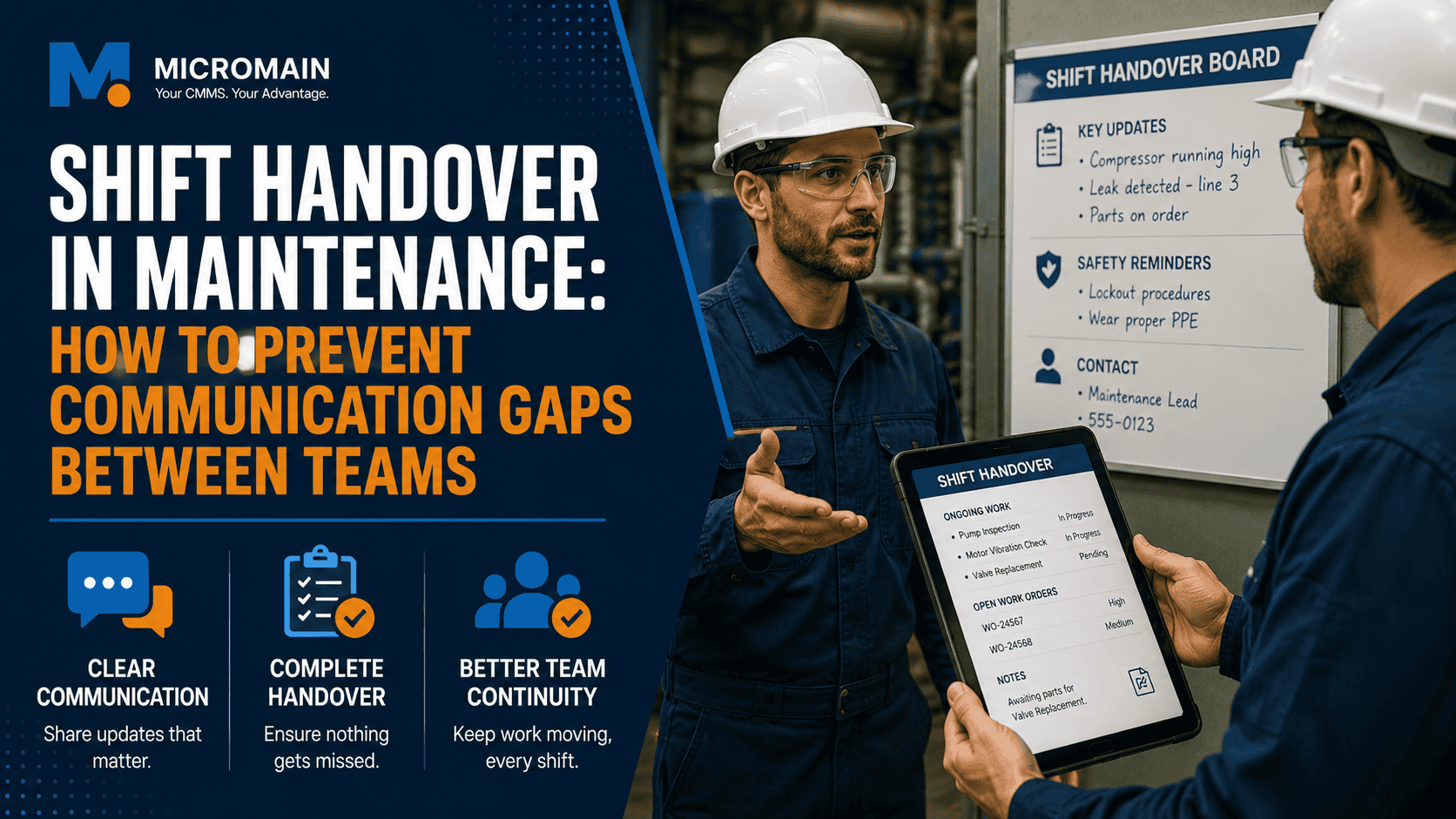
Shift Handover in Maintenance: How to Prevent Communication Gaps Between Teams
Maintenance work does not stop just because one shift ends. An asset may still be running with a warning, a repair may be 70 percent complete, or a safety issue may require follow-up. If that information does not transfer clearly, the next shift starts with gaps — technicians repeat diagnostics, miss carry-over work, or overlook equipment risks.
A good maintenance shift handover gives the incoming team enough context to continue the work safely and effectively, connecting open work orders, equipment status, safety notes, downtime events, parts needs, and follow-up actions into one clear handoff.
Weak handovers create the same risk as any other maintenance control gap: lost work and missed safety issues.
Without one, everyone assumes someone else is handling it, and tasks fall between teams.
What was done, why it’s temporary, how long it can stay, and what the permanent fix requires.
It should reference the work orders and asset records that need attention, not duplicate them.
In This Guide
What Is Shift Handover in Maintenance?
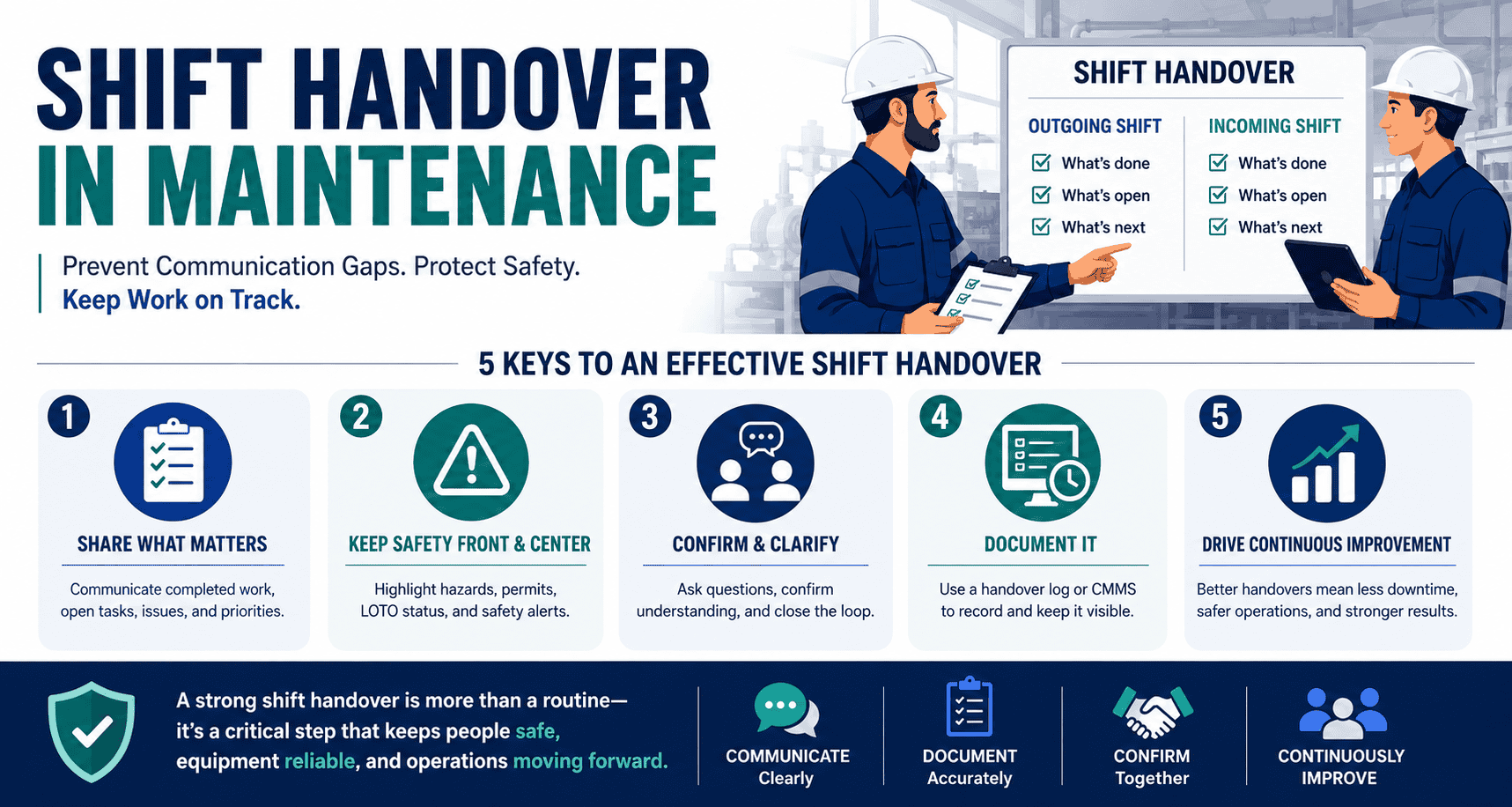
Shift handover in maintenance is the structured transfer of maintenance information from one technician, team, or supervisor to the next shift. It helps the incoming team understand current maintenance conditions, open work, asset risks, safety concerns, and actions that need to continue after the outgoing shift leaves.
In simple terms, a maintenance handover should answer these questions:
- What work was completed this shift, and what is still open or in progress?
- Which assets are running with known issues?
- Which work orders need immediate attention?
- Which parts, tools, or contractors are still needed?
- What safety issues, permits, or temporary controls are active?
- Who owns the next action?
A handover can happen between day and night shifts, weekday and weekend teams, in-house and contractor teams, or supervisors and technicians. The goal is continuity — the incoming team should not have to restart the investigation from zero.
Why Maintenance Shift Handovers Fail
Most shift handover failures are not caused by laziness. They happen because the process depends too much on memory, informal communication, or incomplete records.
| Failure Point | What Happens | Maintenance Impact |
|---|---|---|
| Verbal-only handover | Important details are shared quickly or forgotten | Incoming shift misses risks, repeats diagnostics, or loses context |
| Paper notes | Logs are hard to search or connect to work orders | Asset history and follow-up become unreliable |
| No carry-over tracking | Open work is not clearly assigned to the next shift | Tasks fall between teams |
| Poor equipment status notes | Assets running with faults are not documented clearly | Risk increases during the next shift |
| No safety flag process | Hazards, permits, or lockout status are not visible | Safety and compliance exposure increases |
| Disconnected work orders | Shift notes are not tied to CMMS records | Managers cannot see what happened or what changed |
What Should Be Included in a Maintenance Shift Handover?
A strong shift handover should be structured enough to capture important information, but simple enough that technicians will actually use it.
Open Work Orders
List open work orders that still need attention, including the work order number, asset, current status, priority, assigned owner, and next action. This prevents the incoming shift from guessing what is still active.
Carry-Over Work
Carry-over work is any task that started during one shift but needs to continue into the next. It should include the current progress, what technicians completed, what remains, and any blockers.
Equipment Status
Document assets that are down, running in degraded condition, operating under temporary repairs, waiting for parts, or under monitoring for possible failure.
Safety Issues
Include active hazards, lockout or tagout status, permits, bypassed controls, near misses, required PPE, or areas that need restricted access.
Downtime Events
Record downtime start time, current status, suspected cause, work completed, and whether the team notified production, operations, or facilities.
Parts and Materials Needed
List parts ordered, parts picked, parts not available, vendor lead times, or materials waiting for the next shift.
Temporary Repairs
Temporary fixes should never pass forward casually. Document what technicians did, why it is temporary, how long it can remain in place, and what permanent corrective action is needed.
Contractor or Vendor Work
Include vendor visits, contractor notes, work completed by outside providers, pending return visits, and any documentation still needed.
Follow-Up Actions
Every handover should make ownership clear. If a task needs follow-up, document who owns it, when it is due, and how the team should verify it.
Shift Handover Log vs. Work Order: What Is the Difference?
| Record Type | Purpose | Example |
|---|---|---|
| Shift handover log | Summarizes shift-level context, open issues, risks, and carry-over work | Night shift notes that Pump P-204 is running but needs seal inspection on day shift |
| Work order | Tracks a specific maintenance task from request through completion | WO-3842 to inspect and replace the seal on Pump P-204 |
| Asset history | Stores maintenance activity tied to a specific asset | Past repairs, PMs, parts, and notes for Pump P-204 |
A shift handover log should not replace work orders. Instead, it should point to the work orders, asset records, and follow-up actions that need attention.
How CMMS Helps Improve Maintenance Shift Handover
Centralized Work Order Status
A CMMS helps the incoming shift see which work orders are open, in progress, waiting for parts, completed, or overdue. This reduces the need to depend only on verbal updates.
Digital Handover Notes
Digital notes make handover information searchable, timestamped, and easier to connect with work orders or assets.
Carry-Over Task Tracking
Teams can assign, update, and review carry-over tasks so work does not disappear between shifts.
Asset History
Incoming technicians can review past work, PMs, failure notes, parts used, and recurring problems before continuing a repair.
Photos and Attachments
Photos can show equipment condition, temporary repairs, damaged parts, readings, or safety concerns more clearly than text alone.
Supervisor Visibility
Supervisors can review shift handover records, monitor unresolved work, and confirm that the team acknowledged high-risk issues.
Shift Handover Workflow for Maintenance Teams
Review Open Work Orders
Check open work orders before the shift ends to confirm what is still active.
Update Each Work Order
Add current status, notes, parts, and next action to every active work order.
Flag Critical Items
Flag critical assets, safety concerns, downtime events, and temporary repairs.
Document Carry-Over Tasks
Record carry-over tasks with owner, priority, and expected follow-up.
Attach Supporting Evidence
Add photos, readings, or supporting documents when they help clarify the situation.
Brief the Incoming Shift
Walk the incoming shift through the CMMS record or digital handover log.
Confirm Acknowledgment
Confirm that the incoming shift acknowledges high-risk items before the outgoing team leaves.
Review at Supervisor Check-In
Review unresolved handover items during the next supervisor check-in.
Shift Handover Checklist for Maintenance Teams
| Checklist Item | What to Confirm |
|---|---|
| Open work orders | Status, priority, assigned owner, and next action are updated |
| Carry-over work | Incomplete tasks are clearly documented for the next shift |
| Critical assets | Assets running with faults or degraded performance are flagged |
| Safety concerns | Hazards, permits, LOTO status, or temporary controls are documented |
| Downtime events | Downtime status, cause, and next steps are recorded |
| Parts and materials | Parts needed, ordered, or missing are listed |
| Temporary fixes | Temporary repairs include monitoring needs and a permanent fix plan |
| Contractors | Vendor work, return visits, and documentation needs are noted |
| Follow-up actions | Owner, due date, and verification method are clear |
Common Shift Handover Mistakes
- Relying only on verbal updates: Verbal updates are useful, but they should not be the only record — important details can be forgotten or misunderstood.
- Not updating work orders before handover: If the work order status is outdated, the incoming shift may waste time investigating work that is already completed or blocked.
- Skipping safety and temporary repair notes: Teams should clearly document and acknowledge safety issues, bypasses, permits, and temporary repairs.
- No owner for carry-over work: Carry-over work needs an assigned owner, or everyone may assume someone else is handling it.
- Treating handover as a formality: A rushed handover can create downtime, rework, and accountability gaps — the handover should be a controlled work-management step.
Maintenance Shift Handover KPIs
| KPI | What It Shows |
|---|---|
| Carry-over completion rate | Whether the team completes tasks passed to the next shift |
| Unacknowledged high-risk handover items | Whether critical safety or asset issues were missed |
| Repeat troubleshooting events | Whether incoming shifts are repeating work already done |
| Open work order aging by shift | Whether work is stalling between shifts |
| Downtime events with complete notes | Whether downtime records include enough handover context |
| Incomplete handover records | Whether teams are skipping required handover fields |
How MicroMain Supports Maintenance Communication and Work Order Visibility
MicroMain supports maintenance teams with CMMS capabilities such as work order management, preventive maintenance scheduling, asset management, inventory tracking, reporting, and maintenance documentation.
For shift handover in maintenance, the practical goal is to keep work order status, asset history, technician notes, parts information, photos, and follow-up actions visible to the people who need them. When maintenance teams use the CMMS consistently, handovers become less dependent on memory and more connected to actual work records.
A CMMS does not replace supervisor judgment or team communication. It supports the process by making critical maintenance information easier to document, transfer, search, and review.
Related Resources
Final Takeaway
Shift handover in maintenance is one of the most important communication points in daily maintenance work. If the handover is weak, work gets lost, technicians repeat diagnostics, the team may miss safety risks, and incoming technicians start with incomplete context. If the handover is structured, the next shift can continue work with better visibility, accountability, and confidence.
The best maintenance handovers connect people, work orders, asset history, equipment status, safety notes, parts needs, and follow-up actions. A CMMS helps by keeping those records centralized and easier to review between shifts. The goal is simple: no work lost, no critical context missed, and no technician starting the next shift blind.
Ready to Close the Gap Between Shifts?
See how MicroMain can help centralize work order status, asset history, and handover notes so every shift starts with full context.
Frequently Asked Questions
Understanding Shift Handover
What is shift handover in maintenance?
Shift handover in maintenance is the structured transfer of work order, asset, safety, equipment status, and follow-up information from one shift to the next.
Why is maintenance shift handover important?
Maintenance shift handover is important because it prevents lost work, repeated troubleshooting, missed safety issues, incomplete repairs, and poor communication between teams.
What should be included in a maintenance shift handover?
A maintenance shift handover should include open work orders, carry-over work, equipment status, safety concerns, downtime events, parts needed, temporary repairs, contractor activity, and follow-up actions.
What is a maintenance handover log?
A maintenance handover log is a record used to document shift-level maintenance updates, open issues, asset status, and tasks that need attention from the next shift.
What is carry-over work in maintenance?
Carry-over work is maintenance work that started during one shift but needs to continue or be monitored by the next shift.
Improving Handover With CMMS
How does CMMS help with shift handover?
A CMMS helps with shift handover by centralizing work order status, asset history, technician notes, photos, parts information, carry-over tasks, and supervisor visibility.
What is the difference between a shift handover log and a work order?
A shift handover log summarizes shift-level context and carry-over items. A work order tracks a specific maintenance task from request to completion.
How can teams prevent lost work between shifts?
Teams can prevent lost work by updating work orders before handover, documenting carry-over tasks, assigning owners, flagging safety issues, and using a searchable CMMS record.
What are common shift handover mistakes?
Common mistakes include relying only on verbal updates, failing to update work orders, skipping safety notes, not assigning carry-over ownership, and treating handover as a formality.
Can mobile CMMS improve shift handover?
Yes. Mobile CMMS can improve shift handover by letting technicians update work orders, add photos, record notes, and review asset history from the field before the shift ends.