Asset Criticality Analysis: How to Prioritize Maintenance Work, PMs, and Spare Parts
Maintenance teams rarely have unlimited time, labor, budget, or spare parts. That makes one question especially important: What should we focus on first?
Without a clear way to answer that question, everything can feel urgent. For example, technicians may work on low-risk requests while critical assets wait. Meanwhile, PM schedules may treat every asset the same. Spare-parts budgets may also cover items that carry very different levels of operational risk. As a result, the backlog can grow without a clear priority order.
Asset criticality analysis helps solve that problem. Specifically, it gives maintenance teams a structured way to rank assets by the consequences of failure. Teams can then focus resources where risk and business impact are greatest.
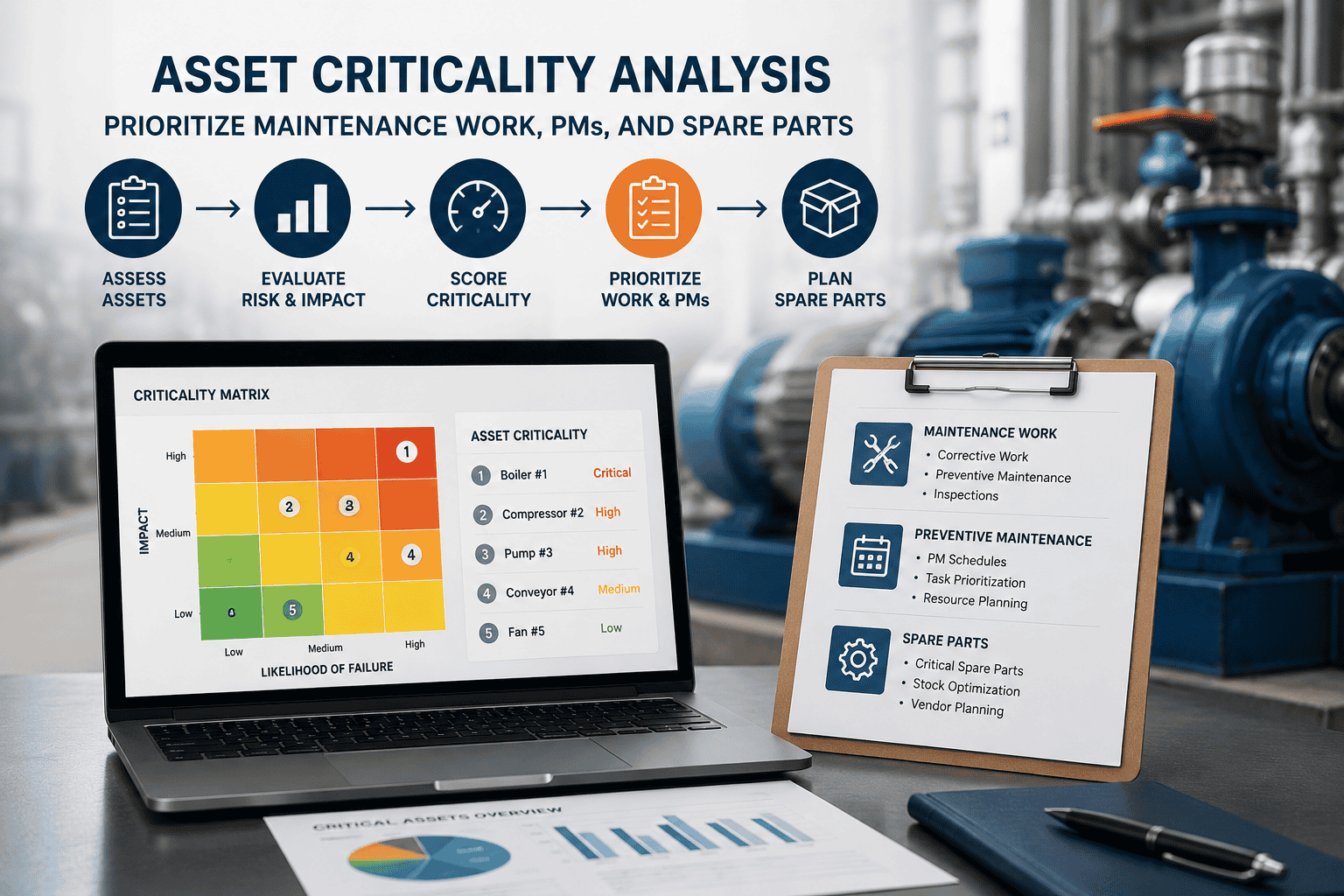
What Is Asset Criticality Analysis?
Asset criticality analysis is the process of evaluating and ranking assets based on the consequences of failure.
An asset becomes more critical when its failure creates a greater impact on safety, operations, production, service delivery, compliance, maintenance cost, customers, the environment, downtime, or replacement difficulty.
For example, a production-line motor may stop an entire facility, so it can rank above a nonessential exhaust fan. Likewise, a fire-protection system may rank highly because it affects safety and compliance. A backup generator may also rank highly because it supports essential operations during a power interruption.
Why Asset Criticality Matters in Maintenance
Maintenance teams make prioritization decisions every day. For instance, they decide which work orders come first, which PMs cannot be missed, which parts need stock, and which equipment needs closer inspection or replacement planning.
Without asset criticality, teams may respond to whoever complains the loudest. They may also focus on the most recent failure or the easiest request. In contrast, a criticality model gives maintenance leaders an objective way to direct limited resources toward the assets with the greatest safety, operational, compliance, reliability, and financial impact.
What Makes an Asset Critical?
Asset criticality depends on the consequences of failure. Although organizations use different criteria, most practical models consider safety, operations, downtime, cost, compliance, redundancy, and spare-parts availability.
Safety Impact
An asset may rank as highly critical when failure creates injury risk, unsafe working conditions, hazardous exposure, fire risk, or the loss of protective systems.
- Fire protection systems
- Emergency lighting
- Pressure systems
- Safety interlocks
- Ventilation systems
- Lifting equipment
- Electrical distribution equipment
Therefore, teams should evaluate safety-related assets carefully because failure can create consequences far beyond repair costs.
Operational Impact
Operational impact measures how strongly an asset affects daily work. For example, an asset may rank as critical when failure stops production, interrupts service, limits capacity, or prevents the organization from meeting operational goals.
- Production line equipment
- Pumps and compressors
- Conveyors
- HVAC systems in critical areas
- Material handling equipment
- Utility systems
Downtime Impact
Some assets can fail with little immediate consequence. However, others can stop an entire line, close a building area, delay service, or disrupt a major schedule.
- How long can the asset be unavailable?
- Does backup equipment exist?
- How quickly can the asset be repaired?
- Does downtime affect other systems?
- Could failure create cascading problems?
As a result, an asset with no redundancy and high downtime impact may deserve a higher criticality ranking.
Cost Impact
Cost impact extends beyond the repair itself. In addition, it may include labor, parts, contractor expense, emergency purchasing, expedited shipping, lost production, overtime, rental equipment, replacement cost, and collateral damage.
Therefore, even a low-cost component can create a high-cost event when failure shuts down an important process.
Compliance Impact
Some assets support regulatory, inspection, safety, environmental, or contractual requirements. Consequently, failure can create documentation problems, failed inspections, penalties, or operating restrictions.
- Fire and life safety systems
- Medical facility systems
- Environmental controls
- Pressure vessels
- Emergency power systems
- Food safety equipment
- Water treatment systems
Spare Parts Lead Time
An asset may also rank higher when repairs require parts that are hard to source, custom-made, expensive, obsolete, or subject to long lead times.
- Is the part stocked?
- Is a substitute available?
- How long is the supplier lead time?
- Is the vendor reliable?
- Is the part obsolete or unusually expensive?
- Can the asset operate safely without it?
Asset Criticality Analysis vs. Asset Condition
Asset criticality and asset condition are related. However, they answer different questions.
- Asset criticality measures the importance of an asset based on the consequences of failure.
- Asset condition measures the current health or state of the asset.
For example, an asset can be highly critical while remaining in good condition. In contrast, another asset may be in poor condition but have low criticality because its failure would create limited impact.
| Asset | Criticality | Condition | Maintenance Priority |
|---|---|---|---|
| Main production compressor | High | Fair | High |
| Office exhaust fan | Low | Poor | Medium or low |
| Emergency generator | High | Good | Monitor and maintain |
| Noncritical storage pump | Low | Good | Standard PM |
In short, criticality explains the consequences of failure, while condition shows current health and urgency. Together, these views support better maintenance decisions.
How to Build an Asset Criticality Ranking
Asset criticality analysis does not need to be complicated. Instead, a practical scoring model can help maintenance teams rank assets consistently.
Identify the Assets to Evaluate
First, build a clear asset list. It may include production equipment, facility systems, HVAC assets, electrical systems, pumps, motors, compressors, conveyors, safety systems, vehicles, material-handling equipment, utilities, and critical infrastructure.
If the asset list is large, begin with equipment that matters most to safety, operations, compliance, or production. However, do not let imperfect data stall the process. Start with the highest-risk assets, and then improve the model over time.
Define Criticality Criteria
Next, choose the criteria that matter most to your organization. Common options include safety, operations, downtime, maintenance cost, compliance, environmental impact, spare-parts lead time, redundancy, and customer or service impact.
Above all, keep the model understandable. When the scoring system becomes too complex, teams may stop using it consistently.
Score Each Asset
Then, use a simple scoring scale for every criterion.
| Score | Impact Level | Description |
|---|---|---|
| 1 | Low | Failure has minimal impact. |
| 2 | Moderate | Failure creates limited disruption. |
| 3 | High | Failure creates significant disruption. |
| 4 | Critical | Failure creates major safety, operational, compliance, or financial impact. |
Afterward, score each asset across the selected criteria.
| Example Criterion | Score |
|---|---|
| Safety impact | 4 |
| Operational impact | 4 |
| Downtime impact | 4 |
| Maintenance cost | 3 |
| Compliance impact | 2 |
| Spare parts lead time | 3 |
| Total Score | 20 |
Group Assets by Criticality
Next, group the scored assets into practical categories. You can then adjust the ranges to fit your model and business needs.
| Criticality Level | Example Score Range | Maintenance Approach |
|---|---|---|
| Critical | 18–24 | Prioritize PMs, spares, monitoring, and rapid response. |
| High | 13–17 | Maintain strong PMs and backlog visibility. |
| Medium | 8–12 | Use standard PMs and planned corrective work. |
| Low | 1–7 | Use a basic strategy and periodically review PM value. |
Apply the Rankings to Maintenance Decisions
Finally, apply the rankings to daily decisions. Use them to identify PMs that must stay on schedule, work orders that need priority, assets that need stronger inspections, parts that require stock, backlog items that create the most risk, and equipment that needs failure or replacement analysis.
Ultimately, a ranking has limited value when it sits in a spreadsheet and never changes a decision.
How Asset Criticality Improves Preventive Maintenance
Preventive maintenance programs often underperform when teams treat every asset the same. In practice, critical assets need more structured PM tasks, clearer instructions, better documentation, and closer compliance tracking. Meanwhile, low-criticality assets may not require the same level of effort.
- Which PMs should never be skipped?
- Which assets need more frequent inspections?
- Which PM tasks should include detailed checklists?
- Which PMs should generate corrective work when issues are found?
- Which assets may be over-maintained?
- Which PMs should be reviewed first?
For example, a monthly inspection on a high-criticality compressor may matter more than a routine check on a low-criticality fan. Therefore, when labor is limited, criticality helps teams decide what to complete first.
For more practical PM guidance, see MicroMain’s articles on preventive maintenance examples and preventive maintenance compliance.
How Asset Criticality Improves Spare Parts Planning
Spare-parts decisions should connect directly to asset criticality. For example, a team may stock a part when it supports a critical asset, has a long lead time, or would cause significant downtime if unavailable.
- Which parts are critical spares?
- Which parts need reorder points or safety stock?
- Which parts can be ordered only when needed?
- Which parts should be linked to specific assets?
- Which suppliers require closer management?
In other words, the goal is not to stock everything. The goal is to stock the right parts based on operational risk.
How Asset Criticality Helps Manage Maintenance Backlog
A long backlog can hide risk when every work order looks similar. Therefore, criticality helps supervisors and planners identify the items that need attention first.
Overall, backlog management should consider both work-order priority and the criticality of the affected asset.
How Asset Criticality Supports Maintenance KPIs
Asset criticality can also make maintenance KPIs more useful. Instead of tracking only organization-wide metrics, teams can segment performance by criticality level.
- PM compliance for critical assets
- Downtime for high-criticality assets
- Backlog aging by criticality
- Repeat failures on critical assets
- Mean time to repair for critical assets
- Parts stockouts affecting critical assets
- Maintenance cost by criticality group
A team may have strong overall PM compliance while still missing PMs on its most important assets. Criticality-based reporting makes that risk clearer. See maintenance KPIs for additional metric examples.
Common Asset Criticality Mistakes
Treating Criticality as a One-Time Project
First, review asset criticality periodically. Asset importance can change as production shifts, equipment ages, facilities expand, regulations change, or spare parts become harder to source.
Using Too Many Criteria
Likewise, a model with too many categories becomes difficult to maintain. Start with the criteria that matter most, and add complexity only when it improves decisions.
Ignoring Technician Input
In addition, technicians often know which assets fail frequently, which parts are difficult to source, and which equipment creates recurring problems. Their input can improve scoring accuracy.
Ranking Only by Replacement Cost
However, an expensive asset is not always the most critical. A lower-cost asset may rank higher when failure causes major downtime, safety exposure, or compliance risk.
Not Connecting Criticality to CMMS Workflows
Criticality should influence PM schedules, work-order priorities, backlog reviews, spare-parts planning, and reporting. Otherwise, the rating becomes just another data field.
Failing to Separate Criticality From Condition
Finally, remember that a critical asset matters because of the consequences of failure. A poor-condition asset creates concern because failure may be more likely. Therefore, use both views to prioritize risk.
How CMMS Software Supports Asset Criticality Analysis
A CMMS can help maintenance teams apply asset criticality in daily work. Specifically, it can connect ratings to asset records, work orders, PMs, parts, history, backlog, and reporting.
- Maintain structured asset records
- Assign criticality ratings
- Link work orders to assets
- Schedule PMs based on asset importance
- Track maintenance and failure history
- Monitor downtime and repeat failures
- Connect spare parts to critical assets
- Prioritize backlog
- Report KPIs by asset group
- Document inspections and corrective work
As a result, the CMMS becomes more useful when criticality connects to real workflows. Teams can flag a high-criticality asset so its PMs, parts, work orders, and reports receive appropriate attention.
How MicroMain Supports Asset-Based Maintenance Prioritization
MicroMain supports maintenance teams with CMMS capabilities for asset management, work-order management, preventive maintenance scheduling, inventory tracking, reporting, and maintenance documentation.
When teams include criticality ratings in asset records and work planning, maintenance leaders can make better decisions about PMs, backlog, spare parts, and reporting. Ultimately, the goal is simple: focus maintenance effort where failure risk matters most.
Turn Asset Criticality Into Daily Maintenance Priorities
See how MicroMain can help your team connect asset records, work orders, preventive maintenance, inventory, backlog, and reporting in one CMMS.
Final Takeaway
Asset criticality analysis helps maintenance teams prioritize limited resources. Instead of treating every asset, work order, PM, and spare part the same, teams can direct attention toward assets that create the greatest safety, operational, compliance, downtime, or cost impact.
In practice, the model does not need to be complicated. Start with a clear asset list, define understandable criteria, rank assets consistently, group them by criticality, and then use the rankings to guide maintenance decisions.
Finally, connecting asset criticality to CMMS workflows can improve preventive maintenance, spare-parts planning, backlog management, KPI reporting, and the overall maintenance strategy.
Related MicroMain Guides
Frequently Asked Questions
What is asset criticality analysis?
Asset criticality analysis is a process for ranking assets based on the consequences of failure, including safety, operations, downtime, cost, compliance, and business impact.
How do you determine asset criticality?
Asset criticality is usually determined by scoring assets against criteria such as safety impact, operational impact, downtime impact, maintenance cost, compliance impact, redundancy, and spare parts availability.
What makes an asset critical?
An asset is critical when its failure could create a major safety risk, operational disruption, compliance issue, high cost, long downtime, or significant service impact.
How does asset criticality improve maintenance planning?
Asset criticality helps maintenance teams prioritize work, schedule PMs, manage backlog, stock critical spare parts, and focus resources on the highest-risk assets.
How does asset criticality affect preventive maintenance?
Critical assets may require more structured PM tasks, stronger compliance tracking, better documentation, and more frequent review than low-criticality assets.
How does asset criticality affect spare parts inventory?
Criticality helps teams decide which spare parts should be stocked, which need reorder points or safety stock, and which can be ordered only when needed.
What is the difference between asset criticality and asset condition?
Asset criticality measures the consequences of failure. Asset condition measures the current health of the asset. Both are useful for maintenance prioritization.
How often should asset criticality be reviewed?
Asset criticality should be reviewed periodically and whenever operations, asset use, regulations, equipment configuration, or spare parts availability change.
Can CMMS software help with asset criticality analysis?
Yes. A CMMS can store asset records, assign criticality ratings, link work orders and PMs to assets, track history, connect parts, prioritize backlog, and report performance by asset group.
Why is asset criticality important for maintenance teams?
Asset criticality helps maintenance teams prioritize limited labor, budget, preventive maintenance effort, spare parts, and backlog attention based on risk and business impact.