Meter-Based Maintenance in CMMS: How to Trigger PMs by Runtime, Mileage, Cycles, and Readings
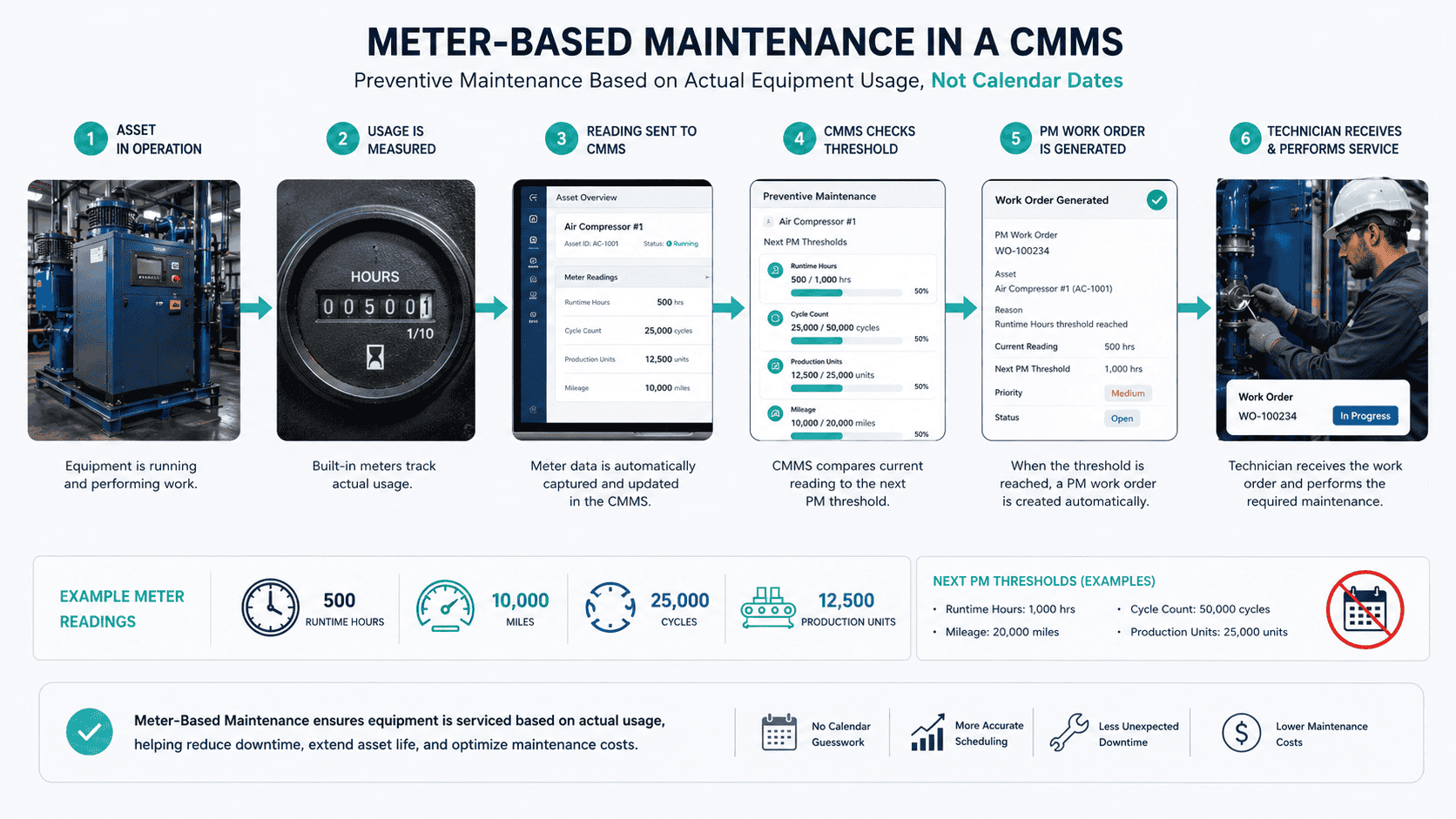
Meter-based maintenance is a preventive maintenance strategy that triggers work based on actual equipment usage. Common triggers include runtime hours, mileage, cycles, units produced, and other measurable readings.
In a CMMS, teams can connect those readings to specific assets. As a result, the system can generate preventive maintenance work orders when an asset reaches a defined threshold.
Quick Answer
Meter-based maintenance schedules preventive maintenance according to measured asset usage. A CMMS records meter values for an asset and generates a PM work order when the reading reaches a defined threshold, such as 500 runtime hours, 10,000 miles, or 25,000 cycles.
Key Takeaways
- Meter-based PM is useful when asset wear depends more on usage than on elapsed time.
- Common meters include runtime hours, mileage, cycle counts, starts and stops, units produced, and gallons pumped.
- Accurate and timely readings are essential because poor data can trigger PMs too early, too late, or not at all.
- Most maintenance programs still need both calendar-based and meter-based preventive maintenance.
- A CMMS helps connect asset readings, thresholds, PM templates, work orders, history, and reporting.
What Is Meter-Based Maintenance?
Meter-based maintenance schedules work according to measured asset usage. Instead of creating a PM every week, month, or quarter regardless of use, the CMMS waits until the asset reaches a defined reading.
Common meter types include runtime hours, mileage, cycle counts, production counts, starts and stops, and gallons pumped. Some teams also record temperature, pressure, vibration, or flow. However, those readings often support condition monitoring rather than usage-based PM.
Why Are Calendar-Based PMs Not Always Enough?
Calendar-based preventive maintenance is simple and useful. It works well for monthly inspections, annual safety checks, seasonal service, and compliance-driven tasks.
However, calendar schedules can become inaccurate when wear depends heavily on use. A heavily used asset may need service sooner than the calendar suggests. Meanwhile, an idle asset may receive maintenance before it needs it.
| Maintenance Type | Trigger | Best Fit | Potential Risk |
|---|---|---|---|
| Calendar-based PM | Time interval, such as monthly or quarterly | Inspections, seasonal work, compliance tasks, routine checks | May over-maintain idle assets or under-maintain heavily used assets |
| Meter-based PM | Usage threshold, such as 500 hours or 10,000 miles | Assets whose wear is closely tied to use | Depends on accurate and timely readings |
| Condition-based maintenance | Measured condition, such as vibration or temperature trend | Critical assets where condition can be monitored | Requires reliable readings, interpretation, and follow-up |
Key point: Meter-based maintenance does not replace every calendar PM. Instead, it gives teams another trigger when actual usage better reflects asset wear.
Common Meter-Based Maintenance Examples
| Asset Type | Example Meter | Example PM Trigger |
|---|---|---|
| Fleet vehicle | Mileage or engine hours | Oil change every 5,000 miles or inspection every 250 engine hours |
| Generator | Runtime hours | Service every 250 run hours |
| Air compressor | Runtime or load hours | Filter replacement or oil service after defined runtime |
| Forklift | Operating hours | Inspection or service after a set number of hours |
| Conveyor | Cycle count or operating hours | Inspection after defined cycles or runtime |
| Pump | Runtime hours or gallons pumped | Seal inspection or lubrication after a usage threshold |
| Production machine | Units produced or cycles | Inspection after a set production count |
When Does Meter-Based Maintenance Make Sense?
Meter-based maintenance makes the most sense when asset wear closely follows usage. It is especially useful when identical assets operate at very different intensity levels.
Use It When Usage Varies
If one asset runs daily and another identical asset runs only occasionally, a fixed monthly PM may not reflect their real maintenance needs. Meter readings allow the team to service each asset according to actual use.
Use It When Manufacturer Guidance Is Usage-Based
Many equipment manuals recommend service intervals based on mileage, runtime hours, or cycles. A CMMS can convert those recommendations into scheduled work orders.
Use It for Fleet and Mobile Assets
Vehicles, forklifts, carts, and mobile equipment often accumulate wear through mileage, engine hours, or use cycles. Therefore, usage-based PM can align service with real operating demand.
Use It for High-Use Production Assets
Production equipment, conveyors, pumps, compressors, and packaging assets may run harder during peak periods. Meter-based PM helps keep the schedule aligned with that higher level of use.
What Data Does Meter-Based Maintenance Need?
Meter-based maintenance depends on accurate readings and clear thresholds. If readings are late, missing, inconsistent, or tied to the wrong asset, the PM schedule becomes unreliable.
| Data Element | Why It Matters |
|---|---|
| Asset record | Connects the reading to the correct equipment |
| Meter type | Defines whether the reading is hours, miles, cycles, starts, units, or another value |
| Current reading | Shows current asset usage |
| PM trigger threshold | Defines when the next work order should generate |
| Reading date | Shows when the value was captured |
| Reading source | Identifies whether the reading came from a technician, operator, mobile user, or integration |
| Reset or rollover rules | Prevents false triggers when a meter resets or rolls over |
| Work order history | Shows whether PMs were completed after the threshold was reached |
How Do You Set Up Meter-Based Maintenance in a CMMS?
A good setup process does more than collect readings. It ensures that the correct work order generates at the correct usage interval.
Identify Assets That Need Usage-Based PM
Start with assets whose wear is strongly related to use, such as vehicles, generators, forklifts, compressors, pumps, conveyors, motors, and production equipment.
Choose the Right Meter Type
Select a meter that reflects the way the asset wears. Runtime may fit a generator, mileage may fit a vehicle, and cycle count may fit packaging equipment.
Define the PM Trigger
Set the usage threshold that should generate the PM work order. Use manufacturer recommendations, maintenance history, asset criticality, failure patterns, and operating experience.
Decide Who Captures Readings
Technicians, operators, supervisors, mobile users, or system integrations may capture readings. Keep the process simple enough that readings remain current.
Create the PM Work Order Template
Include the asset, task instructions, required parts, safety notes, estimated labor, checklist items, and closeout requirements.
Review Early Triggers and Adjust
Review the first few cycles. If work orders trigger too early, too late, or not at all, adjust thresholds, meter rules, or data-entry habits.
| Setup Step | Key Question | CMMS Output |
|---|---|---|
| Identify assets | Which assets wear based on usage? | Candidate asset list |
| Choose meter type | What reading best represents usage? | Meter field tied to asset |
| Set trigger | When should service happen? | PM threshold |
| Capture readings | Who updates readings and how often? | Current meter history |
| Create PM template | What work should be performed? | Meter-triggered work order |
| Review and adjust | Are triggers accurate? | Improved PM schedule |
Meter-Based Maintenance vs. Time-Based Maintenance
Most maintenance programs need both approaches. Time-based PM works well for inspections, safety checks, seasonal tasks, and compliance work. Meter-based PM works well when usage drives wear.
- The task follows a calendar requirement.
- The asset degrades even while idle.
- The task supports safety or compliance.
- The asset has no reliable usage meter.
- Usage varies significantly.
- Wear follows hours, miles, cycles, or production count.
- Manufacturer guidance is usage-based.
- Calendar PM causes over-maintenance or missed maintenance.
How Does Meter-Based Maintenance Support PM Optimization?
Meter-based maintenance makes PM timing more realistic. Instead of relying only on elapsed time, the team can use usage data to decide when work should happen.
As a result, teams may reduce unnecessary PMs on lightly used assets and avoid under-maintaining heavily used assets. The data also helps managers review intervals, reliability, parts usage, and labor demand.
Best practice: Review meter-based PM performance together with asset criticality, failure history, downtime, and PM findings. A threshold should support better decisions, not simply automate an old schedule.
Common Meter-Based Maintenance Mistakes
Using the Wrong Meter
The meter should reflect the main driver of asset wear. Mileage may not fit a machine that wears by runtime, while runtime may not fit equipment that wears by cycle count.
Letting Readings Become Outdated
Meter-based maintenance only works when readings stay current. Late readings may trigger PMs late or prevent them from triggering at all.
Setting Thresholds Once and Never Reviewing Them
Failure history, PM findings, operating conditions, parts usage, and downtime may show that the threshold needs adjustment.
Ignoring Meter Resets or Rollovers
Some meters reset, roll over, or get replaced. The CMMS process must account for those changes so false readings do not create incorrect schedules.
Treating Readings as Data Entry Instead of Decision Support
Readings should guide maintenance decisions. If the team records them but never reviews the results, the process becomes another administrative task.
Meter-Based Maintenance KPIs
| KPI | What It Shows |
|---|---|
| Meter reading compliance | Whether readings are captured on time and consistently |
| Overdue meter-based PMs | Whether usage-triggered PMs are being completed |
| PMs triggered by meter | How much preventive work is usage-based instead of calendar-based |
| Failures before PM threshold | Whether the trigger interval may be too long |
| PMs with no findings | Whether some intervals may be too frequent |
| Meter reading age | How old the latest reading is for each asset |
| Labor hours by meter-based PM | How much labor usage-based PMs require |
| Parts used by meter-based PM | Which parts are consumed during usage-based service |
Meter-Based Maintenance Checklist
- Identify assets where wear depends on usage.
- Choose the correct meter type for each asset.
- Define the PM trigger threshold.
- Decide who captures readings and how often.
- Create clear PM templates and checklists.
- Link required parts and safety notes to PMs.
- Review meter reading accuracy after launch.
- Monitor overdue meter-based PMs.
- Review failures that occur before the PM threshold.
- Adjust thresholds based on history and PM findings.
How Does CMMS Software Support Meter-Based Maintenance?
A CMMS connects meter readings, assets, PM schedules, and work orders in one system. Instead of tracking usage in spreadsheets, maintenance teams can store current readings and use them to trigger PM work when thresholds are reached.
MicroMain supports preventive maintenance scheduling based on time or meter readings. Therefore, teams can create PM tasks based on values such as every 1,000 miles or every 100 runtime hours.
For a broader overview of maintenance scheduling, visit MicroMain’s preventive maintenance software page or explore CMMS software.
How MicroMain Supports Usage-Based PM Workflows
MicroMain supports maintenance teams with preventive maintenance scheduling, work order management, asset management, inventory visibility, mobile access, and reporting.
For usage-based workflows, the practical goal is to connect maintenance work to the asset readings that drive real service needs. This helps teams reduce manual tracking, improve PM timing, and see which assets need service based on actual use.
Ready to Improve Preventive Maintenance Scheduling?
See how MicroMain can help your team connect asset usage, PM schedules, work orders, and maintenance history in one system.
Final Takeaway
Meter-based maintenance helps teams schedule PMs according to actual asset use instead of relying only on calendar intervals. It works especially well for equipment whose wear depends on runtime, mileage, cycles, production count, or similar readings.
The approach works best when readings are accurate, thresholds are realistic, and the team reviews results over time. A CMMS supports that process by connecting readings to assets, work orders, PM schedules, and reports.
The goal is not to replace every calendar PM. Instead, choose the right trigger for the right asset so maintenance happens when the equipment actually needs it.
Related MicroMain Guides
Frequently Asked Questions
What is meter-based maintenance?
Meter-based maintenance is a preventive maintenance strategy that triggers work based on actual asset usage, such as runtime hours, mileage, cycle counts, or production counts.
How does meter-based maintenance work in a CMMS?
A CMMS stores meter readings for an asset and generates preventive maintenance work orders when the asset reaches a defined usage threshold.
What is the difference between time-based and meter-based maintenance?
Time-based maintenance follows calendar intervals, such as monthly or quarterly. Meter-based maintenance follows usage, such as every 500 hours, 10,000 miles, or 25,000 cycles.
What assets are best for meter-based maintenance?
Meter-based maintenance fits vehicles, generators, compressors, pumps, conveyors, forklifts, production machines, and other assets whose wear is closely tied to use.
What types of meter readings can a CMMS track?
A CMMS may track runtime hours, mileage, cycle counts, starts and stops, units produced, gallons pumped, and other measurable usage values.
Can meter-based maintenance reduce unnecessary PMs?
It can help reduce unnecessary PMs on lightly used assets because work is triggered by usage instead of elapsed time alone. Results depend on accurate readings and well-designed thresholds.
Can meter-based maintenance prevent failures?
It can reduce failure risk when the maintenance interval aligns with actual wear. However, it does not guarantee failure prevention and should be reviewed with asset criticality and failure history.
How often should meter readings be updated?
The right frequency depends on the asset and its risk. Critical or high-use equipment may need more frequent readings than low-use assets.
What happens if a meter reading is entered incorrectly?
Incorrect readings may cause PMs to trigger too early, too late, or not at all. Teams should review reading accuracy and account for meter resets or rollovers.
How does MicroMain support meter-based maintenance?
MicroMain supports PM scheduling based on time or meter readings, helping teams generate maintenance work according to actual asset use.