Maintenance Workforce Shortage: How CMMS Helps Teams Do More With Limited Labor
Maintenance teams are being asked to do more with less, but the workload is not getting smaller. Assets are more complex, expectations are higher, and many organizations are struggling to hire, train, and retain experienced technicians.
When teams are short-staffed, the impact shows up quickly: work orders age, PMs get pushed, and emergency repairs take over the schedule. A CMMS cannot replace skilled technicians, but it can help teams use limited labor more effectively.
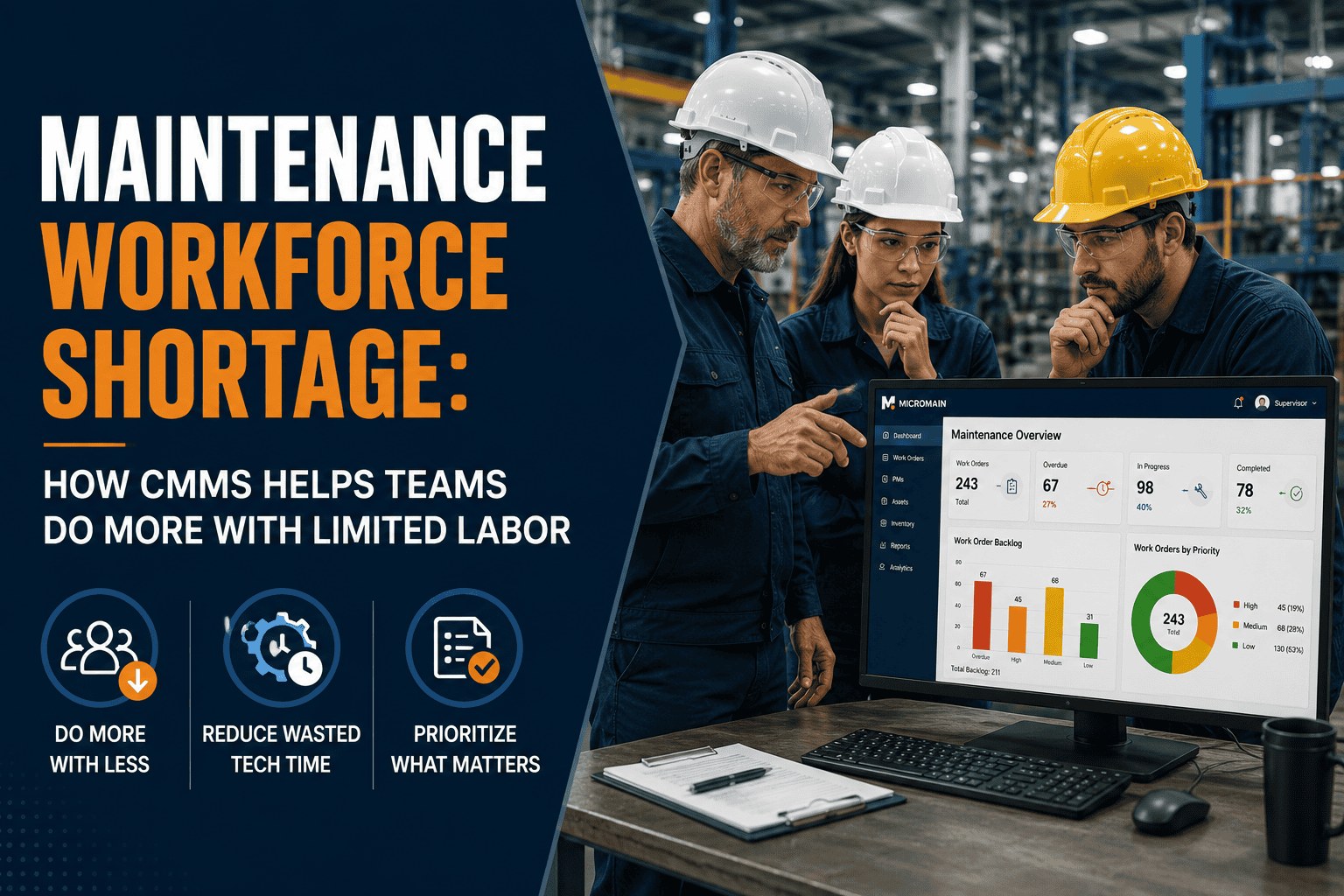
Reduce time lost to unclear requests, missing information, duplicate work, and avoidable searching.
Capture asset history, PM instructions, repair notes, photos, parts usage, and troubleshooting details.
Use asset criticality, safety, compliance, PM due dates, and operational impact to guide limited labor.
Use data to improve planning and staffing conversations instead of simply pushing technicians harder.
In This Guide
Why Maintenance Teams Are Feeling the Labor Crunch
The maintenance workforce shortage is not just a hiring problem. It is a work execution problem. Many teams are dealing with several pressures at once:
- Experienced technicians retiring
- Fewer new workers entering skilled trades
- Increased competition for technical talent
- More complex equipment and controls
- Growing documentation requirements
- Lean staffing models
- Rising expectations for uptime and reliability
- More work orders than the team can realistically complete
The U.S. Bureau of Labor Statistics projects faster-than-average growth for installation, maintenance, and repair occupations from 2024 to 2034, with hundreds of thousands of openings expected each year because of growth and replacement needs. Industrial machinery mechanics, machinery maintenance workers, and millwrights are projected to grow even faster, reflecting continued demand for skilled maintenance labor.
That demand puts pressure on maintenance leaders. Hiring more people may be necessary, but it is not always fast or easy. In the meantime, teams need better ways to organize work, protect limited labor hours, and prevent knowledge loss.
What the Maintenance Workforce Shortage Looks Like Day to Day
A maintenance labor shortage is not always obvious from headcount alone. Sometimes it appears in daily symptoms. Common signs include:
- Technicians constantly interrupted by urgent work
- PMs delayed because reactive work takes priority
- Supervisors manually chasing updates
- Work requests arriving through texts, emails, calls, and hallway conversations
- Senior technicians becoming bottlenecks
- New technicians needing repeated guidance for the same tasks
- Parts and asset information scattered across different places
- Backlog growing faster than the team can close it
- Work orders closed with vague notes because technicians are rushing
- Reports becoming unreliable because data is incomplete
Consequently, the team may be working hard but still losing ground. In other words, the issue is not only how many technicians are available. It is how much of their time goes to high-value maintenance work versus searching, waiting, clarifying, rework, paperwork, and preventable emergencies.
Why “Do More With Less” Is Not a Strategy
Maintenance leaders hear “do more with less” all the time. The phrase sounds efficient, but it can become harmful when it only means pushing people harder.
Instead, a real strategy reduces wasted effort and improves decisions. That means:
- Prioritizing work based on risk
- Planning jobs before assigning them
- Keeping PMs realistic
- Reducing duplicate work
- Making asset history easier to find
- Capturing technician knowledge
- Improving parts visibility
- Reviewing backlog regularly
- Tracking workload and schedule compliance
CMMS software helps by creating structure around those decisions. It gives teams one system for work requests, work orders, assets, PM schedules, inventory, documentation, and reporting.
Ultimately, the goal is not to squeeze more hours out of the same people. Instead, the goal is to help technicians spend more of their time on the right work.
How CMMS Helps Teams Use Limited Labor More Effectively
A CMMS supports lean maintenance teams by reducing avoidable friction in daily work.
Centralized Work Orders
When maintenance work is scattered across emails, spreadsheets, paper notes, phone calls, and verbal requests, teams waste time just figuring out what needs to be done. A CMMS centralizes work requests and work orders so the team can see what work is open, who requested it, which asset or location is affected, how urgent it is, who is assigned, what status it has, what work is overdue, and what has already been completed. This visibility helps supervisors assign work more clearly and helps technicians avoid confusion.
Better Maintenance Prioritization
Limited labor makes prioritization critical. A CMMS helps teams prioritize work based on safety risk, asset criticality, operational impact, compliance impact, work order age, PM due dates, parts availability, and labor availability. Without clear prioritization, teams often respond to whoever complains loudest. With better priority rules, supervisors can focus limited technician time on the work that carries the most risk.
Standardized PM Instructions
Preventive maintenance becomes harder when only experienced technicians know what each task requires. A CMMS can store PM instructions, checklists, safety notes, frequencies, required parts, and task history, which helps make preventive maintenance less dependent on memory. Standardized PMs help technicians understand what to inspect, what to clean, lubricate, test, or adjust, what readings to capture, what safety steps are required, what parts or tools may be needed, and what conditions require follow-up work. This is especially useful when new technicians are learning or when experienced technicians are unavailable.
Easier Access to Asset History
Experienced technicians often carry asset history in their heads. They remember which pump failed last year, which conveyor needs a special adjustment, or which HVAC unit has a recurring issue. That knowledge is valuable, but it creates risk when the team does not document it. A CMMS helps preserve asset history by linking work orders, PMs, parts, labor, notes, inspections, and attachments to asset records — so technicians can quickly answer whether an issue has happened before, what repair fixed it last time, and whether it’s a repeat failure. That reduces unnecessary troubleshooting time and helps newer technicians make better decisions.
Improved Planning and Scheduling
Because labor is limited, lean teams cannot afford to schedule work that is not ready. A CMMS can help planners and supervisors confirm work scope, required labor and skills, parts availability, tools, safety requirements, downtime windows, and technician availability. This helps prevent wasted trips, stalled jobs, and schedule changes caused by missing information. Planning and scheduling also help protect PMs from being constantly displaced by reactive work.
Less Time Searching for Parts and Information
Technicians lose time when they have to search for parts, manuals, asset records, drawings, procedures, or past work history. A CMMS can reduce that wasted time by organizing asset records, parts linked to assets, work order history, PM instructions, photos and attachments, manuals, inventory locations, and vendor information. Even small reductions in search time can matter when the team is already stretched.
Better Knowledge Capture
In addition, tribal knowledge is one of the biggest risks in a maintenance workforce shortage. When senior technicians retire or leave, undocumented knowledge leaves with them. A CMMS helps capture knowledge through work order closeout notes, failure codes, inspection findings, PM checklist results, photos, attachments, asset history, parts usage, and follow-up work orders. The goal is not to replace experienced judgment — it is to make that judgment easier to share with the rest of the team.
How CMMS Helps New Technicians Ramp Faster
New technicians need more than classroom training. They need practical access to maintenance history, asset information, procedures, and clear work instructions. A CMMS can support onboarding by giving new technicians assigned work orders with clear scope, step-by-step PM tasks, asset history, photos and attachments, safety notes, required parts and tools, previous repair notes, and standard closeout expectations.
As a result, this helps reduce the learning curve. Instead of relying entirely on one senior technician to explain every asset, the new technician can use documented information inside the CMMS. Senior technicians still play a critical mentoring role, but they are not forced to repeat the same basic information over and over.
How to Reduce Tribal Knowledge Risk
Tribal knowledge becomes risky when the maintenance program depends on information that only one or two people know. To reduce that risk, maintenance teams should document common failure modes, asset-specific repair tips, known recurring issues, preferred parts, special tools, safety steps, troubleshooting notes, vendor contacts, PM procedures, and downtime requirements. A CMMS can store this information where future technicians can find it.
Therefore, the best time to capture knowledge is before someone leaves, retires, or changes roles. Maintenance leaders should ask experienced technicians to help improve PM checklists, asset notes, job plans, and closeout standards while they are still available.
What Managers Should Track When Labor Is Limited
When labor is limited, maintenance managers need clear visibility into workload and execution. Useful KPIs include:
- Open work orders: Shows how much active work is waiting or in progress.
- Backlog age: Shows how long work orders remain open before completion.
- PM compliance: Shows whether the team completes preventive maintenance on time.
- Schedule compliance: Shows whether the team completes planned work as scheduled.
- Emergency work percentage: Shows how much labor unplanned urgent work consumes.
- Labor hours by work type: Shows how technician time splits between emergency, corrective, preventive, inspection, and project work.
- Repeat work orders: Shows whether the same asset or issue keeps generating repeated maintenance work.
- Mean time to repair: Shows how long repairs take after failure or work identification.
- Work orders per technician: Shows workload distribution across the team.
These metrics should improve planning, staffing discussions, PM design, and workload balance. They should never punish technicians for operating in a constrained environment.
Common Mistakes Lean Maintenance Teams Make
- Letting PMs slip too often: When teams are short-staffed, PMs are often the first work to get delayed, which can create more reactive work later. Not every PM carries equal value, but critical PMs should stay protected.
- Keeping too much work outside the CMMS: If urgent work, verbal requests, or quick fixes never enter the CMMS, the system understates the real workload, which makes staffing and budget conversations harder.
- Depending too much on senior technicians: Experienced technicians are valuable, but they should not be the only source of asset knowledge. Documentation protects the organization and supports the next generation of technicians.
- Scheduling based on hope instead of capacity: A weekly schedule should reflect real technician availability, parts availability, downtime windows, and emergency buffers. Overloaded schedules create frustration and poor schedule compliance.
- Ignoring closeout quality: When technicians rush, closeout notes often become vague, which weakens asset history and makes future troubleshooting harder. Closeout requirements should stay realistic but still capture useful information.
- Using the CMMS as a recordkeeping tool only: A CMMS should support daily execution, not just store completed work. Lean teams get more value when they use it for request intake, prioritization, planning, scheduling, PM management, inventory visibility, and reporting.
CMMS Workforce Productivity Checklist
Use this checklist to help a lean maintenance team get more value from its CMMS:
- Centralize all work requests in the CMMS
- Define clear work order priority levels
- Identify critical assets and protect PMs on critical equipment
- Standardize PM instructions and link work orders to assets
- Attach manuals, photos, and procedures where useful
- Record parts and labor on work orders, and improve closeout notes
- Create follow-up work from inspections
- Review backlog weekly and track PM and schedule compliance
- Monitor emergency work percentage
- Capture technician knowledge before retirements or turnover
- Use CMMS reports to support staffing and budget discussions
How Preventive Maintenance Helps Short-Staffed Teams
Preventive maintenance can feel difficult when labor is limited. However, it is often part of the solution. A realistic PM program helps teams reduce avoidable failures, plan work ahead of time, and protect critical assets. The key word is realistic.
Short-staffed teams should review PMs for asset criticality, task value, frequency, labor requirement, parts needs, safety impact, failure history, and overdue patterns. If the PM program is too large, outdated, or poorly prioritized, it can overwhelm the team. If it stays focused and practical, it can reduce unnecessary emergencies.
How MicroMain Supports Lean Maintenance Teams
MicroMain supports maintenance teams with CMMS capabilities such as work order management, preventive maintenance scheduling, asset management, inventory tracking, reporting, and maintenance documentation.
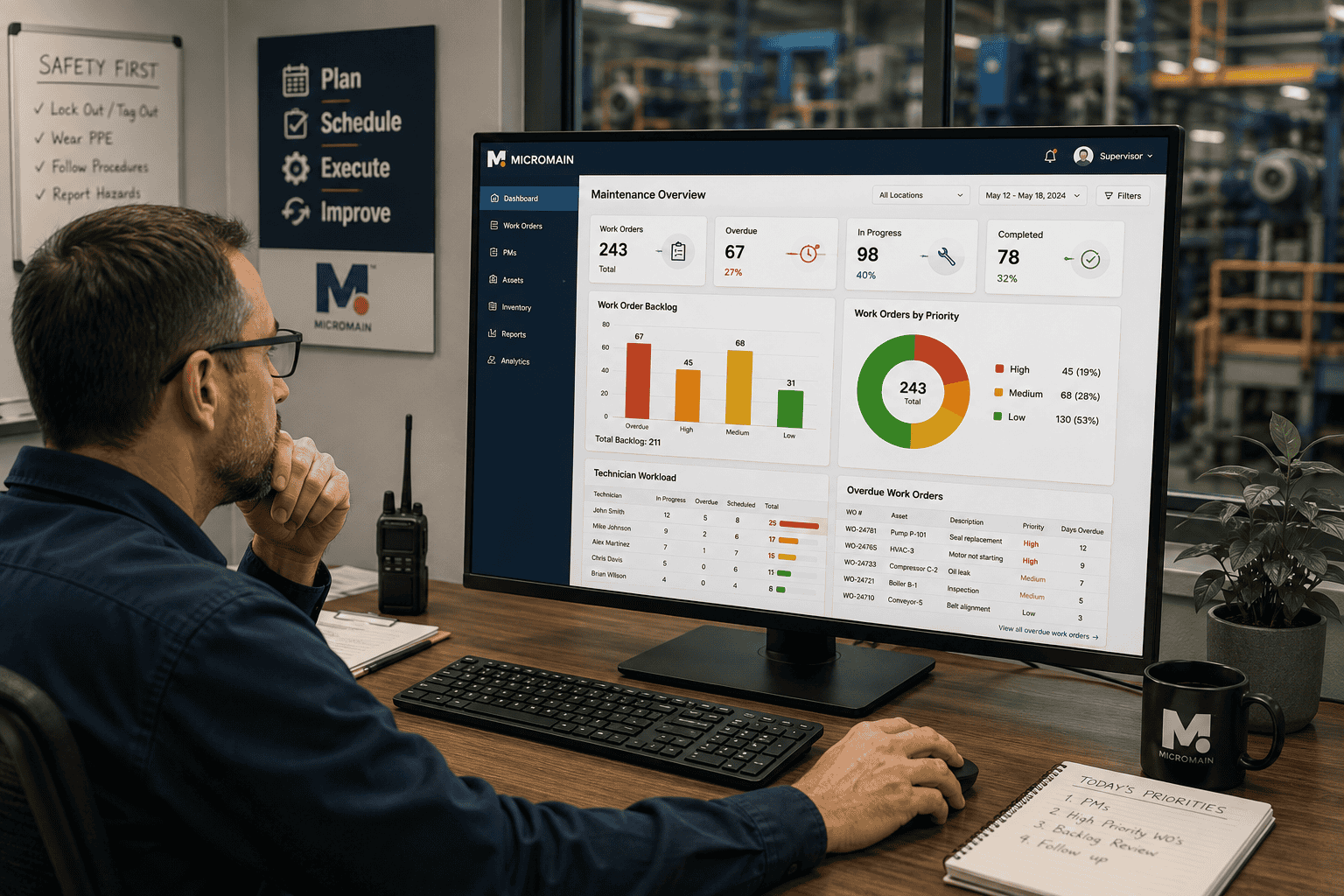
For teams dealing with limited labor, these capabilities can help centralize work, prioritize maintenance activity, preserve asset history, standardize PMs, and improve visibility into backlog and workload. The practical goal is not to replace skilled technicians. It is to help technicians spend less time searching, guessing, repeating work, or chasing unclear requests, and more time completing the work that protects assets and operations.
Related Resources
Final Takeaway
The maintenance workforce shortage is not going away overnight. Therefore, teams need both staffing strategies and better work systems. Hiring and training remain important, but maintenance teams also need better systems for managing the work they already have.
A CMMS cannot replace technician experience. It can help protect it, organize it, and make it easier to share. When work orders, PMs, asset history, parts, schedules, and reports live in one system, teams can prioritize better, reduce wasted time, preserve knowledge, support new technicians, and make stronger staffing and budget decisions.
The goal is not to do more with less by pushing people harder. Instead, the goal is to do the right work, with better information, less chaos, and a more sustainable process for the people keeping assets running.
Help Your Maintenance Team Work With Better Visibility and Less Chaos
See how MicroMain can help centralize work orders, schedule preventive maintenance, track assets, manage inventory, and report on maintenance performance from one system.
Frequently Asked Questions
Understanding the Shortage
What is the maintenance workforce shortage?
The maintenance workforce shortage refers to the difficulty many organizations face in hiring, training, and retaining enough skilled maintenance technicians to keep up with maintenance demand.
Why are maintenance teams struggling to hire technicians?
Maintenance teams may struggle because of retirements, fewer new workers entering skilled trades, competition for technical talent, increased equipment complexity, and training gaps.
Can CMMS replace maintenance technicians?
No. A CMMS cannot replace skilled technicians. It supports technicians by organizing work, data, schedules, assets, parts, and documentation so limited labor can be used more effectively.
What maintenance work should be prioritized when labor is limited?
When labor is limited, teams should prioritize safety work, compliance work, critical asset PMs, high-risk corrective work, and tasks that prevent major downtime or operational disruption.
How does preventive maintenance help short-staffed teams?
Preventive maintenance helps short-staffed teams by reducing avoidable emergency repairs, improving planning, protecting critical assets, and making maintenance work more predictable when the PM program is realistic.
Using CMMS to Close the Gap
How can CMMS help with limited maintenance labor?
A CMMS can help by centralizing work orders, prioritizing work, standardizing PMs, preserving asset history, improving planning and scheduling, tracking labor, and reducing time spent searching for information.
How does CMMS reduce tribal knowledge risk?
A CMMS reduces tribal knowledge risk by capturing work order notes, asset history, PM instructions, photos, failure information, parts usage, and troubleshooting details in a shared system.
How can CMMS help train new technicians?
A CMMS can help new technicians by providing clear work orders, PM checklists, safety notes, asset history, repair documentation, parts information, and previous closeout notes.
How can maintenance teams improve productivity without burnout?
Teams can improve productivity by reducing wasted time, improving planning, protecting realistic schedules, standardizing work instructions, prioritizing by risk, and using CMMS data to balance workload.
What KPIs should lean maintenance teams track?
Useful KPIs include open work orders, backlog age, PM compliance, schedule compliance, emergency work percentage, labor hours by work type, repeat work orders, MTTR, and work orders per technician.