Maintenance Planning and Scheduling: How to Turn Backlog Into a Realistic Weekly Plan
Most maintenance teams do not have a shortage of work. They have open work orders, overdue preventive maintenance, and corrective tasks piling up. On top of that, inspections, safety requests, project work, and emergency repairs keep landing on the list, and the backlog never seems to shrink.
The harder problem is turning all of that work into a realistic weekly plan that technicians can actually execute.
It clarifies scope, labor, parts, tools, safety needs, and job details before execution.
It assigns ready work to the right time and resources based on real capacity and asset availability.
A work order should not enter the weekly schedule until the team can reasonably complete it.
Tracking what was completed versus planned helps teams find weak points in planning and coordination.
In This Guide
Understand the core process and why both activities matter.
See the difference between preparing work and assigning it.
Identify the most common causes of unrealistic schedules.
Learn what must be confirmed before work enters the plan.
Use a practical nine-step process to move backlog into execution.
Measure performance and use CMMS data to improve planning.
What Is Maintenance Planning and Scheduling?
Maintenance planning and scheduling is the process of preparing, prioritizing, organizing, and assigning maintenance work so teams can complete it efficiently.
In practice, planning answers three questions: what needs to be done, what is required, and is the work ready? Scheduling then takes over from there. It answers when the work will happen, who will do it, and whether the plan fits real capacity.
As a result, strong planning and scheduling reduces chaos before work begins.
- Clarify work scope.
- Identify required labor.
- Confirm parts and tools.
- Review safety requirements.
- Coordinate downtime windows.
- Prioritize by risk and asset criticality.
- Balance PMs, corrective work, and emergencies.
- Build a realistic weekly schedule.
- Track schedule compliance.
- Learn from unfinished work.
Maintenance Planning vs Maintenance Scheduling
Maintenance planning happens before scheduling. First, the planner makes the job executable. Then, the scheduler makes the plan realistic.
| Area | Maintenance Planning | Maintenance Scheduling |
|---|---|---|
| Main question | What work needs to be done and what is required? | When will the work happen and who will do it? |
| Focus | Scope, parts, tools, labor, safety, procedures | Calendar, capacity, priorities, downtime windows |
| Output | Ready-to-schedule work order | Weekly or daily maintenance schedule |
| Time horizon | Often days or weeks before execution | Usually weekly and daily coordination |
| Main risk if skipped | Work is unclear or missing resources | Work is overloaded or poorly timed |
Planning, Scheduling, and Dispatching
Maintenance teams sometimes use planning, scheduling, and dispatching interchangeably. However, each activity serves a different purpose.
- Planning prepares the job. It defines scope, steps, materials, labor estimates, tools, safety requirements, and job readiness.
- Scheduling places ready work into a time window based on labor capacity, asset availability, priority, parts availability, and coordination with operations.
- Dispatching handles day-of execution and adjustments based on current conditions.
For example, planning may define that a pump repair needs a seal kit, lockout procedure, two technicians, and four hours. Scheduling may place that repair on Wednesday from 8 a.m. to noon. Dispatching then handles who starts the job and what changes if an emergency appears.
Why Weekly Maintenance Schedules Fail
Weekly schedules usually fail for predictable reasons. Therefore, the fastest way to improve schedule compliance is to remove those failure points before the week begins.
Work Is Scheduled Before It Is Ready
A work order can enter the schedule even though the scope is unclear, parts are missing, tools are unavailable, or safety requirements are undefined. When the technician arrives, the job stalls.
Labor Capacity Is Overestimated
A schedule may assume technicians have eight full hours available for assigned work. In reality, meetings, breaks, travel, setup, documentation, emergency calls, and coordination reduce available capacity.
Parts Are Not Confirmed
A repair may look important, but if the required part is not available, the team cannot complete the work. As a result, trust in the schedule drops.
Operations Cannot Release the Asset
Some maintenance tasks require downtime. If operations has not agreed to a release window, the job stalls even when maintenance is ready to go.
Priorities Are Not Clear
If every work order is urgent, none of them are. A useful weekly schedule depends on real prioritization.
Preventive Maintenance Keeps Getting Pushed
PM work often loses to reactive work. Over time, repeated PM deferrals can keep the organization trapped in a reactive cycle.
Backlog Is Not Reviewed Before Scheduling
Teams should review, prioritize, plan, and filter backlog before it moves into the weekly schedule. Otherwise, schedulers end up pulling work at random.
What Makes Work Ready to Schedule?
Ready-to-schedule work is work that can reasonably be completed if assigned. Before a work order enters the weekly schedule, the team should confirm the following.
Clear Scope
The work order should explain what needs to be done. Vague requests may need an inspection before the team can schedule the repair.
Correct Asset
The work order should link to the correct asset, location, and equipment record. That way, technicians can pull up history and related information.
Priority and Criticality
Priority should consider safety, asset criticality, operational impact, downtime risk, compliance impact, and work order age.
Labor Estimate
Estimated labor helps schedulers determine whether the work fits available capacity.
Parts Availability
The team should identify and confirm required parts before scheduling the job.
Tools, Safety, and Downtime
Teams should confirm special tools, permits, PPE, lockout procedures, access requirements, contractors, and downtime windows.
How to Turn Backlog Into a Weekly Maintenance Plan
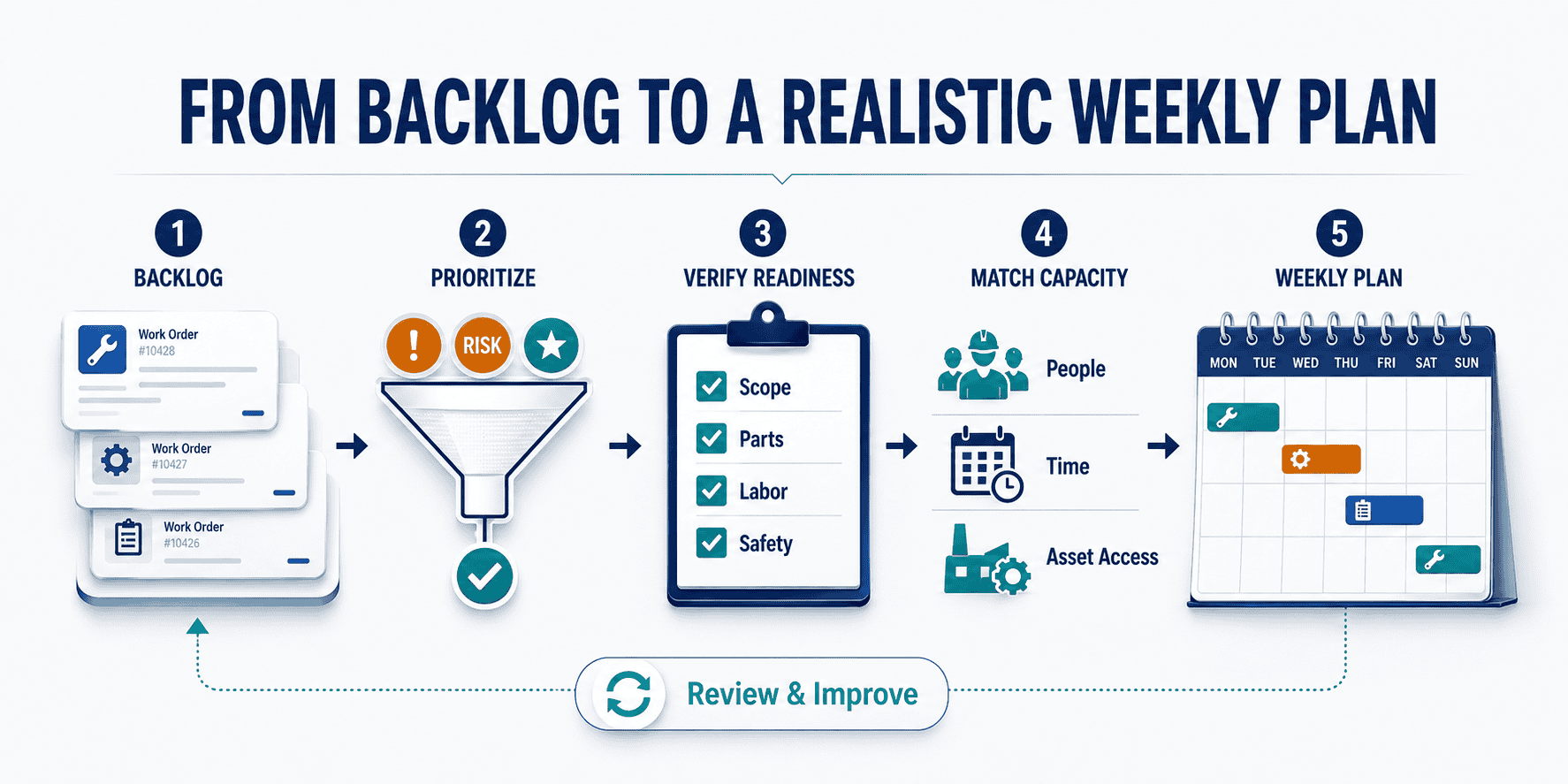
A realistic weekly maintenance plan starts with backlog review and ends with a review of unfinished work. The following nine-step process creates a repeatable rhythm.
Review Backlog by Priority and Asset Criticality
Do not schedule work simply because it is old. Instead, evaluate priority, risk, readiness, and asset criticality.
Separate Work Types
Group emergency, corrective, preventive, project, safety, compliance, and low-priority work into separate categories. Each one needs different treatment.
Confirm Parts and Labor Availability
Check parts, tools, labor hours, technician skills, contractor availability, safety needs, access requirements, and downtime windows.
Match Work to Downtime Windows
Coordinate shutdowns, lockout, room access, line stoppage, production changeovers, contractor access, and permit windows.
Build a Realistic Weekly Schedule
Use actual capacity, not theoretical capacity. Leave room for setup, travel, documentation, coordination, and break-in work.
Communicate the Schedule
Share the plan with technicians, supervisors, operations, production, facilities, contractors, inventory staff, and safety stakeholders.
Protect the Schedule
Allow controlled changes for safety-critical or high-risk work, but avoid reshuffling the plan for every new request.
Track Schedule Compliance
Compare scheduled work completed with total scheduled work to see whether the weekly plan was realistic.
Review Unfinished Work
Identify whether missing parts, unclear scope, labor shortages, emergency interruptions, asset availability, or weak estimates delayed the work.
Weekly Maintenance Planning Example
A simple weekly schedule should reflect planning requirements before scheduling decisions are made.
| Work Type | Example Work | Planning Requirement | Scheduling Decision |
|---|---|---|---|
| Critical PM | Generator load test | Procedure, safety checklist, technician skill | Schedule during approved test window |
| Corrective work | Pump seal replacement | Seal kit, lockout, two technicians | Schedule after parts are confirmed |
| Backlog work | Conveyor guard repair | Scope, tools, access | Schedule based on asset criticality |
| Inspection | HVAC roof unit inspection | Checklist, roof access | Group with nearby rooftop work |
| Low-priority work | Paint touch-up | Materials, low risk | Defer if capacity is tight |
Common Maintenance Scheduling Mistakes
- Scheduling work before scope, parts, labor, or safety needs are clear.
- Ignoring asset criticality when setting priorities.
- Filling every available labor hour with no buffer.
- Failing to coordinate downtime with operations.
- Treating preventive maintenance as optional.
- Ignoring schedule compliance data.
- Using the CMMS only as a recordkeeping system instead of an execution tool.
Maintenance Planning and Scheduling KPIs
Use KPIs to Improve the Process
KPIs help teams understand whether the planning and scheduling process is improving. That said, KPIs should support process improvement, not punishment.
Shows the percentage of scheduled work completed as planned.
Shows how much labor is spent on planned work instead of reactive work.
Shows whether preventive maintenance tasks are completed on time.
Shows how long work orders remain open.
Shows how much planned work is ready to schedule.
Shows how much work interrupts the schedule.
Compares estimated labor hours to actual labor hours.
Shows whether missing parts are delaying scheduled work.
How Preventive Maintenance Fits Into Weekly Scheduling
Preventive maintenance belongs in the weekly schedule, not on the sidelines. Otherwise, PMs can become overdue when teams ignore labor, parts, or downtime constraints.
- Review upcoming PMs before the week starts.
- Prioritize PMs on critical assets.
- Confirm required parts and tools.
- Group PMs by location where practical.
- Coordinate downtime windows.
- Avoid overloading technicians.
- Track PM compliance and missed PMs.
- Create corrective work from PM findings.
How CMMS Software Supports Maintenance Planning and Scheduling
A CMMS can help maintenance teams move from reactive assignment to structured planning and scheduling. When work orders, assets, PMs, parts, and schedules live in one system, teams gain better visibility. They can see what is ready, what is urgent, and what fits the week.
- Centralize work orders and backlog.
- Link work to assets and locations.
- Assign priorities and job plans.
- Schedule recurring PMs.
- Track labor estimates and actuals.
- Connect parts to work orders.
- Assign technicians.
- Track schedule compliance.
- Report on overdue work and backlog trends.
How MicroMain Supports Maintenance Planning and Scheduling
MicroMain supports maintenance teams with CMMS capabilities such as work order management, preventive maintenance scheduling, asset management, inventory tracking, reporting, and maintenance documentation.
These capabilities can help teams organize backlog, schedule recurring PMs, connect work to assets, track parts usage, and review maintenance performance. The practical goal is simple: help maintenance teams see what work needs attention, what resources they need, and what they can realistically finish.
Related Resources
Ready to Build a More Realistic Maintenance Schedule?
See how MicroMain can help your team organize backlog, plan maintenance work, schedule PMs, and improve visibility across work orders, assets, labor, and parts.
Book a DemoFrequently Asked Questions
What is maintenance planning and scheduling?
Maintenance planning and scheduling is the process of preparing, prioritizing, organizing, and assigning maintenance work so teams can complete it efficiently and realistically.
What is the difference between maintenance planning and maintenance scheduling?
Maintenance planning defines the scope, labor, parts, tools, safety requirements, and job readiness. Maintenance scheduling decides when the work will happen and who will complete it.
What is the difference between scheduling and dispatching?
Scheduling creates the planned work calendar before execution. Dispatching handles day-of assignments and adjustments based on current conditions, emergencies, and technician availability.
How do you create a weekly maintenance schedule?
Start by reviewing backlog, prioritizing work by risk and asset criticality, confirming parts and labor, coordinating downtime windows, building a realistic schedule, communicating the plan, and tracking schedule compliance.
Why do maintenance schedules fail?
Maintenance schedules often fail because teams schedule work before it’s ready, overestimate labor capacity, run short on parts, can’t get equipment released in time, leave priorities unclear, or let emergency work disrupt the plan.
What does ready to schedule mean?
Ready to schedule means a work order has a clear scope, correct asset, priority, labor estimate, required parts, tools, safety requirements, and downtime window if needed.
What is schedule compliance?
Schedule compliance measures how much of the scheduled work the team completed as planned. A simple formula is scheduled work completed divided by total scheduled work, multiplied by 100.
How does preventive maintenance fit into weekly scheduling?
Preventive maintenance should be reviewed, planned, and scheduled with the same discipline as corrective work. PMs should be prioritized by asset criticality, labor availability, parts needs, and downtime windows.
How does CMMS software help with maintenance planning?
A CMMS helps centralize work orders, track backlog, schedule PMs, link work to assets, manage labor and parts information, assign technicians, and report on schedule compliance.