Back-to-School Facility Maintenance Checklist: What to Inspect Before Opening and During the First 30 Days
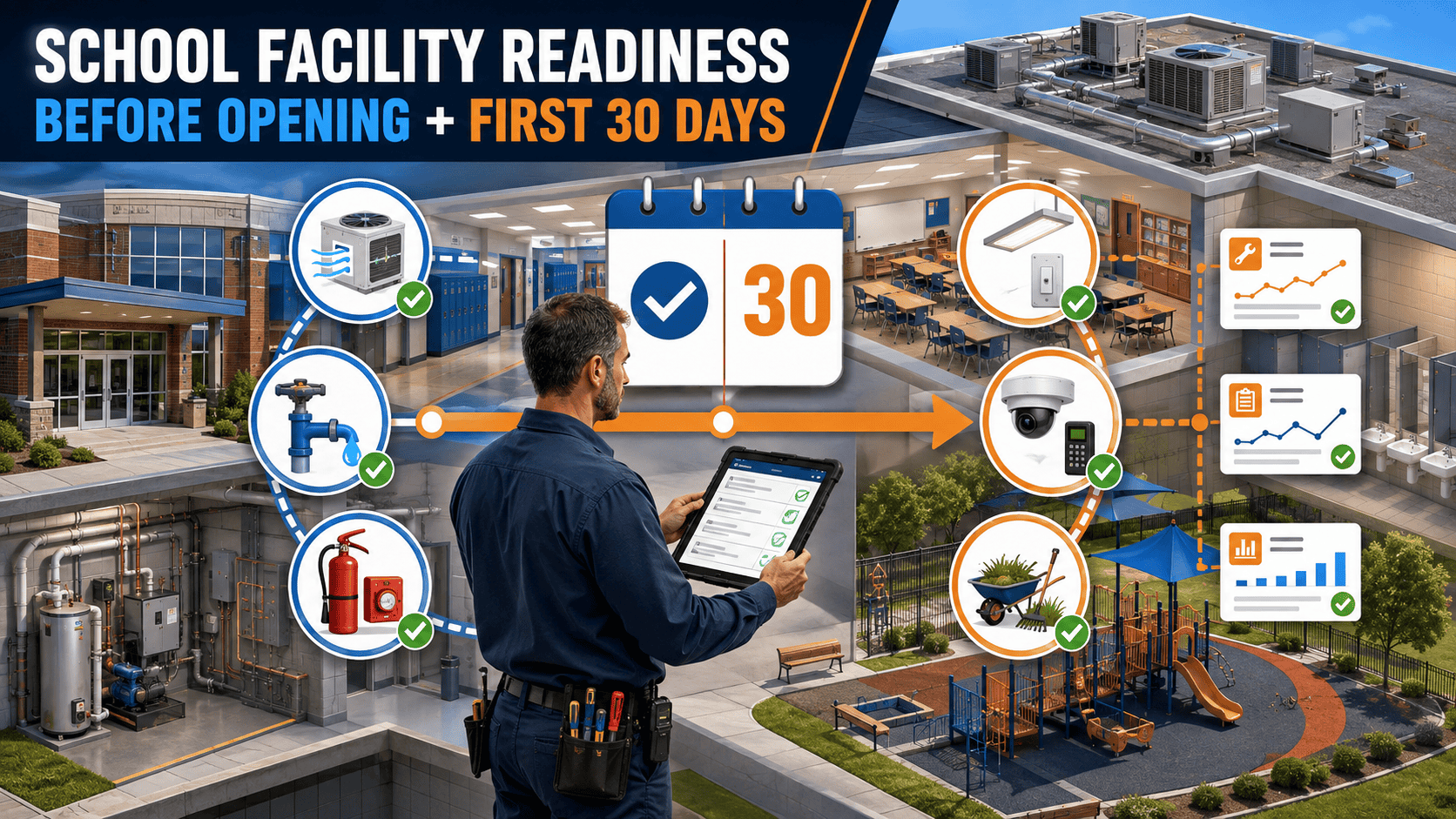
Opening day is an important deadline, but it is not the finish line for school facility maintenance. HVAC systems move from summer schedules to full occupancy. Restrooms, kitchens, classrooms, gyms, and common areas return to daily use. Staff and students begin reporting problems that were difficult to detect while buildings were quiet.
A strong school facility maintenance checklist therefore has two parts: verify that each building is ready for occupancy, then monitor how the facility performs during the first 30 days.
Verify HVAC, safety, plumbing, and life-safety systems before students return.
Full occupancy reveals problems an empty building never shows.
Use a consistent risk model so the most important work moves first.
Centralize findings, assign work, and track completion across campuses.
In This Guide
Why the First 30 Days Matter
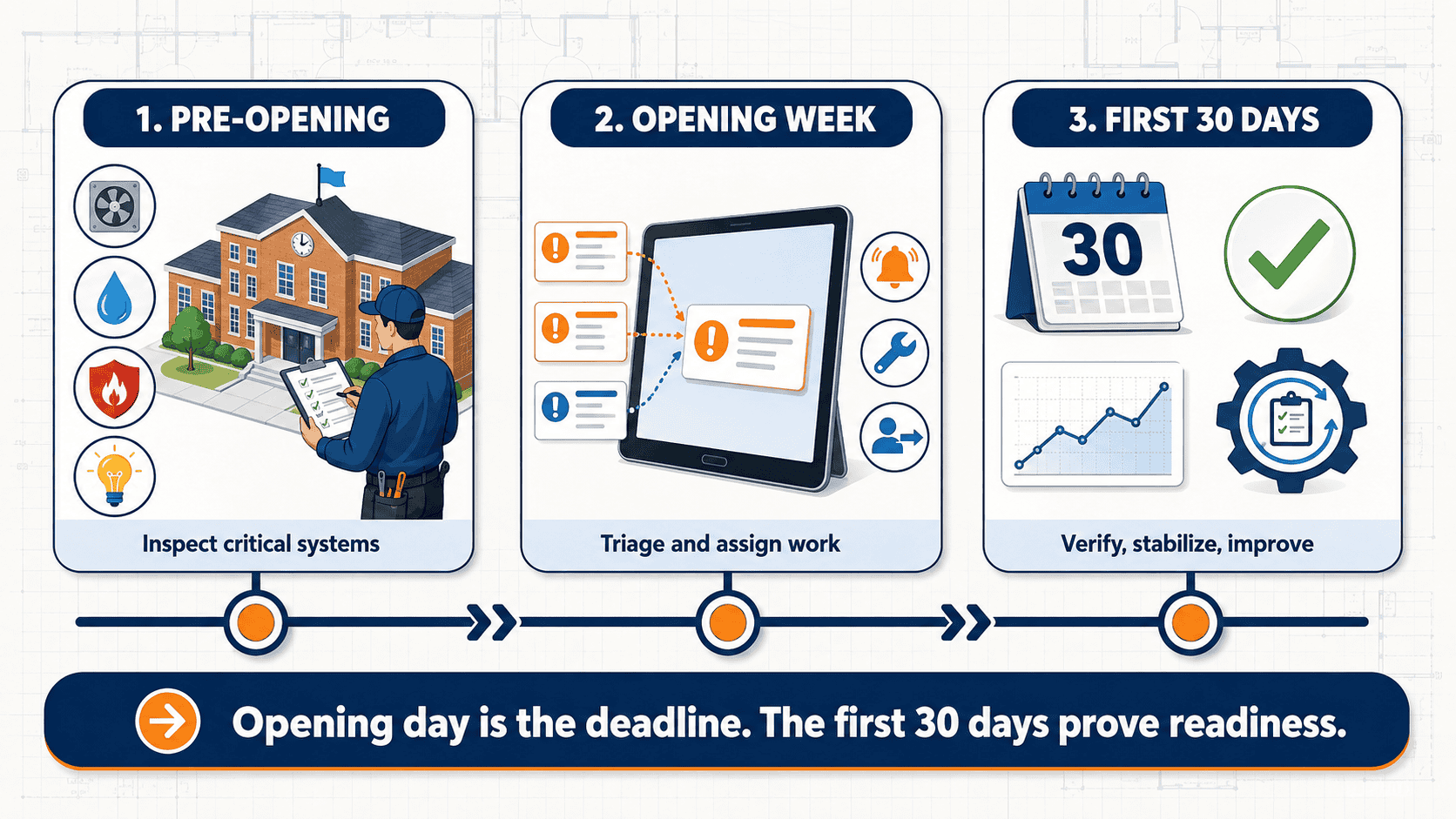
A pre-opening walkthrough shows whether a building appears ready. However, the first month shows whether it performs as intended under real conditions.
The U.S. Environmental Protection Agency recommends checking school ventilation components such as outdoor air intakes, system cleanliness, air distribution, exhaust systems, and outdoor air supply. EPA guidance also notes that a post-occupancy HVAC check is desirable because operating conditions can change when a building is fully occupied. The U.S. Department of Energy similarly recommends verifying HVAC and exhaust-fan operation, schedules, setpoints, airflow, and filtration as part of school reopening and commissioning work.
Therefore, the first month becomes a valuable stabilization period. Facility teams can compare expected and actual conditions, investigate repeat requests, confirm that summer repairs hold up, and refine maintenance schedules based on what the building is telling them.
Phase 1: Pre-Opening Facility Readiness
This school facility maintenance checklist starts here. Complete the following checks before normal occupancy. For every failed item, create a work order that identifies the building, location, affected asset, risk, assigned technician or contractor, target date, and required proof of completion.
HVAC, Ventilation, and Indoor Air Quality
- Confirm that HVAC equipment starts, operates, and shuts down as intended.
- Verify occupied schedules, temperature setpoints, and building automation sequences.
- Also inspect outdoor air intakes for blockage, debris, standing water, or nearby contaminant sources.
- Check filters for correct installation, fit, condition, and replacement status according to system requirements.
- Additionally, inspect coils, drain pans, condensate lines, belts, motors, dampers, and accessible air-handling components.
- Likewise, confirm that supply air reaches occupied rooms and that return-air paths are not obstructed.
- Next, test restroom, kitchen, laboratory, locker-room, and custodial-area exhaust systems.
- Investigate musty odors, visible moisture, staining, condensation, or signs of water intrusion.
- Similarly, review unresolved comfort and indoor-air-quality complaints from the previous school year.
- Finally, document readings, observations, deficiencies, and corrective actions for each building or zone.
Plumbing and Building Water Systems
- Inspect visible piping, valves, fixtures, water heaters, pumps, and mechanical rooms for leaks or corrosion.
- Likewise, test toilets, urinals, faucets, drinking fountains, bottle fillers, showers, and floor drains.
- Also check for slow drainage, sewer odors, unusual water color, or low pressure.
- Verify that shutoff valves and isolation points are accessible and clearly identified.
- Additionally, review water-management procedures after periods of reduced use and complete required flushing or testing.
- Similarly, confirm that completed plumbing repairs have not created new leaks in walls, ceilings, or occupied rooms.
- Finally, record fixture locations and asset IDs so repeat problems can be traced over time.
Reduced building use can affect water quality. The Centers for Disease Control and Prevention advises building owners to evaluate hazards before reopening after prolonged shutdown or reduced operation, including risks involving Legionella, mold, and lead or copper from plumbing. Follow current public-health guidance and the school district’s water-management plan rather than relying on a generic flushing interval.
Fire, Life-Safety, Security, and Accessibility
- Verify that required fire alarms, detection devices, suppression equipment, emergency lighting, and exit signage have current inspections and no unresolved deficiencies.
- Likewise, confirm that exit routes, stairways, corridors, and exterior egress paths are clear.
- Also test doors, locks, closers, panic hardware, access-control readers, intercoms, cameras, and visitor-management equipment.
- Remove temporary construction barriers, stored furniture, tools, and materials from occupied or egress areas.
- Additionally, confirm that emergency power and backup systems have been tested according to the applicable maintenance plan.
- Similarly, inspect accessible entrances, routes, door hardware, lifts, restrooms, parking spaces, and signage.
- Finally, document inspection dates, certificates, deficiencies, corrective work, and final signoff.
Classrooms, Restrooms, Kitchens, Gyms, and Shared Areas
- Walk every instructional room and confirm that lighting, outlets, doors, windows, casework, furniture, and fixed equipment are functional.
- Likewise, check ceilings, floors, walls, and window areas for damage, water staining, loose materials, or trip hazards.
- Also test classroom technology, clocks, bells, public-address speakers, and critical network-connected equipment with the responsible IT team.
- Inspect restrooms for leaks, drainage, damaged partitions, failed dispensers, odors, and accessibility concerns.
- Additionally, verify the operation and service status of kitchen ventilation, refrigeration, cooking, warewashing, and temperature-monitoring equipment.
- Inspect bleachers, goals, wall pads, divider curtains, scoreboards, fitness equipment, and other gym assets according to manufacturer guidance.
- Similarly, confirm that custodial closets, chemical storage, shops, laboratories, and restricted areas are secured and organized.
- Finally, identify rooms affected by incomplete summer work and document an approved plan before occupancy.
Building Envelope, Grounds, and Playgrounds
- Inspect roofs from safe access points and review known leaks, drains, gutters, downspouts, flashing, and recent repairs.
- Walk the building perimeter for damaged doors, windows, sealants, siding, masonry, and signs of pests or water entry.
- Likewise, check sidewalks, curbs, ramps, stairs, handrails, parking areas, drop-off zones, fencing, gates, and exterior lighting.
- Also inspect storm drains and drainage paths for blockage or erosion.
- Additionally, review playground equipment for broken, loose, worn, rusted, missing, or modified components.
- Check protective surfacing, high-use zones, debris, trip hazards, and damaged borders.
- Finally, restrict access to unsafe equipment until qualified repairs and required inspections are complete.
The U.S. Consumer Product Safety Commission recommends a systematic playground inspection and maintenance program based on equipment condition, use, age, climate, and manufacturer instructions. Its current Public Playground Safety Handbook can help teams develop site-specific inspection procedures.
Summer Projects, Contractors, and Handover
- Confirm that summer projects are complete or formally accepted with a documented deficiency list.
- Similarly, collect warranties, manuals, commissioning records, inspection certificates, training records, and updated drawings.
- Then add new equipment to the asset register with location, manufacturer, model, serial number, warranty, and service information.
- Additionally, create preventive maintenance schedules before new assets disappear into daily operations.
- Likewise, verify that contractors removed debris, secured work areas, restored access, and closed permits or required documentation.
- Finally, assign every remaining item to an accountable owner with a realistic due date.
How to Prioritize Inspection Findings
A long checklist can create hundreds of findings across a district. Use a consistent priority model so the most consequential work moves first.
| Priority | Typical Condition | Recommended Response |
|---|---|---|
| Emergency | Immediate threat to life safety, health, security, or continued occupancy | Protect occupants, restrict access or isolate the condition, notify required leaders, and dispatch qualified help immediately. |
| Urgent | Likely to disrupt instruction, damage assets, worsen rapidly, or affect a critical system | Assign a near-term due date, identify parts or contractor needs, and monitor until verified complete. |
| Planned | Important repair that can be scheduled without immediate operational risk | Add it to the weekly plan or maintenance backlog with scope, labor, materials, and target completion date. |
| Routine | Minor repair, adjustment, or cosmetic issue | Bundle similar work by building, trade, or route to improve technician efficiency. |
In practice, priority should reflect consequence, not simply who reported the issue first. Consider student and staff safety, instructional disruption, regulatory or policy requirements, asset criticality, probability of further damage, repair lead time, and whether a temporary control is reliable.
Phase 2: Opening-Week Maintenance Triage
During the first week, facilities teams often receive a surge of requests. A single intake and triage process prevents phone calls, emails, hallway conversations, and duplicate tickets from overwhelming the maintenance team.
- Provide staff with one clearly communicated method for submitting facility requests.
- Similarly, require the building, room, asset or system, problem description, and contact information.
- Also ask for a photo when it will help maintenance staff assess the issue.
- Review new requests at defined intervals and escalate emergency conditions immediately.
- Additionally, consolidate duplicates without losing the names or locations of affected users.
- Route work by trade, campus, priority, technician availability, and required qualification.
- Communicate status so requesters do not submit the same issue repeatedly.
- Finally, close work orders only after documenting the action taken, labor, parts, asset condition, and follow-up needs.
A work order management system helps schools centralize requests, assign and prioritize work, notify technicians, track due dates, attach photos and files, and report on response and completion. For multi-campus districts, a consistent request process also makes it easier to compare workload and recurring problems across buildings.
Phase 3: The First-30-Day Stabilization Plan
However, do not let opening-week urgency become the maintenance strategy for the rest of the year. Use weeks two through four to confirm repairs, analyze the early workload, and move the operation back toward planned maintenance.
Week 2: Verify Conditions Under Full Occupancy
- Review temperature, airflow, humidity, odor, noise, and comfort complaints by room and HVAC zone.
- Reinspect areas with recent leaks, drainage problems, roof repairs, or moisture concerns.
- Also confirm repairs to doors, locks, lighting, restrooms, kitchens, and high-traffic equipment.
- Additionally, identify repeat service requests that may indicate an asset-level or system-level cause.
- Check whether emergency and urgent work is being documented consistently.
Week 3: Rebalance the Backlog
- Separate unresolved opening issues from routine deferred work and capital needs.
- Review aging work orders, parts delays, contractor dependencies, and access constraints.
- Also bundle similar repairs by site or trade to reduce travel and setup time.
- Additionally, update priorities when temporary controls, occupancy, or asset condition changes.
- Communicate realistic completion dates to school leaders.
Week 4: Improve Preventive Maintenance
- Convert recurring corrective work into appropriate inspections or preventive maintenance tasks.
- Adjust seasonal schedules and procedures based on actual equipment performance.
- Also confirm that critical assets have complete records, current PMs, and responsible owners.
- Additionally, review spare-parts availability for equipment that generated repeated or urgent work.
- Document lessons from opening and assign improvements for the next summer cycle.
MicroMain’s preventive maintenance software can schedule recurring tasks, generate work orders, track labor and parts, maintain equipment history, and support time-based or meter-based maintenance. The goal is not to add a PM for every problem. Instead, it is to use actual failure and service history to focus planned work where it can reduce risk and disruption.
Maintenance Metrics to Review After 30 Days
A short opening-period report can help facility leaders explain workload, document risk, and support staffing, budget, contractor, or capital decisions. Review:
- Requests by building and category: Shows where demand and recurring conditions are concentrated.
- Emergency and urgent work: Highlights immediate operational exposure.
- Average response and completion time: Indicates how quickly the team can move work through the process.
- Open backlog by age and priority: Separates current demand from work that continues to accumulate.
- Repeat work by asset or location: Helps identify chronic failures, incomplete repairs, or replacement candidates.
- Preventive maintenance due and completed: Shows whether opening demand displaced essential planned work.
- Labor and contractor hours: Clarifies where internal capacity or outside support is being used.
- Parts and material costs: Supports inventory planning and reveals costly asset patterns.
However, trends should be interpreted in context. A school with more requests is not automatically performing worse; it may have better reporting adoption. Compare request volume with completion, recurrence, asset condition, occupancy, and the quality of closeout data.
How a CMMS Powers Your School Facility Maintenance Checklist
Paper checklists can confirm that someone walked a building. However, teams still need a reliable way to assign corrective work, track completion across campuses, connect findings to asset history, and produce reports. A computerized maintenance management system, or CMMS, creates a connected workflow:
Inspect
Facility staff complete standardized checks and record findings by building, room, and asset.
Prioritize
Each deficiency receives a consistent risk-based priority.
Assign
The system routes work to an internal technician or qualified contractor.
Execute
Technicians access instructions, asset history, photos, documents, parts, and due dates.
Verify
Supervisors confirm the repair, required documentation, and any follow-up work.
Improve
Reports reveal repeated failures, aging backlog, PM gaps, costs, and asset replacement needs.
MicroMain maintenance management software for education helps schools, districts, colleges, and universities manage service requests, work orders, preventive maintenance, inspections, assets, labor, parts, costs, and reporting. Mobile access can also help technicians update work where it happens instead of returning to a desk after every inspection or repair.
Related Resources
Turn Back-to-School Inspections Into Accountable Maintenance Work
See how MicroMain can turn your school facility maintenance checklist into accountable, trackable work: centralize maintenance requests, schedule preventive maintenance, track school assets, manage work across multiple campuses, and report on results.
Frequently Asked Questions
What should be included in a school facility maintenance checklist?
A school facility maintenance checklist should cover HVAC and ventilation, plumbing and water systems, fire and life-safety equipment, electrical systems, lighting, security, classrooms, kitchens, restrooms, gyms, playgrounds, grounds, accessibility, open work orders, and preventive maintenance schedules. Each finding should have an owner, priority, due date, and documented resolution.
When should schools complete back-to-school facility inspections?
Perform a comprehensive inspection before staff and students return, conduct a final readiness walk immediately before opening, and continue targeted checks during the first week and first 30 days. Post-occupancy checks reveal problems that may not appear while buildings are lightly used.
Why should school maintenance continue after opening day?
Full occupancy changes equipment loads, traffic patterns, room schedules, water use, and the volume of maintenance requests. Monitoring the first 30 days helps facility teams identify recurring problems, adjust preventive maintenance, confirm repairs, and prioritize the remaining backlog.
How does a CMMS help with school facility maintenance?
A CMMS centralizes school asset records, inspections, service requests, preventive maintenance schedules, work orders, labor, parts, costs, attachments, and reports. It helps districts assign findings, track completion, identify repeat problems, and maintain a documented history for each building and asset.
How should school maintenance teams prioritize inspection findings?
Prioritize conditions that threaten life safety, health, security, accessibility, or continued school operations. Next, address issues likely to disrupt instruction or cause asset damage, followed by routine repairs and cosmetic work. Validate requirements against local codes, district policy, and manufacturer guidance.
Editorial note: This article provides general maintenance-planning information. It does not establish inspection frequency, certify occupancy readiness, or replace applicable laws, codes, district policies, manufacturer instructions, licensed professionals, or requirements from the authority having jurisdiction.