Technician Skill Matrix in CMMS: How to Match the Right Technician to the Right Work Order
Maintenance work is not interchangeable. One technician may excel at mechanical repairs, while another may have stronger electrical, HVAC, controls, or safety qualifications. Therefore, supervisors need more than a list of available names when they assign work.
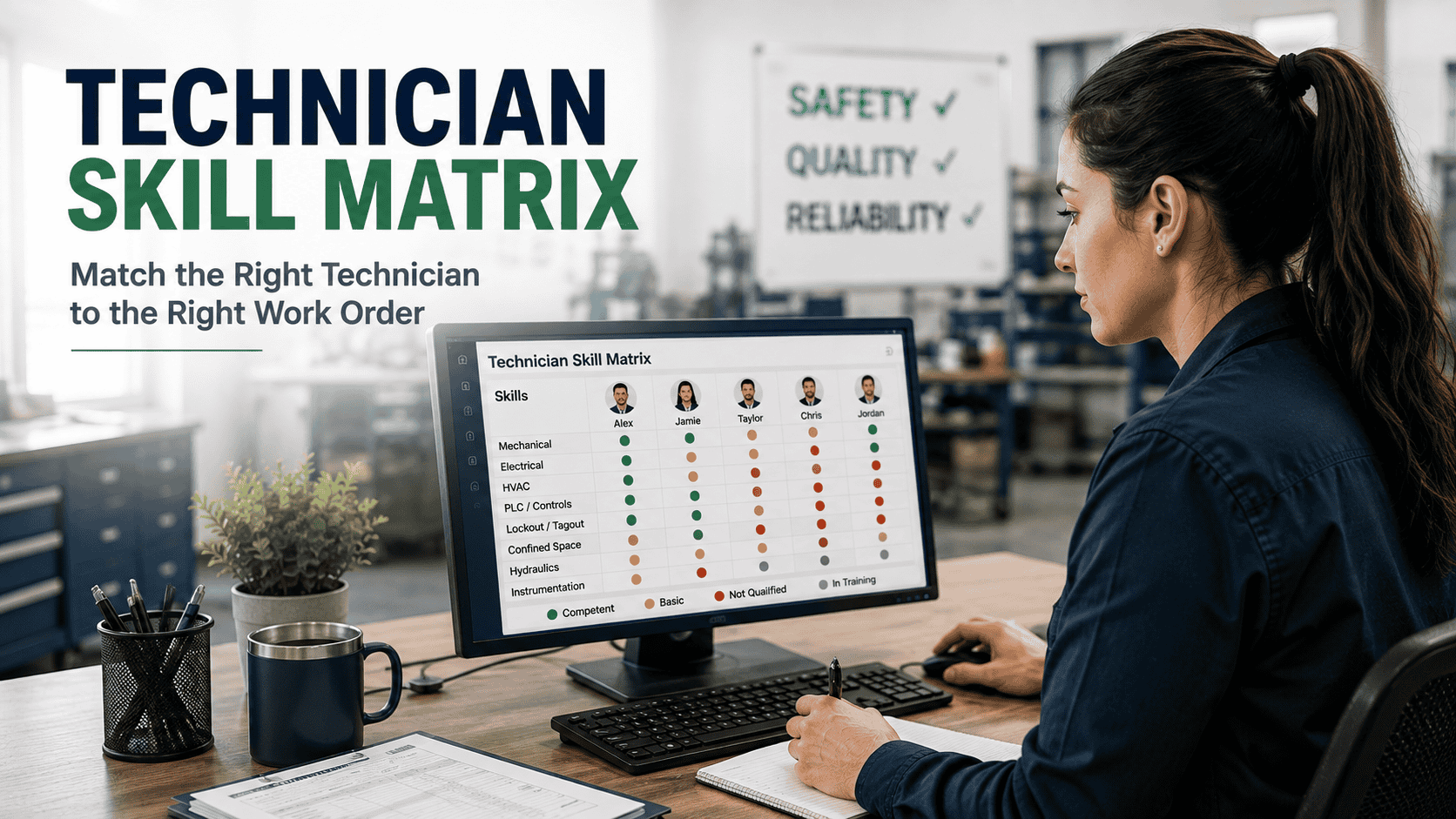
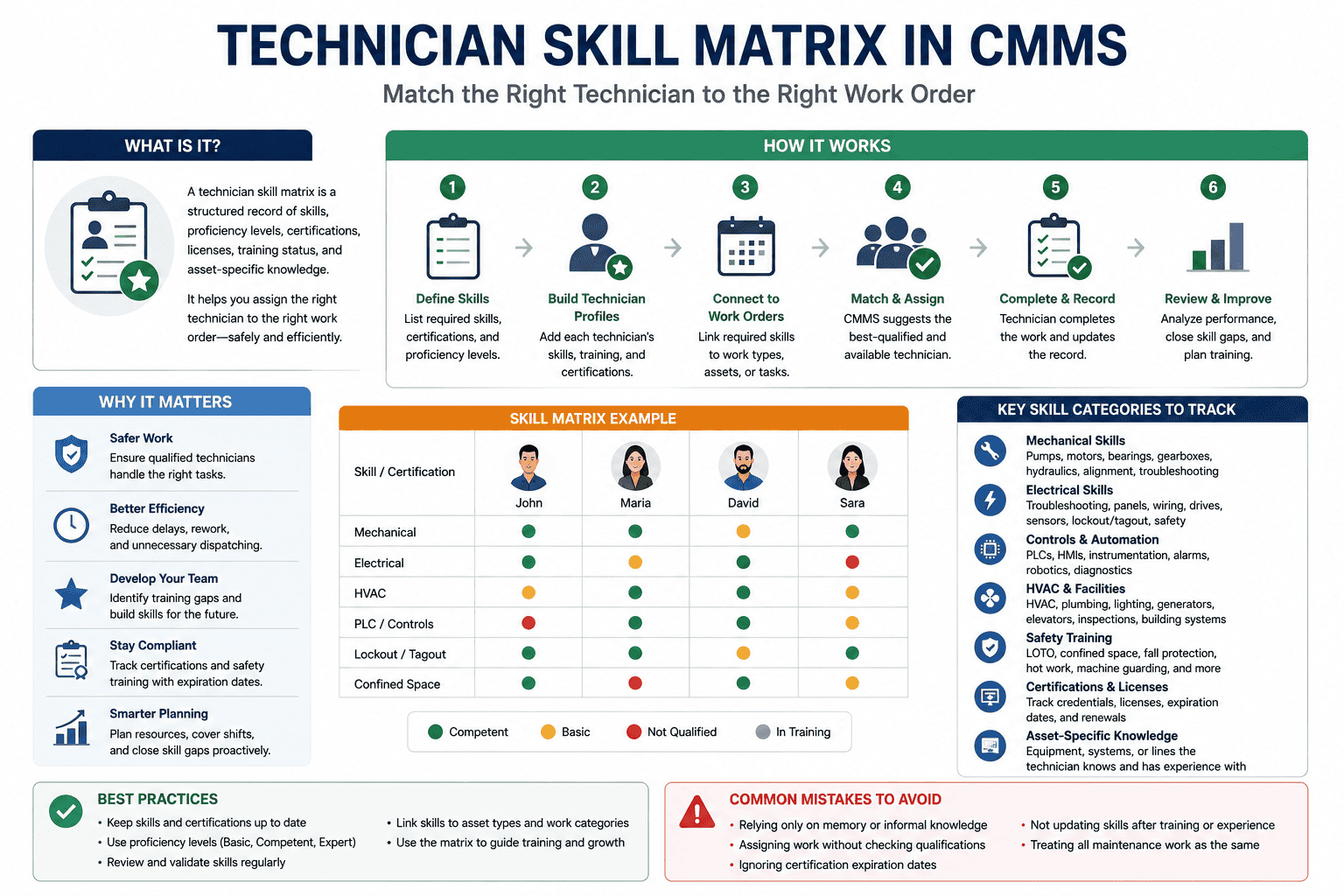
A technician skill matrix gives maintenance leaders a structured view of skills, proficiency levels, certifications, training status, and asset-specific knowledge. As a result, they can match work orders to qualified technicians more consistently.
Key Takeaways
- Use the matrix to support work assignment, not to replace supervisor judgment.
- Track real field capability separately from course attendance.
- Keep proficiency levels simple enough for supervisors and technicians to use consistently.
- Connect skills, certifications, and asset knowledge to work orders and PM requirements.
- Review skill coverage by shift, location, and critical asset to expose workforce risk.
What Is a Technician Skill Matrix?
A technician skill matrix maps each technician to the skills, certifications, and experience required for different maintenance tasks. It shows who can work independently, who needs support, who is still training, and where the team has capability gaps.
In practice, the matrix may track technical skills, safety training, asset-specific experience, certification status, proficiency levels, and expiration dates. When the matrix connects to work orders, managers can assign work more intentionally instead of relying only on memory or availability.
Why Skills Visibility Matters in Maintenance
Maintenance teams often have the right people overall, but they may not have the right coverage on every shift or at every location. Moreover, a technician who performs strong mechanical work may not be qualified for electrical troubleshooting or specialized compliance tasks.
Problems Caused by Limited Skills Visibility
- Work orders go to technicians who are available but not fully qualified.
- Senior technicians become bottlenecks because only they understand certain assets.
- New technicians lack a clear development path.
- Certifications or safety training expire without enough notice.
- Specialized work is delayed because skill gaps appear too late.
- Managers struggle to justify training investment with clear data.
Therefore, a skill matrix gives leaders a clearer picture of team capability, not just headcount. It also makes workforce risks visible before they disrupt maintenance execution.
Technician Skill Matrix vs. Training Matrix
A skill matrix and a training matrix support related goals. However, they answer different questions.
| Area | Technician Skill Matrix | Training Matrix |
|---|---|---|
| Main purpose | Shows what technicians are qualified or able to do | Shows what training has been assigned or completed |
| Primary use | Work order assignment and workforce planning | Training compliance and development tracking |
| Focus | Skills, proficiency, certifications, and asset knowledge | Courses, sessions, completion status, and due dates |
| Best question answered | Who should do this work? | Who has completed this training? |
| CMMS value | Supports skills-based assignment and planning | Supports compliance, onboarding, and follow-up |
The strongest approach connects both records. Training data shows what people completed. Meanwhile, the skill matrix shows what they can safely and effectively do in the field.
What Skills Should Maintenance Teams Track?
The right categories depend on the industry, asset mix, safety requirements, and maintenance strategy. Start with skills that directly affect work assignment, safety, compliance, and reliability.
Mechanical Skills
Track pumps, motors, bearings, belts, conveyors, gearboxes, hydraulics, pneumatics, lubrication, alignment, and mechanical troubleshooting.
Electrical Skills
Include electrical troubleshooting, motor controls, panels, wiring, sensors, breakers, drives, lockout/tagout knowledge, and electrical safety.
Controls and Automation Skills
Track PLCs, HMIs, instrumentation, alarms, robotics, sensors, automation systems, and digital diagnostics.
HVAC and Facilities Skills
Include HVAC, plumbing, lighting, generators, fire and life safety systems, roofing, elevators, and building inspections.
Safety Training
Track lockout/tagout, confined space, fall protection, hot work, electrical safety, machine guarding, and site-specific procedures.
Certifications and Licenses
Record credential type, current status, expiration date, renewal requirements, and supporting documents.
Asset-Specific Knowledge
Document which technicians know specific production lines, buildings, systems, or critical assets.
How a Skill Matrix Improves Work Order Assignment
A technician skill matrix improves assignment by connecting job requirements to technician capabilities. Instead of looking only at availability, supervisors can also consider qualification, experience, certification, workload, and development needs.
| Work Order Requirement | Skill Matrix Data That Helps |
|---|---|
| Electrical troubleshooting | Electrical qualification, safety training, and controls experience |
| Critical asset PM | Asset-specific knowledge, PM experience, and certification status |
| HVAC emergency repair | HVAC skills, on-call status, location, and previous asset history |
| Compliance inspection | Required training, certification, and procedure knowledge |
| New technician development | Proficiency level, mentorship needs, and training gaps |
How to Build a Technician Skill Matrix
A useful matrix does not need hundreds of fields. Instead, build a practical model that supervisors can maintain and use during planning, scheduling, and dispatching.
Define Work Types and Asset Categories
List the main maintenance work your team performs. Then connect those work types to asset categories such as pumps, conveyors, compressors, HVAC units, motors, panels, generators, production lines, and building systems.
List Required Skills
For each work type or asset category, define the skills needed to perform the work safely and correctly. Keep the list focused on real assignment decisions.
Rate Technician Proficiency
Use a simple scale that distinguishes learning, basic, proficient, advanced, and expert capability. A clear scale makes reviews more consistent.
| Level | Meaning | Example Use |
|---|---|---|
| 1 – Learning | Needs supervision or training | Can assist with basic PMs |
| 2 – Basic | Can perform simple tasks independently | Can complete standard inspections |
| 3 – Proficient | Can complete work independently | Can troubleshoot common failures |
| 4 – Advanced | Can handle complex work and coach others | Can diagnose recurring issues |
| 5 – Expert | Recognized internal expert | Can lead RCA, training, or critical repairs |
Track Certifications and Expiration Dates
Record certification type, issue date, expiration date, renewal requirements, and documentation. In addition, create reminders before credentials expire.
Identify Training Gaps
Compare the skills required by your assets with the skills available by shift and location. Look for single-person dependencies and weak coverage for critical work.
Use the Matrix for Assignment
Apply the matrix during planning, scheduling, and dispatching. Match work orders to technicians based on qualification, availability, workload, and development needs.
Technician Skill Matrix Example
| Technician | Mechanical | Electrical | HVAC | Controls | LOTO Training | Critical Asset Experience |
|---|---|---|---|---|---|---|
| Alex | 4 | 2 | 1 | 1 | Current | Line 1 pumps and conveyors |
| Maria | 3 | 4 | 2 | 3 | Current | Electrical panels and drives |
| Devin | 2 | 1 | 4 | 1 | Due in 60 days | Rooftop HVAC units |
| Sam | 5 | 3 | 2 | 4 | Current | Compressors and automation cells |
| Jordan | 1 | 1 | 2 | 1 | Current | Basic PM support |
How a Skill Matrix Supports Training and Cross-Training
A skill matrix turns training from a broad goal into a visible plan. For example, managers can see whether only one person can troubleshoot a critical line or whether second shift lacks electrical coverage.
- Only one technician can troubleshoot a critical production line.
- Second shift lacks electrical coverage.
- New technicians can complete PMs but cannot close corrective work independently.
- Safety training is current for most technicians but expiring for a few.
- Controls and automation skills are not keeping pace with newer equipment.
In addition, the matrix supports cross-training. Managers can pair developing technicians with advanced technicians on selected work orders so learning happens during real maintenance work.
How a Skill Matrix Reduces Tribal Knowledge Risk
Tribal knowledge becomes risky when one or two people know how to maintain a critical asset. A skill matrix reveals those dependencies so leaders can act before a retirement, role change, absence, or emergency creates a coverage problem.
Common Mistakes When Tracking Technician Skills
Tracking Training Attendance Instead of Real Capability
Course completion does not always mean a technician can perform the work independently. Separate training completed from demonstrated field proficiency.
Making the Matrix Too Complicated
A matrix with hundreds of categories can become impossible to maintain. Start with the skills that affect assignment, safety, compliance, and critical asset support.
Not Updating the Matrix
Skills change as technicians gain experience, complete training, earn certifications, change shifts, or stop using certain capabilities. Review the matrix regularly.
Ignoring Shift Coverage
A team may have enough expertise overall but still lack the right coverage on nights, weekends, or specific locations.
Using the Matrix to Punish Technicians
The matrix should support development and safer assignment. If employees view it as a punishment tool, participation and data quality will suffer.
Technician Skill Matrix KPIs
Use KPIs to improve workforce planning, not to reduce people to a scoreboard. The following measures can reveal operational risk and development priorities.
| KPI | What It Shows |
|---|---|
| Skill coverage by shift | Whether each shift has the skills needed for critical work |
| Certification expiration risk | Which credentials need renewal soon |
| Single-point-of-failure skills | Skills or assets covered by only one technician |
| Training gap count | Number of skills below the required level |
| Work orders assigned by skill match | How often work goes to qualified technicians |
| Repeat work by skill category | Whether capability gaps may be contributing to rework |
| Emergency work requiring specialist support | Where limited expertise creates bottlenecks |
How CMMS Supports Skills-Based Maintenance Workflows
A CMMS can support skills-based assignment when technician records, work orders, asset categories, PM requirements, certifications, and training data are connected.
- Store technician skills and qualifications.
- Track certifications and expiration dates.
- Link required skills to work order types.
- Assign work based on skill, availability, location, and priority.
- Document completed work by technician and asset.
- Identify training gaps from real work order history.
- Support onboarding and cross-training plans.
- Improve supervisor visibility into workforce capability.
The value comes from using skills data operationally. If the matrix is not connected to planning, scheduling, assignment, training, and reporting, it becomes another static record.
How MicroMain Supports Workforce and Work Order Visibility
MicroMain supports maintenance teams with CMMS capabilities for work order management, preventive maintenance scheduling, asset management, inventory tracking, reporting, and maintenance documentation.
For technician skill visibility, the practical goal is to connect work requirements, assets, PMs, documentation, and maintenance history. Consequently, managers can plan labor more intentionally and reduce assignment guesswork.
Match the Right Technician to the Right Work
See how MicroMain can help your maintenance team connect work orders, assets, preventive maintenance, and workforce visibility in one system.
Technician Skill Matrix Checklist
- List the main work types your team performs.
- Group assets by category, system, or criticality.
- Define required skills for each work type or asset category.
- Create a simple proficiency scale.
- Track certifications, licenses, and expiration dates.
- Identify skills needed by shift and location.
- Review single-person dependency risks.
- Connect skills data to work order assignment.
- Use the matrix to guide training and cross-training.
- Review and update the matrix regularly.
Final Takeaway
A technician skill matrix helps maintenance teams move from assignment guesswork to skills-based planning. When managers know who is qualified for which work, they can assign work orders more effectively, reduce bottlenecks, protect safety, and identify training gaps.
The best matrix is not the most complicated one. Instead, it is the one that helps supervisors answer a practical question quickly: who is the right technician for this work order?
When skills data connects to CMMS work orders, assets, PMs, certifications, and maintenance history, it becomes more than a training record. It becomes a workforce planning tool.
Related MicroMain Guides
Frequently Asked Questions
What is a technician skill matrix?
A technician skill matrix is a structured record that maps technicians to their skills, proficiency levels, certifications, training status, and asset-specific knowledge.
Why is a technician skill matrix important in maintenance?
It helps maintenance leaders assign work to qualified technicians, identify training gaps, reduce bottlenecks, manage certification risk, and improve workforce planning.
What is the difference between a skill matrix and a training matrix?
A skill matrix shows what technicians are qualified or able to do. A training matrix shows what training has been assigned or completed.
What skills should a maintenance team track?
Teams may track mechanical, electrical, controls, HVAC, safety, compliance, certification, and asset-specific skills based on their maintenance environment.
How does a skill matrix help with work order assignment?
It helps supervisors match work orders to technicians based on required skills, certification status, proficiency, availability, and asset experience.
How often should a technician skill matrix be updated?
Update the matrix when technicians complete training, gain experience, earn certifications, change roles, or when asset and work requirements change.
Can a CMMS track technician certifications?
A CMMS can support certification visibility when technician records include certification status, expiration dates, documents, and qualification requirements tied to work types.
How does a skill matrix reduce tribal knowledge risk?
It reveals where critical knowledge is concentrated in one or two people, which helps managers plan documentation, cross-training, and backup coverage.
Should technician skill levels be scored?
Yes. Many teams use a simple proficiency scale to distinguish learning, basic, proficient, advanced, and expert capability.
How does CMMS support skills-based maintenance?
A CMMS can connect technician records, work orders, asset categories, PMs, documentation, and reporting so maintenance teams can assign work and plan training with better visibility.