Maintenance Maturity Model: How to Know If Your Team Is Ready for CMMS, Preventive Maintenance, AI, or Predictive Maintenance
A maintenance maturity model helps maintenance teams understand where they are today, what they should improve next, and when they are ready for more advanced strategies such as CMMS optimization, preventive maintenance, AI-assisted workflows, or predictive maintenance.
In general, every maintenance team wants better results: less downtime, fewer emergencies, more reliable assets, cleaner work order history, stronger preventive maintenance compliance, better reporting, and more confident budget decisions. However, many organizations struggle because they try to jump too far ahead.
For example, a team that still manages work requests on paper, spreadsheets, texts, and verbal updates may start asking about predictive maintenance. Meanwhile, a team with incomplete asset records may want AI-powered insights. In addition, a team with low preventive maintenance compliance may invest in advanced dashboards before fixing daily execution.
Still, the problem is not ambition. Instead, the problem is sequence. Maintenance improvement works best when teams build maturity step by step.
Finally, this guide explains the five stages of maintenance maturity and shows how to assess whether your team is ready for CMMS, preventive maintenance, AI, or predictive maintenance.

Quick answer
A maintenance maturity model is a framework that helps teams evaluate how reactive, organized, preventive, data-driven, or predictive their maintenance operation is. Most teams should first centralize work orders, clean asset data, improve CMMS adoption, build preventive maintenance, track PM compliance, and use KPIs before investing in AI or predictive maintenance.
What Is a Maintenance Maturity Model?
A maintenance maturity model is a framework for evaluating how advanced, organized, and data-driven a maintenance operation is. More importantly, it helps leaders identify the team’s current stage and choose the next practical improvement.
Instead of labeling a team as good or bad, the model shows what the team needs next. For example, an early-stage team may need better work order tracking. Meanwhile, a more mature team may need PM optimization, backlog control, or KPI reporting. Meanwhile, an advanced team may be ready to evaluate condition monitoring, predictive maintenance, or AI-enabled maintenance features.
A maturity model helps answer:
- Are we mostly reactive or proactive?
- Do we have a reliable work order process?
- Can we trust our asset data?
- Do technicians use the CMMS consistently?
- Are preventive maintenance tasks completed on time?
- Do leaders review useful maintenance KPIs?
- Are we ready for predictive maintenance or AI-assisted tools?
Why Maintenance Maturity Matters
Today, maintenance teams often face pressure to modernize quickly. For example, software vendors may promote advanced tools. At the same time, leadership may ask for better dashboards. Meanwhile, operations may demand less downtime. Technicians may also need clearer priorities and easier access to asset history.
Therefore, a maturity model creates a realistic roadmap. As a result, teams can avoid buying advanced technology before they have the data, workflows, and adoption habits required to make that technology useful.
Important: You cannot reliably analyze maintenance history if technicians do not complete work orders. Likewise, you cannot optimize preventive maintenance if the team does not track PM completion. Finally, you cannot trust AI-assisted recommendations if the source data is inaccurate.
The 5 Stages of Maintenance Maturity
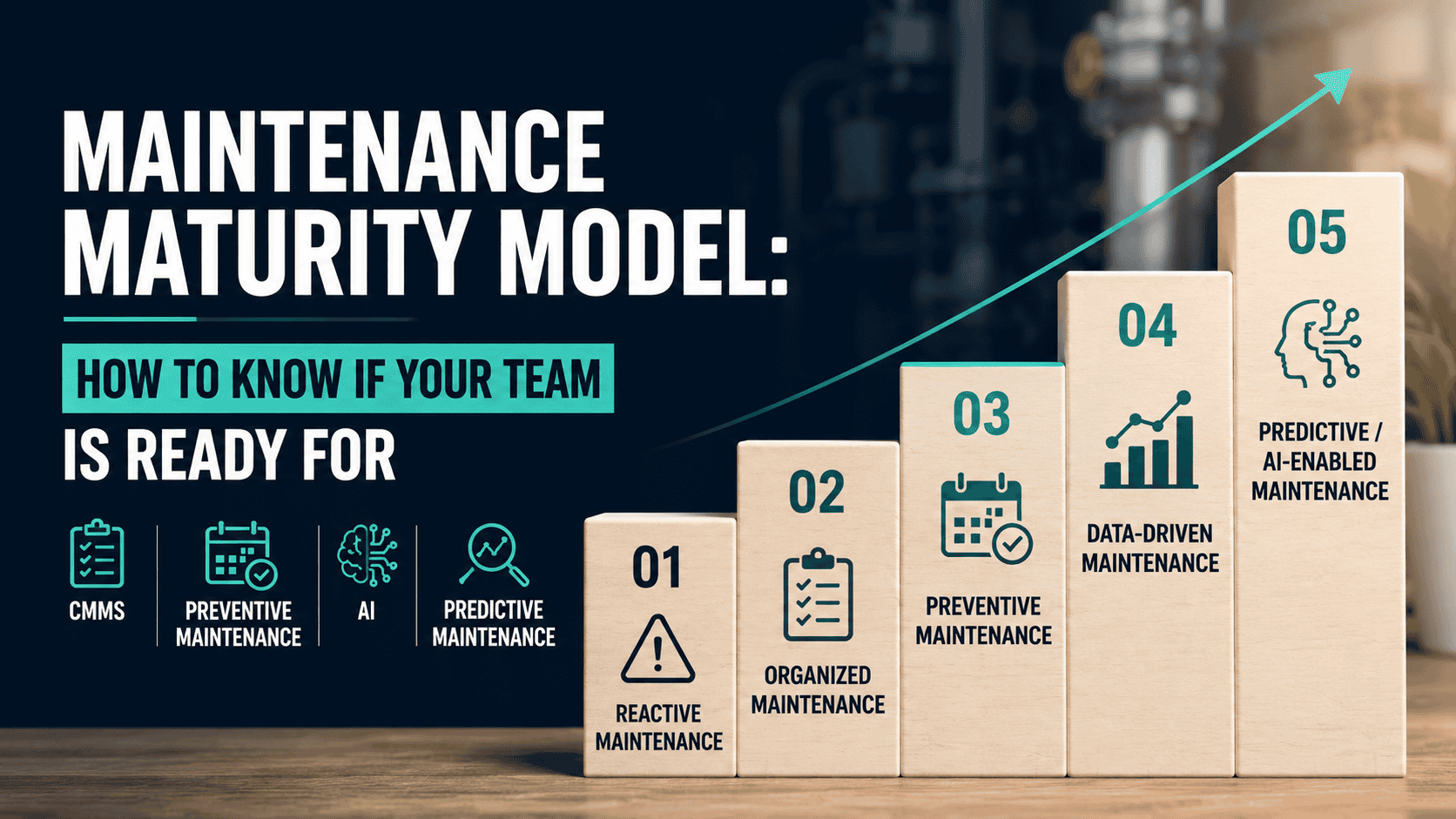
A practical maintenance maturity model can be divided into five stages. In this model, each stage builds on the one before it.
| Stage | Description | Best next focus |
|---|---|---|
| 1. Reactive maintenance | The team responds after equipment fails or work becomes urgent. | Centralize work orders. |
| 2. Organized maintenance | The team starts using structured workflows and basic records. | Improve adoption and data quality. |
| 3. Preventive maintenance | The team schedules, completes, and tracks recurring maintenance. | Track PM compliance and effectiveness. |
| 4. Data-driven maintenance | The team uses KPIs, asset history, and reporting to guide decisions. | Review KPIs and act on trends. |
| 5. Predictive or AI-enabled maintenance | The team uses condition data, analytics, or AI to support decisions. | Evaluate use cases and readiness. |
Stage 1: Reactive Maintenance
First, reactive maintenance is the earliest stage of maturity. At this stage, technicians perform work after equipment fails, breaks down, or becomes urgent. As a result, the team may stay busy every day, but leaders often lack full control over priorities, backlog, downtime, and asset history.
Common signs
- Work requests come through calls, texts, emails, paper notes, or hallway conversations.
- Technicians respond based on urgency instead of planned priority.
- Asset history is missing or hard to find.
- Preventive maintenance is inconsistent or informal.
- Managers cannot easily see open work, backlog, or overdue tasks.
Main risk: At this stage, the biggest risk is lack of visibility. If the team does not centralize work, maintenance leaders cannot reliably prioritize, schedule, measure, or improve it.
What to fix first: Centralize work orders. Before investing in predictive tools or AI features, the team first needs a clear way to capture requests, assets affected, labor used, parts used, completion notes, and follow-up actions.
Best-fit technology: At this stage, the best-fit technology is usually a CMMS or work order management system. The goal is not advanced automation yet. Instead, the goal is visibility and consistency.
Stage 2: Organized Maintenance
Next, organized maintenance begins when the team starts managing work through a structured process. Typically, this stage includes a CMMS, standardized work orders, basic asset records, and clearer roles for requesters, technicians, supervisors, and managers.
At this point, the team has moved beyond pure firefighting. However, the process may still feel inconsistent if users do not follow the same workflow.
Common signs
- For example, users create work orders in a central system.
- Then, technicians receive assigned work.
- In addition, assets are recorded in a database.
- As a result, supervisors can see open and completed work.
- Finally, basic reporting is available.
- Maintenance history is starting to build.
Main risk: Here, the biggest risk is poor adoption or poor data quality. For example, if technicians do not close work orders correctly or supervisors still accept off-system requests, the CMMS may not become the trusted source of maintenance truth.
What to fix first: To improve this stage, standardize work order fields, clean asset records, train users by role, simplify technician workflows, define priority levels, create closeout rules, and reduce duplicate records.
Best-fit technology: A CMMS remains the core system at this stage. However, the focus should be configuration, adoption, and data quality rather than adding advanced modules too quickly.
Stage 3: Preventive Maintenance
After that, preventive maintenance maturity begins when the team consistently schedules, completes, and tracks recurring maintenance tasks. For instance, these tasks may include inspections, lubrication, cleaning, calibration, testing, adjustments, and planned component replacements.
At this stage, the team actively tries to prevent failures instead of only responding to them. Therefore, PM quality matters just as much as PM volume.
Common signs
- PM tasks are scheduled in a CMMS.
- Then, the CMMS generates recurring work orders.
- In addition, technicians follow documented PM instructions.
- Meanwhile, managers track PM compliance and overdue PMs.
- Also, critical assets have defined maintenance plans.
- Technicians create corrective work from PM findings.
Main risk: At this stage, the biggest risk is creating a PM program that looks good on paper but does not work in practice. Common problems include too many low-value PMs, unrealistic frequencies, poor instructions, missed tasks, and no review of PM effectiveness.
What to fix first: Therefore, prioritize PMs by asset criticality, improve PM instructions, track PM compliance, review overdue PMs, adjust frequencies based on failure history, and remove outdated or duplicate PM tasks.
Best-fit technology: CMMS preventive maintenance functionality is essential at this stage. The system should schedule PMs, generate recurring work orders, track completion, document findings, and report on PM compliance.
Stage 4: Data-Driven Maintenance
Then, data-driven maintenance begins when the team uses maintenance records, KPIs, asset history, and reporting to improve decisions. In other words, maintenance is not just completed. It is measured and improved.
This is the stage where a CMMS becomes more than a digital filing cabinet. Instead, it becomes a decision-support tool.
Common signs
- For example, work order history is reliable.
- In addition, asset records are mostly accurate.
- Likewise, PM compliance is tracked regularly.
- Meanwhile, backlog is reviewed by priority and age.
- Also, downtime, labor, and parts usage are recorded.
- Finally, leadership reviews maintenance KPIs.
- Managers use reports for planning and budgeting.
Main risk: However, the biggest risk is reporting without action. Dashboards and KPIs only help when teams use them to change priorities, improve schedules, adjust PMs, manage backlog, and address recurring issues.
What to fix first: Instead, build a practical KPI set. Useful KPIs may include PM compliance, work order completion rate, backlog, schedule compliance, MTTR, MTBF, downtime, reactive maintenance percentage, planned maintenance percentage, and parts stockout rate.
Best-fit technology: A CMMS with reporting, dashboards, asset history, inventory tracking, and KPI visibility adds value at this stage. In addition, the team may begin evaluating integrations, analytics, or condition monitoring.
Stage 5: Predictive or AI-Enabled Maintenance
Finally, predictive and AI-enabled maintenance is the most advanced stage in this model. At this advanced stage, teams may use condition data, sensors, analytics, machine learning, or AI-assisted tools to identify risks, support planning, and improve maintenance decisions.
However, advanced technology needs a strong foundation. Predictive maintenance and AI-assisted features depend on data quality, workflow discipline, and human follow-through.
Common signs of readiness
- For example, asset data is accurate.
- For example, work order history is reliable.
- Likewise, PM compliance is under control.
- Also, failure and downtime data are tracked.
- Meanwhile, critical assets are clearly identified.
- Furthermore, technicians use the CMMS consistently.
- Most importantly, the team can respond to alerts or recommendations.
- Leadership has a clear use case for predictive or AI tools.
Main risk: In this stage, the biggest risk is investing in advanced tools before the organization is ready. If work orders are incomplete, assets are mislabeled, or PMs are often missed, advanced tools may have limited value.
What to fix first: Before moving forward, confirm which assets justify advanced monitoring, what data is required, whether condition monitoring is available, whether the team can act on alerts, and whether expected value justifies the cost and effort.
Best-fit technology: Predictive maintenance tools, condition monitoring systems, AI-assisted CMMS features, and analytics platforms may make sense at this stage. Even so, these tools should support maintenance decisions, not replace technician judgment, safety procedures, or maintenance leadership.
CMMS, Preventive Maintenance, AI, or Predictive Maintenance: What Comes First?
Often, one of the biggest questions maintenance leaders ask is what they should invest in first. Ultimately, the answer depends on the team’s current maturity level.
| Current situation | Best next step |
|---|---|
| Work requests are lost or informal | Centralize work orders in a CMMS. |
| Asset records are missing or inconsistent | Clean and standardize asset data. |
| PMs are not scheduled consistently | Build a preventive maintenance program. |
| PMs are often overdue | Track PM compliance and workload. |
| Work is visible but not prioritized | Manage backlog and asset criticality. |
| Reports are unreliable | Improve work order closeout and data quality. |
| KPIs are tracked but not used | Build a monthly review process. |
| Critical assets have a reliable history | Consider condition monitoring. |
| Data is clean, and workflows are mature | Evaluate AI or predictive maintenance use cases. |
Again, the key is sequence. Advanced technology works better when foundational maintenance practices are already in place.
How to Assess Your Maintenance Maturity
To start, maintenance teams can use a simple self-assessment. Then, rate your team from 1 to 5 for each question and total the score.
| Assessment question | Score 1-5 |
|---|---|
| Work orders are captured in one central system. | |
| Technicians consistently close work orders with useful notes. | |
| Asset records are accurate and easy to find. | |
| Critical assets are identified and prioritized. | |
| Preventive maintenance tasks are scheduled and tracked. | |
| PM compliance is reviewed regularly. | |
| Maintenance backlog is visible and prioritized. | |
| Labor and parts usage are recorded. | |
| Downtime and repeat failures are tracked. | |
| Maintenance KPIs are reviewed by leadership. | |
| Reports are trusted and used for decisions. | |
| The team can act on predictive alerts or AI recommendations. |
How to interpret the score
| Score range | Likely maturity stage | Best focus |
|---|---|---|
| 12 to 24 | Mostly reactive | Work orders and asset records. |
| 25 to 39 | Organized but inconsistent | Adoption, data quality, and PM setup. |
| 40 to 54 | Preventive maintenance stage | PM compliance, backlog, and reporting. |
| 55 to 66 | Data-driven stage | KPIs, reliability trends, and continuous improvement. |
| 67 to 72 | Advanced stage | Predictive or AI-enabled maintenance use cases. |
This scoring system is not a formal standard. Instead, it is a practical planning tool that helps teams identify their next step.
What to Fix Before Investing in Advanced Tools
Before buying AI or predictive maintenance tools, maintenance teams should fix the foundations first. Otherwise, advanced tools may simply analyze poor data faster.
- Clean asset data: Name assets consistently, assign locations, and link maintenance history.
- Standardize work orders: Capture enough information to support planning and troubleshooting.
- Improve CMMS adoption: Make sure technicians, supervisors, and managers use the system consistently.
- Track PM compliance: Know whether preventive maintenance is completed on time.
- Manage backlog: Prioritize open work by risk, age, asset criticality, and labor needs.
- Track downtime and failures: Understand how assets fail and what failures cost.
- Review KPIs: Use maintenance metrics to guide decisions, not just fill dashboards.
How MicroMain Supports Maintenance Maturity
Additionally, MicroMain supports maintenance teams with core CMMS capabilities that align with each stage of maintenance maturity. These capabilities include work order management, preventive maintenance scheduling, asset management, inventory tracking, maintenance reporting, maintenance records, KPI visibility, implementation, and training support.
For organizations early in their maturity journey, MicroMain can help centralize work and build better asset history. Meanwhile, for teams focused on preventive maintenance, it can help schedule recurring tasks and track completion. Finally, for more mature teams, reporting and maintenance records can support better planning, budgeting, and continuous improvement.
The goal is not to chase every new technology trend at once. Instead, the goal is to build the maintenance foundation needed for better decisions over time.
For additional context on maintenance improvement and data-driven asset management, teams can review the U.S. Department of Energy’s Operations and Maintenance Best Practices Guide and NIST artificial intelligence resources.
Build the foundation for maintenance maturity
Explore MicroMain CMMS software to centralize work orders, improve asset records, schedule preventive maintenance, track KPIs, and support smarter maintenance decisions.
Final Takeaway
Maintenance maturity is not about having the newest technology. Instead, it is about knowing what your team is ready for and what to improve next.
A team struggling with lost work orders probably needs better work management before predictive analytics. Likewise, a team with poor asset data should clean records before expecting reliable AI insights. Meanwhile, a team with overdue PMs should fix preventive maintenance execution before expanding into advanced strategies.
Overall, CMMS, preventive maintenance, AI, and predictive maintenance all have a place in modern maintenance operations. However, they work best when teams introduce them in the right order.
Start with visibility. Then build consistency. Next, improve preventive maintenance. After that, use data to guide decisions. Finally, evaluate advanced tools when the foundation is ready.
Frequently Asked Questions
What is a maintenance maturity model?
A maintenance maturity model is a framework that helps organizations evaluate how reactive, organized, preventive, data-driven, or advanced their maintenance operation is.
What are the stages of maintenance maturity?
Common stages include reactive maintenance, organized maintenance, preventive maintenance, data-driven maintenance, and predictive or AI-enabled maintenance.
How do you move from reactive to proactive maintenance?
Start by centralizing work orders, improving asset records, scheduling preventive maintenance, tracking PM compliance, managing backlog, and reviewing maintenance KPIs.
When is a team ready for CMMS software?
Generally, a team may be ready for CMMS software when work requests are difficult to track, asset history is scattered, PMs are inconsistent, or managers need better maintenance visibility.
When is a team ready for predictive maintenance?
In most cases, a team may be ready for predictive maintenance when it has accurate asset data, reliable work order history, identified critical assets, failure tracking, and the ability to act on condition-based alerts.
Does AI work without good maintenance data?
However, AI-assisted maintenance tools depend on data quality. If asset records, work orders, PM schedules, and failure data are incomplete or inconsistent, AI insights may be limited.
What KPIs show maintenance maturity?
Useful KPIs include PM compliance, schedule compliance, backlog, MTTR, MTBF, downtime, reactive maintenance percentage, planned maintenance percentage, and repeat failure rate.
Is preventive maintenance part of maintenance maturity?
Yes. Preventive maintenance is a key stage in maintenance maturity because it helps teams move from reactive repairs to planned maintenance.
What should maintenance teams fix first?
Overall, most teams should start by centralizing work orders, cleaning asset data, improving CMMS adoption, and building a realistic preventive maintenance program.
How does a CMMS support maintenance maturity?
A CMMS supports maintenance maturity by centralizing work orders, asset records, preventive maintenance schedules, inventory data, records, and reporting.